

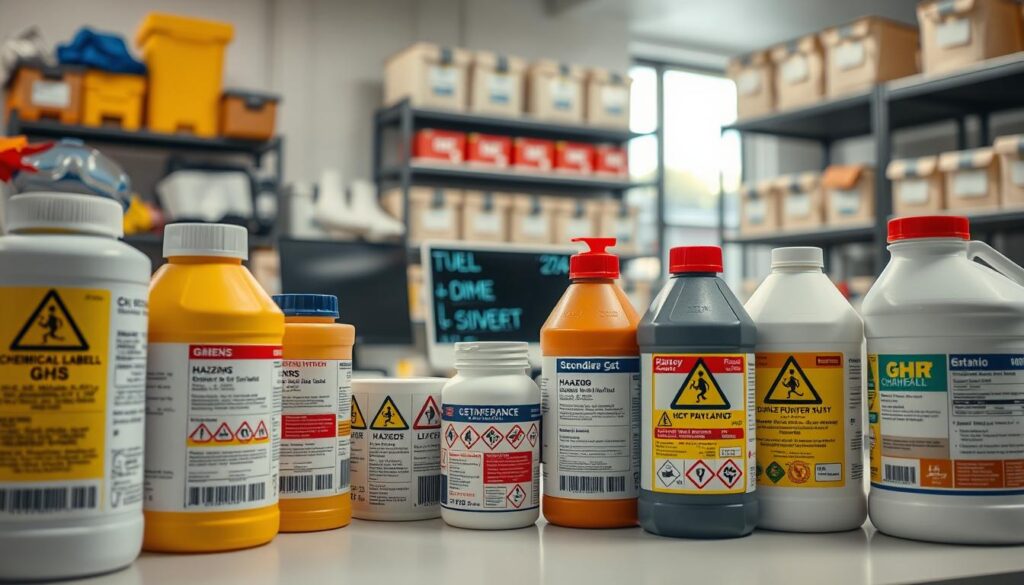
There’s a beautiful theory behind chemical safety. But, the messy reality of your workplace is different.
The GHS labeling system is like a symphony. It has six elements that tell a clear story of hazard. It’s elegant and standardized. But, what happens when it meets the chaos of daily operations?
Then, you’re not dealing with theory anymore. You’re playing a high-stakes game of safety. Chemicals get poured into new containers, and the hazard information can get lost fast.
This isn’t just about checking boxes. It’s the frontline of workplace communication. A mislabeled container isn’t just a paperwork error. It’s a risk that everyone wants to avoid.
Let’s follow a hazard’s journey. We’ll see how it goes from the supplier’s label to the workplace. It’s like a cultural analysis of safety symbols. We learn to spot the important signals.
GHS Label Elements: The Six-Part Symphony of Safety
A GHS label is more than a sticker; it’s a key part of safety information. Each element plays a vital role in keeping workplaces safe. Knowing these six label elements is essential for safety communication.
The Product Identifier is the chemical’s official name, not its nickname. It matches the Safety Data Sheet exactly. Think of it as the chemical’s ID, not its social media handle.
The Signal Word is like the headline of a safety story. You have two choices: “Danger” for severe hazards and “Warning” for less severe ones. OSHA’s Hazard Communication Standard guidance explains the difference.
Hazard Statements are clear warnings. They tell you exactly what can happen, without beating around the bush. “Causes severe skin burns” means just that, not a slight possibility.
The Precautionary Statements offer ways to avoid or handle hazards. They give you instructions for safety, organized into four categories. It’s like getting a treatment plan for a problem.
The Supplier Information is for emergencies. It includes the company’s name, address, and phone number. This is for when you need help fast, not for marketing.
The GHS Pictograms are symbols that quickly show danger. They include a flame, skull, and bomb. These symbols are universal, helping everyone understand danger fast.
Learning these six label elements is key for working with chemicals. They help create safe labels and ensure proper handling. Each element has its own role, working together to keep people safe.
The beauty of GHS labels is their simplicity. With just six elements, they communicate safety clearly. They show how standardization can be powerful, focusing on what’s most important.
Supplier vs Workplace/Secondary Container Labels (What Must Appear)
Think of the supplier label as the full movie. It has every detail, every credit. The workplace label for a secondary container is like the trailer. It just needs to entice you to watch the full movie.
This difference is key to HazCom 2012. It shows how regulations meet real-world needs. OSHA knows you can’t put a whole book on a small bottle.
So, what’s the minimum for your label? OSHA’s Thomas Galassi gave us clarity in 2017. The rules for secondary container labels are simple.
Your secondary container label does not need the supplier’s name and address. It does not need all the hazard statements or precautionary measures. It only needs two things.
First, the product identifier. This is the chemical’s name from the Safety Data Sheet (SDS). It’s like a link to more information. Second, you need general hazard information. This can be words, pictures, symbols, or any mix that gets the point across.
This rule is smart because it’s flexible. A skull and crossbones, “FLAMMABLE,” or “DANGER” can be enough. The key is that this info, with other immediately available details, tells the worker everything they need to know.
But there’s a catch. You, the employer, must prove your employees are informed. Your label is the prompt; their knowledge is the script.
| Label Element | Supplier Label (The “Director’s Cut”) | Workplace/Secondary Label (The “Trailer”) |
|---|---|---|
| Product Identifier | Required. Must match SDS. | Required. Must match SDS. |
| Signal Word | Required. “Danger” or “Warning.” | Not Explicitly Required. Hazard can be communicated by other means. |
| Hazard Statements | Required. Full GHS phrases. | Not Required. General hazard info suffices. |
| Precautionary Statements | Required. Full GHS phrases for handling, storage, etc. | Not Required. |
| Supplier Information | Required. Name, address, phone. | Not Required. |
| Pictograms | Required. Applicable GHS symbols. | Can be Used. A valid method for conveying general hazard info. |
This table is more than a cheat sheet. It’s a guide for following HazCom 2012 in a practical way. The workplace label is about clear communication. It’s not about making a lesser label. It’s about making a label that works for the user.
The goal isn’t just to follow rules. It’s to make sure workers understand the risks right away. The supplier label is like an encyclopedia. Your job is to make the cliff notes that get read.
Labeling Special Cases: Mixtures, kits, decanted containers
Think of the supplier label as your chemical’s birth certificate. But what happens when it gets mixed, has siblings, or changes containers? This is where the rules get tested.
Chemistry in real life is messy and creative. The GHS rules need to be flexible to handle this.
Let’s talk about mixing chemicals. When you mix A and B, you get C. This new mix has its own dangers. You can’t just use the old label. The law and common sense say you need a new label for C.
To make a new label, look at the Safety Data Sheets for each original chemical. Check Sections 2 and 3. Your new label must show the combined hazards and warnings.
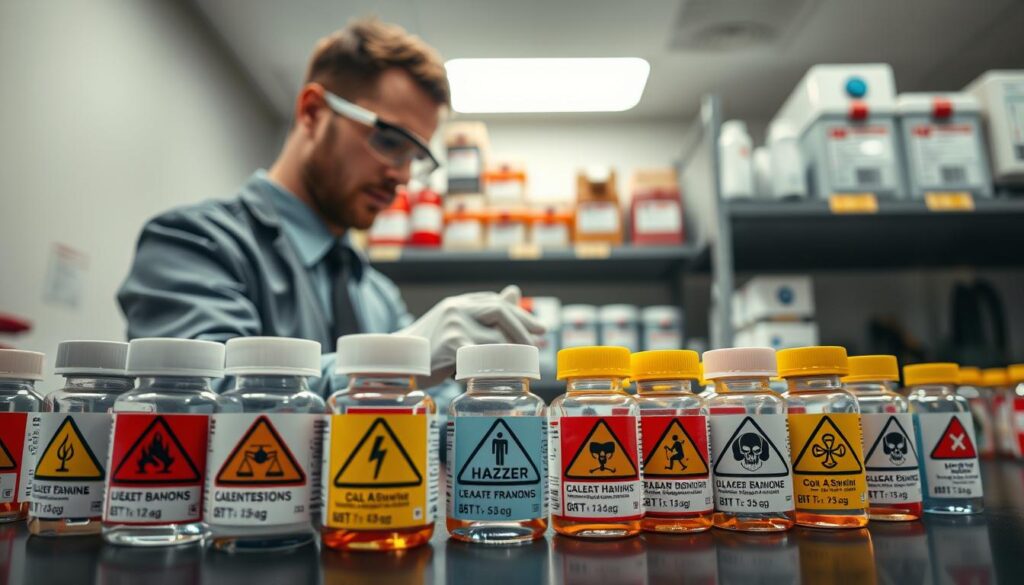
Next, let’s look at chemical kits. These are boxes with different chemicals. Does the box label cover everything? The answer is yes, but also no.
The box should say it has many hazardous chemicals. But each vial inside needs its own label. This keeps workers safe.
Now, let’s talk about decanted containers. Using a soda bottle for acetone or a beaker for xylene is a big mistake. It’s a major GHS compliance issue.
The rule for immediate use is strict. It means the chemical is used right away and never left alone. It’s like a personal rule for hazardous materials.
What about weirdly shaped or small containers? Containers like test tubes or small jars are tricky. The goal is to communicate hazards clearly, not to look perfect.
- Abbreviate. Use the product name and main hazard. A small tag with “HCl – Corrosive” is better than nothing.
- Use durable tags. Tie-on tags work for odd shapes. Make sure they can withstand chemicals, heat, or moisture.
- Maximize contrast. Use colors like black on yellow or white on red for easy reading.
The rule is clear: if it’s a hazardous chemical and not in its original packaging, it needs a label. No container is too small or temporary to ignore.
NFPA/HMIS vs GHS: Using both without confusion
Your chemical storage area might show both NFPA fire diamonds and GHS pictograms. This mix could confuse more than help. It’s like the old VHS versus Blu-ray debate in safety. Both systems can work together, like bilingual street signs in a multicultural area. But without clear translation, these symbols are just decorations.
The NFPA 704 diamond and HMIS are America’s risk assessment tools. They’re like the imperial system in U.S. culture. These systems rate hazards from 0 to 4 for health, flammability, and stability. A “3” in the health quadrant means serious risk for firefighters.
GHS is the global harmonized system. It’s like the metric system for hazard communication. GHS warns about substance hazards, like corrosiveness and carcinogenicity. Its pictograms are specific warnings, not risk scores.
OSHA said it’s okay to use both NFPA and GHS on labels. This is like the government approving a car with both analog and digital dashboards. The systems can share space without legal issues.
The real danger is using both systems without understanding them. Imagine an NFPA health rating of “2” next to a GHS skull-and-crossbones pictogram. This looks like conflicting information. The NFPA rating might describe irritation risk during fire, while the GHS pictogram warns of fatal toxicity if swallowed.
Using NFPA/HMIS and GHS together is like having both a map and a compass on a hike. The map (GHS) shows permanent features like cliffs and rivers. The compass (NFPA/HMIS) indicates immediate danger direction—”storm approaching from the west.” Both are valuable. Both save lives. But if your team only knows how to read the map, the compass becomes a decorative trinket.
Your practical playbook is simple. First, never alter the supplier’s original GHS label. That’s the baseline truth. Second, when creating workplace labels for secondary containers, you can add NFPA or HMIS ratings alongside the required GHS information. Third, and most importantly, train everyone to read this bilingual safety language. Explain that NFPA answers “how bad in a fire” while GHS answers “what’s inherently dangerous.”
The coexistence isn’t just tolerated—it’s often wise. Many facilities use NFPA signage for emergency response and GHS for daily worker protection. It’s a pragmatic dual-citizenship approach in our transitional era. Just remember: clarity trumps completeness. A perfectly multilingual label that confuses your team is worse than a simple, universally understood warning.
Practical Labeling Workflow at Receiving & Point of Use
Tuesday morning at 8:47 AM is when labeling theory meets reality. Conference room PowerPoints fade. What remains is the unmarked bottle, the hurried technician, and the gap between knowing and doing.
Let’s build a system where the right way is the easy way. It should not demand heroic memory or saintly discipline. “I was busy” isn’t a valid hazard statement when someone needs to know what’s in that container.
The primary container arrives. Your first move isn’t stashing it in storage. Step one is verification. Is the SDS obtained? Is the supplier label intact, legible, and compliant?
This label is your source truth—the Rosetta Stone for everything that follows. Check it like you’d check a passport. Missing signal word? No precautionary statements? That shipment gets quarantined faster than spoiled milk.
This moment sets the stage. A clean, verified supplier label means your downstream workflow starts with accurate data. Garbage in, gospel out.
Act 2: The Point of Use
Here’s where the magic—or the tragedy—happens. The chemical moves from its original container to a secondary one. This is the transfer point, the moment of truth.
Have a labeling station. Not a dusty corner with a dried-out marker. A dedicated zone with technology. Tools like Brady’s label printers and software or SDS Manager’s free secondary label generator turn SDS data into compliant workplace labels with a few clicks.
Think of it as automation removing friction. The software auto-fills hazard pictograms, signal words, and precautionary statements from the SDS. You print on durable, chemical-resistant vinyl. Suddenly, creating a perfect label takes less time than searching for tape.
Want to get slick? Add a QR code linking directly to the digital SDS. That’s not just tech theater. It’s “immediately available information” embodied. Scan, know, proceed.
The Workflow Mindset
This isn’t about adding steps. It’s about designing a path of least resistance toward compliance. Make not labeling feel like more work than labeling.
When your workflow is this simple, compliance stops being a chore and starts being a rhythm. The receiving check, the point-of-use print—it becomes as routine as coffee. And that’s how you turn Tuesday morning theory into all-week-long practice.
Updating Labels on SDS Revisions or Composition Changes
Your Safety Data Sheet is always changing, like a Twitter feed. Suppliers change formulas, and you mix things up too. This means the danger level can change a lot.
When this happens, your labels become outdated fast. They turn into historical fiction, telling the wrong story about what’s in the container. A “Warning” might need to turn into “Danger.” A new health hazard pictogram could pop up.

This isn’t a “set and forget” job. It’s a constant update to safety. You need a system to catch every SDS change right away. If Section 2 or 3 changes, that’s your warning.
Think about how changes affect everything. One SDS update means every container with that chemical needs a new label. It’s like changing every street sign because one neighborhood got renamed. But the wrong sign can lead to danger.
To stay safe, follow a few steps:
- Centralize your SDS management—one place for all updates and changes
- Have a system for reviewing updates, where someone actually reads them
- Make updating labels a formal process—document what changed and who did it
- Keep track of secondary containers so you know where old labels are
Your future self will thank you for this hard work. OSHA inspectors love finding outdated labels—it’s like finding old news being sold as new.
Changing a mixture in your lab or production area is big. You become the supplier. Your labels must show the truth about what you’re working with.
Remember, accurate labeling isn’t just about following rules. It’s about keeping people safe. When the SDS changes, your labels must match that change exactly—no mistakes, no delays.
Multilingual and Accessibility Considerations
The GHS aimed for a single language, but we’re far from it. Pictograms are like a visual Esperanto, helping everyone understand. But, the text on labels is often in just one language.
It’s a problem if your team speaks many languages but labels don’t. Workers like the Spanish cleaner, Vietnamese assembly worker, and Polish technician need to understand warnings in their own language.
This isn’t just about being polite. It’s about making sure everyone gets the message. OSHA’s HazCom standard says information must be clear and available. If your labels only use English, you’re missing the mark.
Here’s a practical solution:
- Bilingual or multilingual labels for high-risk chemicals or areas with significant non-English speaking populations
- Supplemental translation sheets posted near chemical storage areas
- Visual aids and pictogram reinforcement during training sessions
But it’s not just about language. What about workers who can’t read small print or have limited literacy? Everyone needs to understand the dangers.
True accessibility means considering:
- Large-print labels for low-vision workers
- Braille tags on frequently handled containers
- Color contrast optimization for those with color vision deficiencies
- Simple, clear language that avoids technical jargon
Pictograms are great because they mean the same thing everywhere. But words add important details. They tell you why and what to do.
Real compliance isn’t just about labels. It’s about making sure everyone gets the message. A beautifully made GHS label is useless if no one can read it. The system fails when it faces real diversity.
Think of it as creating inclusive communication channels. Your labeling strategy should reflect the real world. Safety info that’s not understood is just decoration.
Training Requirements & Refresher Frequency
OSHA makes employers prove their team knows about safety labels. Just pointing at a label isn’t enough. You must show they understand it. This makes the label seem like safety theater—it looks good but doesn’t really help.
Training is a must, not just a suggestion. It’s like learning a new language. You need to know the difference between a flame and an exploding bomb. And where to find important safety information.
But many programs don’t keep up. They think one-time training is enough. But hazards change, and so does the GHS standard.
OSHA doesn’t give you a schedule for refresher training. They want you to update training when new hazards appear. This is the legal minimum.
But in reality, knowledge can fade. It’s wise to refresh training every year or two. This keeps your team safe and informed.
| Training Component | Initial Training Focus | Refresher Focus | Verification Method |
|---|---|---|---|
| Pictogram Recognition | Meaning of all 9 GHS pictograms | Recognition speed, new variants | Flashcard drills, label identification games |
| Signal Word Understanding | “Danger” vs “Warning” hierarchy | Reinforcement of severity differentiation | Scenario-based questioning |
| SDS Navigation | Locating Sections 2, 4, 8 | Finding specific exposure limits, new data | Timed lookup exercises |
| Label Information Application | Reading supplier labels | Interpreting workplace/secondary labels | Hands-on container review |
| Hazard Communication Program | Overall system awareness | Updates to procedures, new chemicals | Written quiz, program walk-through |
Make training fun. Avoid boring presentations. Use real labels and play games to teach. Ask questions like “What do you do if this is corrosive?”
This training is your proof. It shows you’re serious about safety. Keep records of who was trained, when, and on what.
An untrained employee is like me looking at a car engine. They see parts but don’t know what they do. Training is like a map. Without it, you’re taking risks.
Inspection Readiness: common citations & fixes
An OSHA inspection is like your workplace’s final exam. The data shows that not labeling hazardous chemicals is a big problem. It’s a test you definitely don’t want to fail.
There’s a list of common mistakes that lead to citations and incidents. Unlabeled secondary containers, like that mystery cleaner, are a big issue. Also, safety data sheets that are hard to find and employee training on GHS pictograms are problems too. And, using outdated labels is another mistake.
To avoid these issues, do an internal audit first. Walk through your facility like an inspector. Check if all containers are labeled and if workers can find safety data sheets quickly. Make sure they know what the GHS pictograms mean.
Fixing these problems creates a safety culture, not just fear of fines. Use tools like a secondary label template and a guide to GHS pictograms. They help make the Globally Harmonized System easy to understand.
This effort keeps everyone safe and happy at the end of their shift. Passing this test means keeping your fingers and sense of humor intact.