

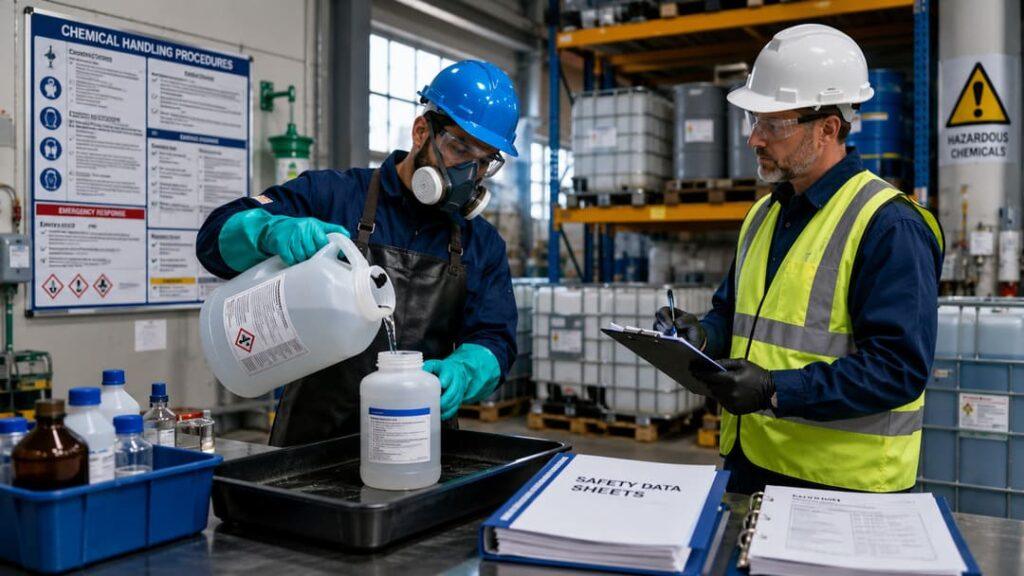
Chemical handling procedures are often treated as the backbone of workplace safety, but written instructions cannot see a shortcut, stop a rushed transfer, or correct a worker using the wrong container. The real safety test happens where chemicals are received, stored, mixed, moved, and cleaned up — and that is where supervision turns procedure into discipline.
Industrial facilities face a simple but uncomfortable truth: the weakest point in chemical safety is rarely the absence of a rule. It is the gap between the rule and the work as it actually happens. That is why practical guidance on chemical storage and handling matters most when it is paired with active oversight, trained judgment, and clear responsibility.
Chemical Handling Procedures Reduce Risk, But They Do Not Manage Behavior
A strong procedure tells workers what to do. It defines the correct container, transfer method, PPE, labeling requirement, ventilation condition, spill response, segregation rule, and disposal step. Without that structure, chemical handling becomes dependent on memory, habit, and informal workplace shortcuts.
But procedures are still static documents. They cannot account for every rushed shift, blocked aisle, damaged label, missing glove size, unfamiliar substitute product, or temporary worker who has not handled that substance before.
That is where supervision becomes a control, not just a management layer. Supervisors check whether the procedure is realistic, whether workers understand it, and whether the conditions on the floor still match the assumptions behind the document. A procedure reduces uncertainty; supervision reduces drift.
The Real Risk Is Usually The Small Deviation
Major chemical incidents often receive attention because they are dramatic. The more common warning signs are quieter: a secondary container left unlabeled, incompatible products stored too close together, a drum moved without the right equipment, a spill kit blocked by inventory, or PPE worn incorrectly because the task feels routine.
These are not always signs of reckless behavior. Sometimes they reflect production pressure, fatigue, unclear ownership, weak training, or a procedure that looks good in a binder but does not match the layout of the work area.
That is why supervision must focus on the small deviations before they become normalized. Once an unsafe workaround becomes “how we usually do it,” the procedure has already lost authority.
| Safety Element | What Procedures Do | What Supervision Adds |
|---|---|---|
| Labeling | Defines required identifiers and warnings | Confirms labels remain visible, accurate, and used |
| PPE | Lists required protection by task | Checks fit, condition, availability, and correct use |
| Storage | Sets segregation and container rules | Spots crowding, leaks, damage, and poor placement |
| Transfers | Explains approved methods | Watches for shortcuts, spills, and incompatible tools |
| Emergency Response | Provides spill and exposure steps | Confirms readiness through drills and clear roles |
Why Supervisors Are The Link Between SDS Information And Actual Work
Safety Data Sheets are essential, but they are not the same as task-level control. OSHA’s Hazard Communication Standard centers on communicating chemical hazards through labels, safety data sheets, and worker information. That information is only valuable when it is translated into the specific actions workers must take during real operations.
A supervisor helps make that translation practical. The SDS may describe hazards, storage needs, exposure controls, and emergency measures. The supervisor makes sure those details are reflected in the work instruction, the training, the equipment setup, and the daily behavior of the team.
This is especially important when employees handle multiple chemicals with different hazards. A worker may remember that gloves are required, but not all gloves protect against all substances. A worker may know ventilation matters, but may not recognize when an extraction point is poorly positioned. Chemical handling is not only about compliance; it is about judgment under working conditions.
Training Without Supervision Becomes A One-Time Event
Training is necessary, but it has a shelf life if nobody reinforces it. Workers may attend a safety briefing, sign a form, and still develop habits that move away from the approved method over time.
Supervision keeps training alive. It gives workers immediate correction when something is misunderstood. It also gives managers feedback when a procedure is confusing, impractical, outdated, or missing a real-world step.
The best supervisors do more than police mistakes. They ask questions that reveal whether the system is working: Do workers know why a rule exists? Can they find the SDS quickly? Do they know what to do if a label is damaged? Is the required PPE actually available at the point of use? Are spill controls accessible without delay?
The UK Health and Safety Executive’s COSHH guidance places emphasis on identifying, assessing, and controlling risks from hazardous substances. That control mindset is critical because chemical safety cannot depend on awareness alone. It needs visible routines that prove the controls are being used.
Procedures Also Need A Feedback Loop
A procedure should never be treated as finished simply because it has been approved. Chemical inventories change. Suppliers change. Containers change. Workflows change. Production volumes rise. New employees join. A process that was safe at one scale may become more exposed, crowded, or time-sensitive at another.
Supervision creates the feedback loop that keeps procedures current. When supervisors observe recurring confusion, repeated non-compliance, or frequent near misses, the answer should not be limited to blaming workers. The deeper question is whether the procedure is clear, practical, and supported by the right tools.
A good procedure tells people what safe work looks like. A good supervisor confirms whether safe work is still possible under current conditions.
This matters for procurement and operations teams as much as it matters for safety departments. Choosing a chemical product is not only about technical performance or cost. It also affects storage compatibility, handling complexity, documentation burden, training needs, and emergency planning. The safer choice is often the one the facility can control consistently.
The Next Pressure Point Is Accountability On The Floor
Chemical safety programs are under pressure from tighter documentation expectations, more complex supply chains, and faster operational demands. In that environment, weak supervision creates a false sense of security. A company may have procedures, SDS access, labels, PPE rules, and storage charts, yet still allow unsafe behavior to become routine.
The next signal to monitor is not simply whether procedures exist. It is whether supervisors are trained, present, and empowered to intervene before small failures become accepted practice.
Facilities should pay attention to near misses, repeated PPE issues, unlabeled containers, poor housekeeping around storage areas, and worker uncertainty during transfers or spill response. These are early warnings that the safety system is relying too heavily on paperwork and not enough on human oversight.
Chemical handling procedures remain essential, but they are only one part of a living control system. The real protection comes when procedures, training, supervision, and worker feedback operate together. For any facility handling hazardous substances, the question is no longer whether rules are written down. It is whether someone is making sure those rules still work when the shift gets busy, the task changes, and the risk becomes real.