


Remember that carnival game where you bash moles popping up from random holes? Welcome to global compliance. Just when you think you’ve nailed lead-free solder, California’s Prop 65 slaps a warning on your brass fittings.
You dodge one PFAS regulation, only to face a new state reporting mandate. It’s enough to make anyone nostalgic for simpler times. But here’s the twist: this isn’t just about avoiding fines or playing defense.
Companies like Microsoft show us a better way. They treat their Restricted Substances List not as a static legal document, but as a dynamic, policy-driven compass. They phase out materials based on science and the precautionary principle—when safer alternatives exist.
This shifts the entire game. Instead of reactive scrambling, you build proactive leadership. Compliance stops being a cost center and becomes a core competency. It’s the difference between seeing regulations as nuisance and viewing them as a map to more sustainable, trustworthy products.
So, grab your coffee. We’re decoding this maze—from “right-to-know” warnings to exemption labyrinths—and figuring out how to turn declarations into advantage.
Prop 65: listings, safe-harbor concepts, labeling/contract flowdowns
California’s Proposition 65 acts like a gatekeeper at the commerce club. It decides which substances get a warning label. This law requires businesses to warn about chemicals that can cause cancer or harm reproduction.
The list of chemicals is long, with over 900 items. It grows like kudzu, with updates as regular as Netflix.
The Prop 65 list is like California’s naughty list for molecules. It includes lead, cadmium, and others like acrylamide and phthalates. The real magic is in the safe harbor levels.
These levels are specific amounts that let you avoid warning labels. For lead, it’s 0.5 micrograms per day. For cadmium, it’s 4.1 micrograms.
These numbers are based on how much exposure can cause cancer in 100,000 people over 70 years.
| Common Prop 65 Chemical | Safe Harbor Level | Typical Applications | Risk Priority |
|---|---|---|---|
| Lead | 0.5 μg/day | Brass fittings, solder, pigments | High |
| Cadmium | 4.1 μg/day | Plating, batteries, pigments | Medium |
| Phthalates (DEHP) | 8.7 μg/day | Plasticizers, vinyl products | High |
| Formaldehyde | 40 μg/day | Composite wood, adhesives | Medium |
| Bisphenol A (BPA) | 3 μg/day | Epoxy resins, polycarbonate | Medium-High |
The Prop 65 warning label is iconic in California. It’s a legal shield. The wording must be clear and reasonable.
The contract flowdown is complex. Knowing your valve contains leaded brass isn’t enough. You must warn everyone in the supply chain.
Miss this flowdown, and your compliance is shaky. One broken link means no warnings for consumers. This opens the door to bounty hunters.
Tools like CDX are essential for managing chemicals in complex supply chains.
The smartest operators avoid warnings by choosing safer materials. For example, use AISI316L stainless steel in the U.S. drinking water market. It sidesteps the Prop 65 warning requirement.
This law turns chemical management into a communication operation. You must test materials, document results, and warn consumers. The paper trail is as important as the chemical analysis.
Proposition 65 compliance asks a big question: How much responsibility does a manufacturer have for informing users about chemical exposures? California says “all of it,” with strict rules and consequences for ignoring warnings.
RoHS for Industrial Buyers (exemptions, testing evidence)
RoHS isn’t a total ban for industrial buyers. It has special rules and exemptions. Unlike consumer electronics, industrial buyers have more freedom.
Consumer electronics face strict bans. But, industrial buyers can use certain products that are banned for others. For example, a leaded brass valve in your system is okay.
The directive bans ten substances. But, Annexes III through VI offer exceptions for industrial use. This means things like cadmium in solar panels or mercury in lamps might be allowed if needed.
Take that brass fitting you mentioned. It’s made of CW614N alloy with up to 3.5% lead. This is okay under Annex III because lead makes it better for safety valves.
RoHS exemptions need solid proof. You can’t just say it’s okay. You need to show why it’s necessary and that it meets the rules.
The ten banned substances are at the heart of RoHS:
- Lead (Pb)
- Mercury (Hg)
- Cadmium (Cd)
- Hexavalent chromium (Cr6+)
- Polybrominated biphenyls (PBB)
- Polybrominated diphenyl ethers (PBDE)
- Bis(2-ethylhexyl) phthalate (DEHP)
- Butyl benzyl phthalate (BBP)
- Dibutyl phthalate (DBP)
- Diisobutyl phthalate (DIBP)
For industrial buyers, it’s not about getting rid of everything. It’s about managing what’s allowed. Each exemption has its own rules and deadlines.
Platforms like CDX make managing exemptions easier. They help you keep track of what’s allowed and what’s not. It’s like having a map to follow.
When it comes to testing, you need solid evidence. Supplier statements are at the bottom. XRF tests are in the middle. But, full lab analysis is the best proof.
| Industrial Application | Common RoHS Exemption | Substance Involved | Typical Justification | Documentation Required |
|---|---|---|---|---|
| High-reliability solder | Annex III, 7(c) | Lead | Military/aerospace reliability requirements | Military specs, test data, application justification |
| Brass machine parts | Annex III, 6(a) | Lead (up to 4%) | Machinability, pressure resistance | Alloy specifications, material certs, application evidence |
| Photovoltaic modules | Annex IV, 39 | Cadmium | Thin-film solar cell efficiency | Technical necessity proof, alternative analysis |
| Professional lighting | Annex III, 1(b) | Mercury | Color rendering, energy efficiency | Performance data, exemption expiration tracking |
| Spare parts for legacy equipment | Annex IV, 41 | Various restricted substances | Continued operation of equipment placed before July 2019 | Equipment manufacturing date, compatibility proof |
The table shows how exemptions work. Each one is for a specific use. Your brass valve has lead because it needs to work well, not because you like it.
Managing exemptions is key during audits and when customers ask questions. When someone asks about lead, show them the Annex III document. If a competitor doubts you, present the lab certificates.
Following RoHS is like playing chess. You’re not just removing pieces. You’re placing them where they help the most, while staying within the rules. Your testing evidence is your proof of every move.
PFAS Landscape: state reporting, TSCA actions (overview)
The PFAS regulatory scene is complex. Fifty states and the federal government are tackling the same issue. It’s like a big mess with everyone trying to solve it their own way.
The EU, Switzerland, and the U.S. have different approaches. The U.S. is playing catch-up with a patchwork system. It’s like trying to organize a big group of people.
Microsoft shows a smart approach. They comply with EU and Swiss regulations. They also know about upcoming PFAS restrictions. It’s like they’re preparing for a big storm.

TSCA has been updated to tackle PFAS. It focuses on specific substances like DecaBDE and PIP (3:1). It’s like targeting specific houses in a neighborhood.
This focus is important. A valve manufacturer might say their products are PFAS-free. But they might use PTFE (Teflon), which isn’t considered a PFAS. It’s like saying your cake is gluten-free but using almond flour.
State-level regulations are fascinating. Here’s a look at some:
- Maine’s PFAS in products reporting law (effective 2023)
- California’s Proposition 65 listing of specific PFAS
- Minnesota’s ban on PFAS in food packaging
- New York’s restrictions on PFAS in apparel
- Multiple states considering “PFAS as a class” legislation
Each state is doing its own research. They’re all studying the same chemicals but in different ways.
So, what should an industrial buyer do? They need a material disclosure system that can adapt quickly. When asked about PFAS content, they should have the right data ready.
Effective PFAS reporting involves three key areas:
- Which specific substances are regulated today (the TSCA list)
- Which broad families might be regulated tomorrow (the “PFAS as a class” movement)
- How your specific materials map to both categories
That valve manufacturer didn’t just say “we’re PFAS-free.” They explained why PTFE doesn’t count. This level of detail is what you need.
The landscape is always changing. New states join, the EPA updates the TSCA list, and the EU expands its restrictions. It’s like trying to keep up with a fast-moving train.
Your PFAS reporting strategy should focus on flexibility. It should be ready for whatever changes come next. Because PFAS regulations are always changing.
Companies that succeed in this area are chemically literate. They know the difference between different chemicals. They track specific substances and broad categories. And they have disclosure processes that can change quickly.
When looking at your supply chain, ask if you can answer PFAS questions from anyone. If you’re scrambling for documents, you’re already behind. True PFAS reporting readiness means having the data ready for any question.
Gathering Supplier Declarations & Test Reports (XRF, Lab Certs)
The real work of compliance isn’t just asking for paperwork. It’s about building a strong foundation of declarations and verifications. A supplier declaration is a promise. A test report is the proof. Without both, your program is at risk.
Think of it like a courtroom drama. The declaration is like sworn testimony. It’s compelling but just words. The lab analysis is like the forensic evidence—the DNA, the fingerprints. A strong case needs both. Your compliance program is no different.
So, how do you gather this evidence effectively? You need tools for both quick scans and deep dives.
The Quick Scan: XRF Screening
An XRF gun is like a flashlight in a dark warehouse. It gives you instant, on-site screening. Need to check that brass fitting for lead or that plastic housing for bromine? Point and shoot. It’s non-destructive, relatively inexpensive per scan, and perfect for risk-based surveillance.
Use it for incoming inspection of high-risk materials, random spot-checks on the production floor, or verifying a batch that has a questionable declaration. The result is a elemental snapshot—a red flag or a green light. It’s not the final verdict, but it tells you where to focus your expensive, definitive testing.
The Deep Dive: Laboratory Analysis
When you need the sworn affidavit, you send a sample to the lab. Methods like ICP-MS or GC-MS don’t just screen; they quantify with extreme precision. This is your definitive proof for regulators, customers, and your own peace of mind.
Lab certs are mandatory for final product validation, specially for high-risk SKUs or when a substance is right at the regulatory limit. They are the foundation of a credible Declaration of Compliance (DoC). As one source notes, voluntarily submitting for third-party testing is how you verify those supplier material declarations aren’t just hopeful fiction.
The savvy strategy uses these tools in a powerful tandem. The table below breaks down the dynamic duo:
| Tool | Primary Purpose | Speed & Cost Profile | Best Use Case |
|---|---|---|---|
| XRF Screening | Rapid elemental screening & risk identification | Fast (seconds), Low cost per scan | Incoming inspection, production line audits, verifying supplier declarations for common restricted substances. |
| Laboratory Testing | Definitive quantification & compliance certification | Slow (days/weeks), Higher cost per test | Final product validation, investigating XRF red flags, supporting a formal DoC, meeting specific customer testing mandates. |
| Combined Strategy | Comprehensive verification & cost-effective management | Optimized workflow | Use XRF to triage and screen widely; use lab tests to conclusively verify high-risk or non-conforming materials. This creates a layered defense. |
From Chaos to Centralized Truth
Here’s the kicker: a perfect lab report is worthless if it’s buried in a procurement manager’s email from 2022. A supplier’s Declaration of Compliance means nothing if you can’t find it during an audit.
This is where the trench work turns into strategic advantage. You need a compliance information repository—a single source of truth. Modern solutions, like CDX, provide options for collecting RoHS DoCs, test certificates, and more into one centralized system.
The goal is to create an unbreakable, auditable trail. This repository doesn’t just store files; it links the promise (the declaration) directly to the proof (the test report). It answers the auditor’s question before it’s asked: “We didn’t just take their word for it. Here is how we verified.”
Gathering declarations and tests isn’t a clerical task. It’s the process of building your evidence locker. Make it organized, make it accessible, and make it tell your compliance story convincingly.
Material/Article Disclosure: BOM-level vs mixture-level data
If your bill of materials was a restaurant menu, it would list “burger” but ignore the secret sauce ingredients. This is the core comedy—and crisis—of material disclosure. Your engineering team documents articles: plastic gears, metal brackets, finished subassemblies. But regulators and customers want to know about substances: the chemical soup within those materials.
Think of it as two different languages describing the same object. Your BOM speaks the language of function and form. Compliance databases speak the language of chemistry and composition. When they meet without a translator, misunderstandings are guaranteed.
This disconnect isn’t just theoretical. It’s practical and painful. REACH often cares about a substance in the mixture. RoHS cares about that same substance in the final, homogeneous material. Your BOM proudly lists “Plastic Housing, Part #A123.” It says nothing about pigments, stabilizers, or flame retardants.
So, how do you bridge this gap? The answer lies in pursuing full material declarations. This isn’t just a nicer form from your supplier. It’s the deep, ingredient-level data that lets you answer both the BOM-level question (“What’s in this gear?”) and the mixture-level inquiry (“What chemicals are in the resin that made this gear?”).
A robust system, like the CDX platform mentioned in our data, manages this elegantly. It builds a flexible hierarchy: substance → mixture/material → subcomponent → final assembly. This architecture lets you pivot instantly. A customer asks about their BOM item? You trace up from the assembly. A regulator asks about a mixture? You drill down from the substance.
Let’s make this concrete. Below is how these two perspectives play out in the real world:
| Aspect | BOM-Level Approach | Mixture-Level Approach | Primary Regulatory Focus | Typical Data Source |
|---|---|---|---|---|
| Data Perspective | Views the product as discrete, functional articles and parts. | Views materials as homogeneous mixtures of chemical substances. | Product safety, mechanical specs | Engineering drawings, supplier part numbers |
| Documentation | Part numbers, descriptions, quantities on a bill of materials. | Chemical formulas, percentages, CAS numbers within a material. | REACH, Prop 65 (for mixtures) | Material Safety Data Sheets (MSDS), lab certificates |
| Regulatory Applicability | RoHS (restricted substances in homogeneous materials), conflict minerals. | REACH SVHCs in mixtures, TSCA, PFAS reporting for chemical content. | Depends on regulation type | Legal lists, substance inventories |
| Supplier Information Request | “Is this part RoHS compliant?” | “Provide a full declaration of all substances in this resin over 0.1%.” | Defined by question asked | Supplier declaration forms, test reports |
| System & Process Complexity | Relatively simple, ties to existing ERP and PLM systems. | Highly complex, requires specialized chemical data management. | Drives IT architecture needs | Chemical compliance software, specialized databases |
Searching a database of full material declarations turns panic into precision. Suddenly, you’re not guessing if that plastic gear contains a newly listed Prop 65 chemical. You know. You’ve moved from reactive scrambling to proactive intelligence.
The magic happens when these two data models converge. Your BOM item becomes a portal, not a dead end. Click on that “plastic gear” and see its substance tree. Trace that “phthalate” substance up to every assembly where it lives. This is the data architecture that lets you sleep at night.
Without it, you’re just hoping your supplier’s “RoHS compliant” checkbox covers the regulatory landscape. With it, you have a map of the entire chemical territory. Which would you prefer to trust when the next substance listing drops?
Risk Ranking SKUs & Substitution Strategy
Risk ranking is like a map that shows you which battles to fight. You can’t tackle every issue at once. Some products are big risks, while others are just minor annoyances. The key is knowing the difference.
It’s like triage for your products. Which one uses a lot of a restricted plasticizer? Which product is sold in California, where rules are strict? These are survival questions.
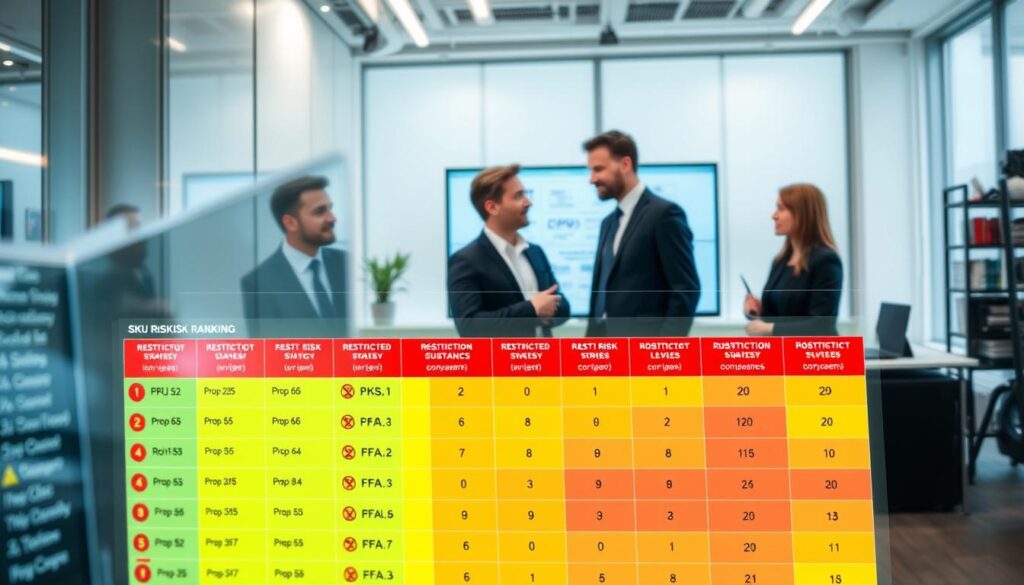
Today, we have tools for threshold-based analysis. It’s like noise-canceling headphones for compliance. It helps ignore small amounts and focus on big ones. It’s about finding the real issue.
But finding the problem is just the start. Knowing a product is risky without a plan is useless. That’s where substitution strategy comes in.
Microsoft shows how it works: they replace substances when better options are available. They look for feasible and available alternatives. Some changes are easy, while others are complex.
Creating a substitution plan is as detailed as ranking risks. It’s not just about flagging products. You need a clear plan to make them safer. This turns compliance into a proactive strategy.
High-Risk vs. Low-Risk SKU Characteristics
| Characteristic | High-Risk SKU | Low-Risk SKU | Strategic Action |
|---|---|---|---|
| Regulatory Exposure | Contains substances newly listed under Prop 65, RoHS, or state PFAS laws | Uses well-established, compliant materials with long history | Immediate substitution planning required |
| Market Presence | Sold in jurisdictions with aggressive enforcement (CA, EU, NY) | Markets with minimal substance regulations | Geographic market analysis essential |
| Alternative Availability | No drop-in replacements; requires formulation changes | Multiple certified alternatives readily available | R&D timeline mapping critical |
| Volume & Revenue Impact | High-volume product or key revenue generator | Low-volume niche item | Business continuity assessment needed |
| Testing History | Limited or failed third-party testing results | Consistent passing scores with full documentation | Accelerated verification testing |
This table is your decision guide. High-risk SKUs often have many problems. A product with a restricted plasticizer, sold in California, with no easy fix? That’s your top priority.
Fixing such a SKU is a big project. It needs its own plan, budget, and goals. Sometimes, you need to redesign the product. Other times, you find a supplier who’s already solved the problem.
Risk ranking and substitution together are powerful. They turn compliance into a competitive edge. You’re not just avoiding fines; you’re making better products for the future.
Your suppliers should be part of this process too. When you ask them clearly, they help more. It’s like asking for “gluten-free pasta” instead of just “healthier food.”
Keep all your plans and decisions documented. When auditors come, this shows you’re prepared. It’s like playing chess while others play whack-a-mole.
Change Control When Substances Are Added/Delisted
When a substance is added to Prop 65 or an RoHS exemption expires, your static spreadsheet becomes a compliance time bomb. Regulatory bodies don’t send engraved invitations—they drop updates like surprise album releases. This leaves you scrambling to decode the new rules.
Effective change control isn’t an event you calendar. It’s the continuous background process of your compliance program. The moment a new substance hits the restricted list, your response time determines whether you’re leading the industry or facing liability.
Think of it as a three-act play where manual processes always flub their lines:
- Act I: The Alert – Those regulatory newsletters you keep “marking as read” contain plot twists that could reshape your product portfolio. Monitoring isn’t optional; it’s your early-warning system against regulatory shock.
- Act II: The Investigation – When substances are added to lists, you need digital forensic tools. A proper where-used analysis scans your entire supplier and product database in minutes, not months. It answers the critical question: “Which components contain this newly restricted chemical, and who supplies them?”
- Act III: The Resolution – Updating specifications, re-evaluating suppliers, revising test plans, and communicating changes through your supply chain. This is where spreadsheets go to die and automated systems prove their worth.
The brutal truth? Manual change control processes crumble under this pressure. They’re like trying to track cryptocurrency transactions with an abacus—theoretically possible, practically absurd. When regulators move at digital speed, your response can’t be trapped in analog thinking.
Consider this reality check: Your RSL needs updating at minimum annually, but substances get added or delisted quarterly. That mismatch creates compliance gaps wider than plot holes in a summer blockbuster. Automation isn’t a luxury feature; it’s the life support system keeping your program alive in a world where the rulebook gets rewritten overnight.
Here’s what robust change control actually looks like in practice:
- Automated monitoring feeds that flag relevant regulatory updates before they become compliance emergencies
- Integrated databases that enable instant where-used analysis across all products and suppliers
- Workflow systems that trigger spec revisions, supplier communications, and test plan updates automatically
- Audit trails documenting every decision and action taken in response to regulatory changes
When substances are delisted, the process works in reverse—but requires equal rigor. Removing unnecessary restrictions can lower costs and simplify sourcing, but only if you systematically update your requirements and communicate the changes. This way, you’re not paying compliance premiums for problems that no longer exist.
The ultimate test of your change control system? How quickly you can answer this question after any regulatory announcement: “Exactly which products are affected, what needs to change, and who needs to know?” If that answer takes weeks instead of hours, you’re not managing change—you’re documenting your decline.
Customer Communication & Self‑Serve Certificates
You’ve navigated Prop 65’s labyrinth. You’ve conquered the RoHS exemption matrix. Your supplier declarations are filed with precision. Yet, a simple email from procurement feels like a final boss.
We’ve all been there. The “URGENT: CoC for P/N 12345” request hits the inbox. You scramble, find the PDF, attach it, and hit send. It’s a magic trick where your compliance data vanishes.
This isn’t a compliance failure. It’s a communication failure. In the old model, your perfect data dies in a PDF attachment.
The new model asks a better question: What if the customer never had to ask? Imagine a dedicated portal where buyers log in, type a part number, and poof—a current, validated Certificate of Compliance appears. Need it for RoHS? Click. Prop 65? Click. Their own internal standard? Click.
This is the essence of simplified supply chain communication. It turns static documents into dynamic, on-demand services. Platforms built for this don’t just store data; they enable automated data collection and reusability. One validated declaration feeds countless certificates.
The shift is profound. Look at the difference between the old way and the new reality.
| Aspect | The Old Way (Email Chaos) | The New Way (Self-Serve Portal) |
|---|---|---|
| Access Speed | Hours or days, depending on your team’s inbox backlog. | Instant. 24/7/365 access. |
| Data Accuracy | Risk of sending an outdated or incorrect version. | Always serves the single, current, master version. |
| Team Burden | Heavy on sales, customer service, and quality staff. | Near-zero. The portal handles the query. |
| Customer Experience | Frustrating. Feels like pulling teeth. | Empowering. Feels like a premium service. |
| Competitive Signal | Says “we are reactive and bogged down.” | Screams “we are organized, transparent, and easy to do business with.” |
That last point is the kicker. In today’s market, supply chain transparency isn’t just nice-to-have; it’s a measurable competitive metric. A self-serve certificate portal is a silent but powerful salesperson.
It answers the question before it’s finished being asked. It proves your house is in order without you having to say a word. You stop selling compliance and start selling confidence.
Stop letting your best work get lost in a reply-all chain. Bring it into the light where your customers can actually use it.
RSL Template & Supplier Declaration Form
Your RSL is not just a list. It’s a living document that guides your company’s material health. Think of Microsoft’s H00594 specification—it’s detailed because their products require it. Your RSL should be tailored to your needs.
The supplier declaration form is key to your RSL. It should collect structured data, not stories. A good form asks yes or no questions about certain substances and levels. A bad one leads to made-up answers. You need facts, not fiction.
For a great example, look at the Cradle to Cradle Certified supplier declaration form. It’s clear, with separate sections for banned lists and the RSL, exact CAS numbers, and clear statements. Digital tools like CDX can help make this work.
Your RSL and smart declaration form are the heart of your program. Start with a solid foundation. Your strategy for Prop 65, RoHS, and PFAS compliance relies on it. Get this right, and the rest will follow easily.