

Storing volatile materials isn’t just about finding a spot in your lab or workshop. It’s like hosting a guest who’s invisible, temperamental, and can destroy your building with a spark.
This guest needs strict rules. Your first defense isn’t a fire extinguisher you hope to never use. It’s about thoughtful containment from the moment you put the bottle on the shelf.
We can’t just stick things in a yellow cabinet and call it safe. A coat of paint doesn’t make something safe. Real safety comes from knowing why we use special safety cabinets. They protect from fires, keep incompatible chemicals apart, and control who can access them.
In the United States, following these rules isn’t just smart—it’s the law. Local fire laws, often based on NFPA standards, tell us what we must do. But following the law is just the starting point.
This is like your safety briefing before a game. We’re about to explore flash points, compliance, and the big difference between a yellow cabinet and a truly safe one.
Definitions: flash point/boiling point classes
Think of flash point and boiling point as the personality profile of your flammable liquid. One tells you when it gets angry, the other how volatile that temper is. This isn’t abstract chemistry. It’s the foundational language of fire safety, and speaking it fluently is what separates a compliant storage area from a disaster scene.
So, what are we actually measuring? The flash point is the lowest temperature at which a liquid gives off enough vapor to form an ignitable mixture with air near its surface. It’s the moment your liquid whispers, “I could catch fire.” The boiling point is the temperature at which a liquid’s vapor pressure equals atmospheric pressure, causing it to boil. A low boiling point means it vaporizes easily, creating more fuel for a fire, faster.
These two numbers are the raw data fed into the NFPA 30 classification system—the industry’s standard playbook adopted by codes like Canada’s National Fire Code. It sorts flammable and combustible liquids into distinct classes: IA, IB, IC, II, and IIIA. Why does this matter? Because treating a Class IB liquid like acetone the same as a Class II liquid like some paint thinners is like storing a lit firecracker next to a damp firework. The risk profiles are fundamentally different.
| NFPA 30 Class | Flash Point | Boiling Point | Common Example | Volatility Vibe |
|---|---|---|---|---|
| Class IA | Below 73°F (22.8°C) | Below 100°F (37.8°C) | Diethyl ether | The most volatile. It’s impatient and explosive. |
| Class IB | Below 73°F (22.8°C) | At or above 100°F (37.8°C) | Acetone, gasoline | Easily ignitable, but slightly less eager to vaporize than IA. |
| Class IC | At or above 73°F (22.8°C) and below 100°F (37.8°C) | Any | Some alcohols, xylene | Moderate temper. Needs a warmer environment to flare up. |
| Class II | At or above 100°F (37.8°C) and below 140°F (60°C) | Any | Kerosene, diesel fuel | Combustible, not flammable. It needs convincing. |
| Class IIIA | At or above 140°F (60°C) and below 200°F (93°C) | Any | Some paints, lubricating oils | The slow burn. High flash point means greater safety margin. |
See the critical divide? Class IB liquids (flash point under 22.8°C, boiling point at or above 37.8°C) live in a different regulatory universe than Class II. This classification is the DNA of your hazard. It dictates everything downstream: the Maximum Allowable Quantities you can keep in a control area, the type of safety cabinet required, and the ventilation specs.
Memorizing this table isn’t the goal. Understanding the why is. A low flash point plus a low boiling point (Class IA) is a worst-case scenario—highly ignitable and quick to fill a space with vapor. The NFPA 30 system exists to quantify that danger so you can manage it with precision, not guesswork.
So next time you look at a safety data sheet, find those two temperatures. They’re not just numbers. They’re the secret code that tells you exactly what kind of guest you’re inviting into your storage area—and how much security you’ll need to keep it from causing trouble.
MAQs/control areas and implications for layout
Handling flammable liquids storage is more about urban planning than chemistry. The fire marshal acts like your city council. It’s like a high-stakes game of Tetris, where the wrong move can be disastrous.
The International Fire Code (IFC) sets strict limits. Your building’s type—business, mercantile, industrial, or laboratory—sets your starting point. Each type has its own Maximum Allowable Quantity (MAQ), limiting how much flammable liquid you can store.
For a typical business, the IFC MAQ is as low as 5 liters per control area. Industrial settings can store up to 5,000 liters. These limits depend on fire load, occupant density, and building construction.
| Occupancy Type | Typical MAQ (Liters) | Control Area Concept |
|---|---|---|
| Business | 5L per room | Single fire compartment |
| Mercantile | 10L per floor | Separated by fire walls |
| Industrial (Incidental) | 5,000L | Dedicated hazardous area |
| Laboratory | Varies by class | Ventilated cabinet zones |
A “fire compartment” is key. It’s a space with fire-resistant walls, floors, and ceilings. You can have many control areas, each with its own MAQ. But they must be separated properly.
The cabinet exemption is a bit of a loophole. Ontario’s Industrial Establishments Regulation allows up to 235 liters per cabinet. But you can only group three cabinets together, separated by at least 30 meters.
Planning your layout is complex. You can’t just place cabinets anywhere. Each spot must be strategic, considering control areas and separation rules.
This affects your space greatly. Laboratories might need to spread chemicals across fire compartments. Industrial facilities might need special rooms for storage. Retail spaces have strict limits per floor.
Can you just line up cabinets? The IFC MAQ rules say no. Your layout must be a three-dimensional safety matrix, balancing quantity, separation, and compartmentalization.
These rules aren’t just red tape. They’re based on what happens when flammable liquids are stored wrong. Your layout is about creating safe spaces, not just efficiency.
Cabinets vs liquid storage rooms; self‑closing doors and ratings
A flammable storage cabinet is more than a yellow box. It’s a safety system, like a fire-resistant safe for dangerous liquids. A liquid storage room is like a big vault. Choosing between them is serious, based on how much you have, the rules, and how safe it is.
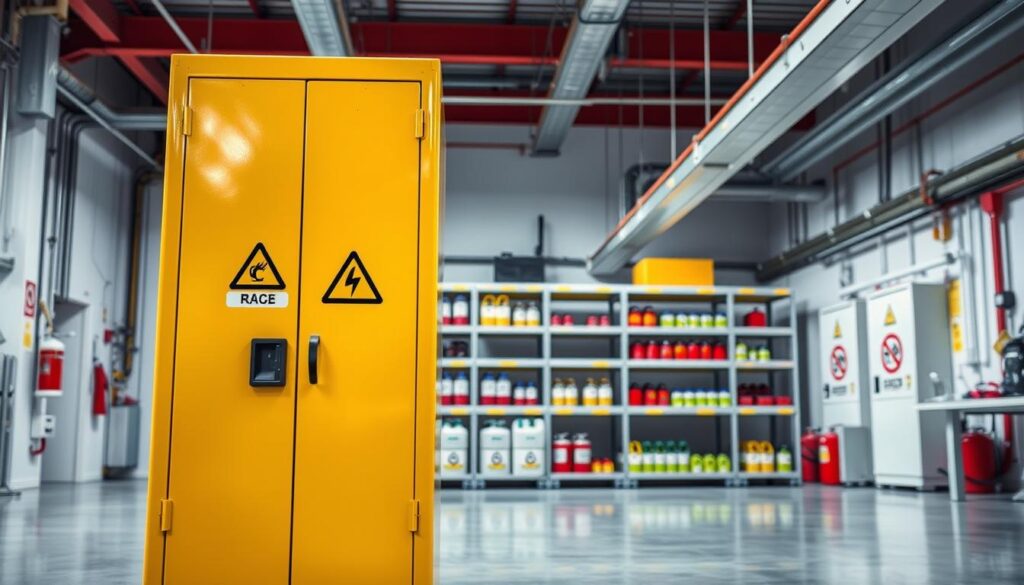
So, when do you need one over the other? The rules are clear. If you have too much or can’t keep it far enough away, you need a cabinet or a room. It’s like choosing between a small apartment and a big warehouse.
What makes a cabinet safe? It must meet strict standards like UL/ORD C1275 or NFPA 30. This means it’s built strong, with special doors that close by themselves. These doors help keep fires in for 10 to 20 minutes.
How much can it hold? Most say 500 liters, but NFPA 30 allows 460 liters. And that yellow color? It’s to help spot danger fast in an emergency.
| Feature | Flammable Storage Cabinet | Liquid Storage Room |
|---|---|---|
| Construction Standard | ULC/ORD C1275, FM, NFPA 30 | NFPA 30, Building & Fire Code (Chapter 4) |
| Max Capacity (Typical) | 500 L (460 L per NFPA 30) | Varies; often for quantities exceeding cabinet limits |
| Door Requirement | Self-closing, tight-sealing | Self-closing, fire-rated (often 1-hour minimum) |
| Primary Use Case | Smaller quantities, point-of-use segregation, when distance rules can’t be met | Large bulk storage, central distribution, high-hazard operations |
| Fire Containment | Provides limited fire resistance (10-20 min) | Designed as a dedicated, fire-separated area |
The cabinet is for storing small amounts in labs, workshops, or closets. It keeps things safe and contained. The room is for big amounts, needing strong fire protection and special systems.
Don’t forget the labels. Every flammable storage cabinet must say “FLAMMABLE – KEEP FIRE AWAY.” It’s not just for looks; it’s a warning.
In the end, it’s about how much you have and how you manage it. Cabinets are for everyday use, while rooms are for big amounts. Both need self-closing doors to keep fires in.
Cylinder Storage Basics (Separation, Caps, Chains; NFPA 55 Overview)
Proper flammable liquids storage is key, but ignoring cylinder storage rules is a big mistake. Compressed gases are silent, under high pressure, and full of energy. Their storage rules are not just suggestions; they are based on physics.
NFPA 55 is like the Emily Post of compressed gas etiquette. It outlines the must-do’s for safe storage, preventing accidents.
When you have too many cylinders, safety cabinets can help. But, they have strict limits. Think of it as a VIP section with a strict bouncer: no more than three large cylinders or 30 small ones per cabinet. This prevents overcrowding and limits disaster scope.
The most critical rule? Social distancing for gases. Incompatible gases must be stored separately. This isn’t a mild recommendation. Storing fuel gases like acetylene near oxidizers like oxygen is dangerous. Always segregate by hazard class.
NFPA 55 boils down the basics to three non-negotiable pillars:
- Segregation: Keep fuel gases and oxidizers in different zones. It’s the oldest rule in the hazardous materials playbook: don’t mix your matches with your pure oxygen.
- Secure Restraint: Every cylinder must be chained or strapped to a stable structure. A falling cylinder is a broken valve, and a broken valve is a runaway rocket. Your “tipping point” should be a philosophical concept, not a literal event.
- Valve Protection Caps: That threaded cap isn’t a decorative top hat. It’s a vital safety device that must be screwed on whenever the cylinder is not actively connected for use. It protects the valve stem—the cylinder’s most vulnerable point—from damage. Consider it the cylinder’s helmet.
These steps seem basic. Yet, they are often ignored. In a flammable liquids storage plan, mastering cylinder storage is critical. It’s not just about putting things away; it’s about ensuring they stay put, and stay safe.
Ventilation: When to Vent Cabinets (Pros/Cons per Manufacturer/Code)
Venting a flammable storage cabinet might seem like a good idea for safety. But, codes often say it’s not always the best choice. This is because venting can actually make things worse in some cases.
The short answer? Venting is usually not recommended for fire protection with flammable liquids alone. A sealed cabinet is designed to keep a fire contained for 10 minutes. Venting it can make the fire worse by letting in air.
So, when is venting mandatory? It’s needed for toxic chemicals, decomposing materials, or stored gas cylinders. In these cases, the main danger is not just fire but also poisonous or pressurized gases. Venting helps remove these hazards.
If you must vent, you can’t just use any old hose. You need strict requirements for safety. Use rigid metal ducting, fire-rated where it goes through walls, and exhaust it safely outside. Always choose mechanical exhaust over natural draft.
When venting, follow precise steps. Remove the cabinet’s bungs, install flash arresters, and connect to a non-sparking, appropriately rated fan.
This leads to the explosion-proof vs intrinsically safe debate. Using a standard fan to exhaust flammable vapors is dangerous. You need equipment rated for the hazard. Explosion-proof means the housing can contain an internal explosion. Intrinsically safe means the electrical energy is so low it can’t cause ignition. Your choice depends on the specific area classification.
| Scenario | Venting Recommended? | Primary Rationale | Key Code/Standard Trigger | Electrical Equipment Requirement |
|---|---|---|---|---|
| Flammable Liquids Only (No Toxics) | Generally No | Preserves cabinet fire integrity; prevents creating explosive air mixture. | NFPA 30, OSHA 1910.106(d)(3) | Not applicable if sealed. |
| Toxic or Poisonous Chemicals | Yes, Required | Prevents lethal vapor accumulation inside cabinet. | OSHA 1910.1450 (Lab Standard), ACGIH Ventilation Guidelines | Fan must be suitable for chemical exhaust. |
| Decomposing or Peroxide-Forming Materials | Yes, Required | Mitigates pressure buildup from gas generation. | Prudent Practices in the Laboratory (NAS) | Non-sparking construction critical. |
| Compressed Gas Cylinders (Flammable/Inert) | Yes, Required | Dilutes leaks, prevents asphyxiation or explosion. | NFPA 55, CGA Pamphlets | Area classification dictates explosion-proof vs intrinsically safe rating. |
| Mixed Storage (Flammables + Toxics) | Yes, Required | Toxic hazard governs; ventilation must address worst-case scenario. | Most restrictive code applies. | Combination of chemical corrosion resistance and explosion protection. |
Manufacturers are often caught in the middle. Their cabinets are tested and listed as fire-resistant units. But, if you modify them by drilling and ducting, you void that listing unless you follow their specific, often cumbersome, kits and instructions. Their consensus? If you don’t need to vent for toxicity, don’t. The sealed cabinet is the safer choice for pure flammables.
The pros and cons are like a classic risk assessment. A vented cabinet solves an air quality problem but can create a fire and liability problem if done incorrectly. A sealed cabinet solves a fire problem but can create an exposure problem if misused for the wrong chemicals. Your choice isn’t about good vs. bad. It’s about correctly identifying the primary villain in your specific story: fire or poison.
Ultimately, the ventilation question forces you to think like a code official. It’s not about what feels safest. It’s about what the hazard analysis dictates. And when that analysis points to venting, remember: the ductwork and fan aren’t afterthoughts. They are critical safety systems where the explosion-proof vs intrinsically safe decision is your final guard against turning a safety measure into a spark in the dark.
Dispensing/transfer: bonding/grounding, pump choices, anti‑static measures
Bonding and grounding are like a safety dance for handling flammable liquids. If you skip a step, disaster can happen. It’s not about being too careful. It’s about avoiding the dangers of physics in your lab or workshop.
Static electricity is the hidden enemy. When you pour liquids, friction can create a spark. This spark can ignite flammable vapors. So, the goal is to remove any chance of a spark before you start.
So, what’s the difference between bonding and grounding? Bonding connects two conductive objects to balance their electrical charge. Grounding links that bonded system to the earth, allowing charges to safely escape. You need both to ensure safety.
Codes are clear about this. When working with Class I flammables in a metal cabinet, that cabinet must be grounded. This rule is strict. Most good cabinets have a grounding lug. You connect an anti-static wire from that lug to a verified ground point.
A non-conductive cabinet is a bad choice. It can’t be grounded, making it a risk. If your cabinet is in a flammable area, grounding is essential.
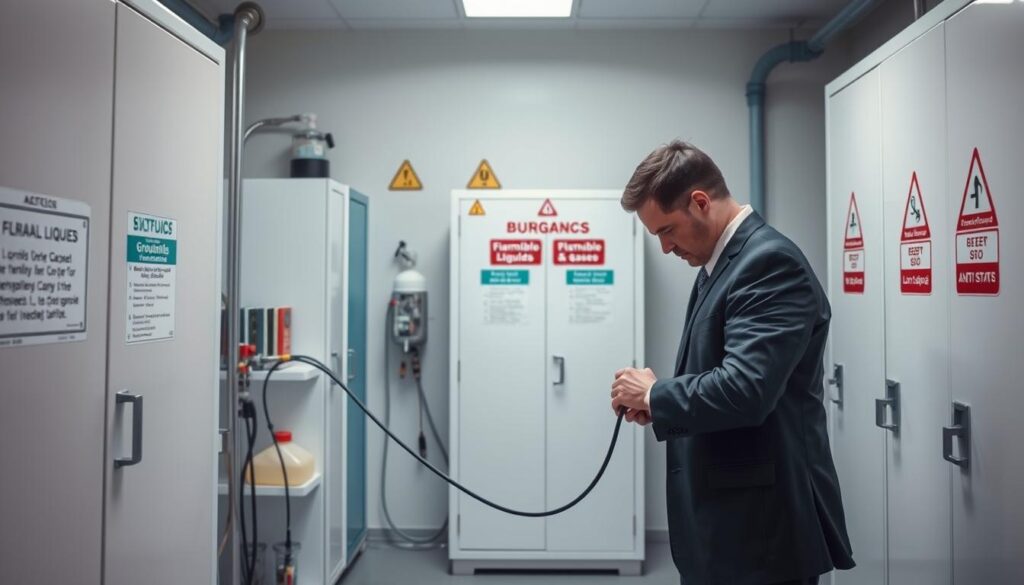
The type of transfer pump you use is also important. The wrong pump can be like using a sieve. You have manual and powered pumps, each with its own safety rhythm.
| Pump Type | Best For | Key Safety Feature | Static Consideration |
|---|---|---|---|
| Manual Drum Pump (Hand-operated) | Smaller, intermittent transfers; control is key. | Operator controls flow speed. | Must be bonded to drum and receiver. Ensure conductive materials. |
| Electric/Pneumatic Transfer Pump | High-volume, repetitive dispensing. | Can be integrated with grounding interlocks. | Pump housing and all connections must be grounded. Use conductive hoses. |
| Safety Can with Trigger Valve | Secondary containment and small pours. | Self-closing valve prevents spills. | Can itself must be bonded during filling. Metal path is essential. |
| Closed-Loop Transfer System | Maximum vapor control and safety. | Virtually eliminates vapor release. | The entire system is designed as a bonded, grounded unit. |
Your environment also affects safety. Low humidity can lead to static. Increase humidity to help, but don’t rely on it. Use anti-static mats and wear conductive shoes in dispensing areas. Even your clothes can generate charge, so choose wisely.
In the end, making transfers safe is about routine. Bonding and grounding are not just rules. They are essential steps in a safety dance. Get it right, and your transfers will be smooth.
Refrigerated Flammables: Use of Rated Lab/Industry Fridges (Not Household)
Some flammables need to be chilled, and it’s not just a suggestion. It’s a key safety rule that requires special equipment. Using a regular household fridge for flammable liquids storage is a big mistake. It can turn a harmless appliance into a fire hazard.
Think about your kitchen fridge. It’s full of hidden sparks. The thermostat, the light switch, and the compressor relay can all start fires. Storing volatile chemicals in it is like putting a lit match in a closet with gasoline.
That’s why safety rules and common sense say you need special refrigerators. These units are made to be spark-free. All electrical parts inside are sealed or designed to prevent fires.
You’ll find two main types: laboratory-safe and explosion-proof refrigerators. Lab-safe models keep ignition sources away from the cabinet. Explosion-proof models contain any explosion inside and stop it from getting out. The right choice depends on your specific needs and safety rules.
Your flammable liquids storage plan is only as good as its weakest point. A regular fridge is a clear danger. Getting the right cold storage equipment is not just an upgrade. It’s the last, essential step to keep your storage safe and cool.
Hot work permitting near flammable storage
Imagine welding near a gasoline spill. That’s what unpermitted hot work near flammable liquids storage is like. Welding, cutting, and grinding create sparks. These sparks and vapors can lead to disaster.
A hot work permit system is not just red tape. It’s a lifesaver that forces a safety check before starting work. It’s not about slowing down. It’s about avoiding accidents.
So, what does this safety check entail? It’s like a pre-flight checklist. The permit, based on standards like NFPA 51B, asks important questions.
First, distances. How far is the hot work from the storage area? Being in the same room is often too close. Next, container management. Are all flammable liquid containers sealed, removed, or behind a barrier? An open jug is a danger.
The permit also requires preparedness. A dedicated fire watch is essential. They must have a clear view and a way to communicate. Fire extinguishers must be ready, the right type for the fire.
Ventilation is also key. Is there enough air flow to clear vapors? Or are you creating a fire risk?
This process is like “measure twice, cut once.” It’s about checking for vapors. The permit makes it clear: don’t play with fire near fuel.
Having a strict hot work permit near flammable liquids storage makes a big difference. It turns a big risk into a manageable one. It replaces hope with a checklist and luck with a procedure. That piece of paper is a shield.
Inspection checklist and training notes
The best flammable liquids storage cabinet is useless without the right people. It’s like a sports car without a driver. NFPA 30’s smart design is wasted without someone to use it. Your job is to create a culture of safety.
Begin with a simple checklist. Check your storage area every week. Make sure all containers are labeled and cabinet doors close properly. Look for any loose connections or incompatible chemicals.
Training is key to making safety second nature. Forget boring lectures. Instead, practice drills and show how to transfer chemicals safely. Use real-life examples to explain why safety rules are important. Keep records of these sessions to show your dedication.
Learning about flammable liquids storage is more than passing a test. It’s about making safety automatic. Regular checks and active training are essential. They make sure safety advice is not just read but lived every day.