


Welcome to the world of hazmat rules. That simple drum of cleaner or box of lab samples turns into a thrilling story when it’s shipped. It’s not just about following rules. It’s like solving a mystery.
Imagine it like decoding secret messages and labeling with the care of a museum expert. Your task is to navigate the complex global supply chain. With DOT hazmat training, we’ll show why that 2-hour course is key.
The rules from PHMSA and others are clear. Millions of products are shipped every day, many with hazardous materials. Proper labeling is not optional. It’s what keeps dangerous goods off the news.
So, let’s explore this complex system. Your aim is not just to pass an audit. It’s to become the expert of the shipping world.
When your purchase becomes “hazmat” in transit
Buying something doesn’t mean you’re done. It means you’re starting a new journey. You need to find a UN number for your shipment. This is a big step.
It’s not just about owning something dangerous. It’s about moving it. When you plan to send it, you become a “hazmat employer.” This brings new rules into your life.
I’ve seen it happen. A team buys lithium-ion batteries for prototypes. They’re just parts in the lab. But when they ship them, they become a Class 9 hazard. A lab buys a bacterial culture for study. It’s just a sample in the lab. But when it ships, it’s a Category A infectious substance.
When you ship something, you take on a big responsibility. The law says you need training. This is not optional.
It’s like the “Ship of Theseus” paradox for logistics. If you change everything but the hazard, it’s your problem. You must label containers with a durable label. This is more than a sticker. It’s a warning and a defense.
UN numbers are key. They tell everyone what’s in the box. Without them, it’s a mystery. And the DOT doesn’t like surprises. The fine for not labeling can be huge.
Buying something and moving it is a big change. You become a regulated shipper. You need training, labels, and UN numbers to remember. Welcome to the club. The first rule is: you must talk about the hazard.
Proper Shipping Name, UN/NA ID, hazard class/division, packing group
If hazmat shipping were a legal drama, the Proper Shipping Name would be the defendant’s true identity, read aloud in a courtroom of regulations. Get it wrong, and you’re committing perjury before the box even leaves your dock. This isn’t about creative labeling. It’s about a precise, four-part code that acts as a hazardous material’s non-negotiable passport.
Think of it as the holy quartet of identification. Each element tells a critical part of the story. You have the Proper Shipping Name, the UN/NA ID, the hazard class or division, and the packing group. Miss one, and you’ve introduced a wolf as a “fluffy canine” at a sheep convention.
Let’s break down this bureaucratic poetry. The Proper Shipping Name is the substance’s official, legal title. It’s not a trade name or a cute nickname. For example, “Isopropyl alcohol” is correct; “rubbing alcohol” is a fast track to a violation.
Next, the UN/NA ID. This is the government-issued Social Security Number for dangerous goods. “UN1993” isn’t a random code. It whispers a specific story: “Flammable liquids, n.o.s. (not specified).” This number is the key that unlocks everything else in the rulebook.
The hazard class or division assigns your material to its family. Is it a flammable liquid (Class 3)? A toxic substance (Class 6.1)? This classification dictates the entire safety playbook—from the labels you must use to how it can be transported.
Lastly, the packing group. This is where we assess the relative threat level within a hazard class. It’s a triad: PG I (high danger), PG II (medium danger), and PG III (low danger). Your packing group directly dictates the strength of the packaging required. It’s the difference between shipping in a stout, certified drum versus a standard box.
Where do you find this quartet? In the almighty Hazardous Materials Table (HMT) in 49 CFR. You don’t need to memorize it. You need to learn how to read it. This is the core language of compliance.
Consider a biomedical example. You have a patient specimen known to contain a pathogen. Is it a Category A infectious substance (UN2814 or UN2900) or a Category B (UN3373)? The Data from our sources highlights that classifying this correctly is key. Calling a Category B substance “exempt specimens” on a shipping paper is a catastrophic error. The Proper Shipping Name “Biological substance, Category B” must be used.
For a common industrial chemical like our friend UN1993, the HMT entry gives you the name, the ID, the class (3), and the packing group (which varies by flash point). This four-part code is the foundation. Every subsequent step—packaging, marking, labeling, documentation—flows from this identification.
Getting this right is less about rote memorization and more about linguistic fluency. You’re learning to speak the regulator’s language. Misidentify your hazmat, and every step that follows is built on a lie. The labels won’t match. The packaging will be insufficient. The emergency responders will be misinformed.
Master this quartet first. Everything else in hazmat shipping is commentary.
Packaging: UN spec marks, performance tests, inner/outer combos
A UN specification mark on a drum is not just for show. It’s a sign of survival after tough tests. These tests include drops, pressures, and chemical baths. Your hazmat shipment becomes a certified unit, not just a package.
The “UN” code on the side is a badge of honor. It shows the package has passed brutal tests. These tests include drops, stack pressure, and leak tests. If it fails, it goes back to the start.
The packaging strategy is smart. It uses inner and outer layers. The inner receptacle keeps the substance safe. The outer packaging protects it from the world.
Durability is key at every level. Labels and markings must be tough too. They’re made from materials like polypropylene or polyester. A faded or missing label is useless.
Shipping by sea adds a new challenge: salt. The IMDG Code has its own rules for sea travel. It requires packaging that can handle salt, humidity, and waves. What works on land might not make it across the ocean.
| Component | Primary Function | Key Requirement | Material Example |
|---|---|---|---|
| Inner Receptacle | Directly contains the hazardous material. | Must be chemically compatible and leak-proof. | Glass bottle, plastic jerrican, metal can. |
| Outer Packaging | Protects the inner receptacle from physical damage and environmental exposure. | Must pass UN performance tests (drop, stack, leak). | UN-certified fiberboard box, steel drum, plastic pail. |
| Cushioning/Absorbent Material | Prevents movement and contains minor leaks within the outer package. | Must not react with the hazmat; sufficient quantity to absorb entire liquid contents. | Vermiculite, clay, polyurethane foam. |
| Markings & Labels | Communicates critical hazard and handling information. | Must be durable, legible, and displayed on contrasting background. | Tear-resistant polypropylene labels, embossed metal tags. |
Seeing a UN-marked box means you’re looking at a system. It’s a tested, layered, and planned fortress. It’s designed to keep hazards in and the world out. Whether on land or sea, the packaging is your first defense.
Marking and Labeling vs Placarding: The Visual Hierarchy of Hazard
Think of hazmat packaging like a novel. Markings are the fine print, labels are the cover art, and placards are the billboard ad. This isn’t just about following rules. It’s a system where getting it wrong is a big deal.
Markings are like the package’s permanent tattoo. They include the UN number, shipping name, and consignee address. Labeling is the immediate warning. DOT labels are the bright, diamond-shaped badges that tell you about the hazard.
These labels are the standard signs. They tell handlers about the hazard. They must be tough so they don’t fade or fall off. This is because they tell first responders what they’re dealing with.
Then, there’s the placard. This is for bigger things like trucks. Placards are the big signs on transport vehicles. They shout the hazard to the fire department from far away.
Placards are needed for big amounts of the same hazardous material. A single bottle gets a label, but a whole pallet needs a placard. This shows the importance of the visual hierarchy.
To make it clear, here’s a comparison:
| Element | Primary Audience | Scale & Placement | Key Function |
|---|---|---|---|
| Markings | Logistics personnel, inspectors | Permanent on the package itself (e.g., UN number). | Provides permanent identification and tracking data. |
| Labels | Package handlers, loaders, immediate responders | Diamond-shaped, on package surface near shipping name. | Communicates specific hazard class for close-proximity safety. |
| Placards | Emergency services, public, other drivers | Large signs on transport vehicles (e.g., truck, railcar). | Broadcasts primary hazard from a distance for emergency response. |
This system is all about who needs to know what. A dockworker needs the label’s details. But a firefighter needs the placard’s clear message from afar. Each part is important for safety from start to finish.
Getting this wrong is like sending the wrong message in an emergency. The DOT’s rules are clear for a reason. They help everyone know their role. Mastering this visual language is key in hazmat.
Shipping papers, emergency numbers, and segregation in transport
The shipping paper is like a detailed biography for the hazmat package. It’s checked carefully in the cargo hold, following IATA rules. It’s not just a simple packing slip. It’s the key document for everyone involved, from the warehouse staff to the pilot and firefighters.
This document, known as a Dangerous Goods Declaration, tells the whole story. It lists the Proper Shipping Name, UN number, hazard class, and more. For air transport, IATA rules add even more details, requiring great accuracy.
The most important part is the 24/7 emergency response number. This number is non-negotiable. It connects to experts who know the chemical well. When there’s an emergency, this number is the first call responders make.
Segregation is also key in the cargo hold. It’s like keeping chemicals apart to avoid conflicts. You can’t mix an oxidizing agent with a flammable liquid. The result could be dangerous.
Segregation rules are like a game of chess. They use compatibility tables to decide how to keep chemicals apart. Knowing these rules is important to avoid accidents.
| Hazard Class/Division | Incompatible With | Potential Risk | Typical Segregation Requirement |
|---|---|---|---|
| 2.1 Flammable Gases | 5.1 Oxidizers, 2.3 Toxic Gases | Fire, explosion, toxic gas release | Separate freight containers or minimum 3-meter distance. |
| 4.3 Dangerous When Wet | 8 Corrosive Materials | Violent reaction, release of flammable gas | Must be in different closed transport units. |
| 5.1 Oxidizing Substances | 3 Flammable Liquids, 4.1 Flammable Solids | Intense fire, explosion | “Separated from” status; cannot be on same pallet. |
| 8 Corrosive Acids | 6.1 Toxic Substances, 4.2 Spontaneously Combustible | Heat generation, toxic fume release | Segregation by a complete pallet or barrier. |
The key elements are the shipping papers, the emergency number, and segregation. If any part is wrong, the shipment could become a major incident. For air cargo, following IATA rules is not just a good idea—it’s the law.
Modal Nuances: Highway (49 CFR), Air (IATA DGR), Ocean (IMDG), International (ADR)
The DOT’s hazmat rules are like a gritty procedural drama. Air freight regulations, on the other hand, are a high-stakes techno-thriller. Shipping dangerous goods is not a one-size-fits-all approach. It’s a series of distinct cinematic universes, each with its own rules.
Your commodity’s journey defines its rules. Let’s break down the cast of characters: the pragmatic road warrior (49 CFR), the anxious overthinker (IATA), the patient long-hauler (IMDG), and its European cousin with a penchant for paperwork (ADR). Knowing which show you’re in is the first step to a safe, compliant finale.

Highway transport under 49 CFR is your baseline, the blue-collar workhorse of DOT hazmat. It’s built for the grind. The philosophy here is pragmatic risk management on a moving landscape shared with the public. The rules are detailed, but they assume a certain level of containment failure can be managed—you can pull over. It’s the procedural manual you dog-ear and curse, but it gets the job done across state lines.
Now, switch genres to air. The IATA Dangerous Goods Regulations (DGR) are the sequel, co-produced with the FAA. This is the zero-tolerance thriller. A pressurized cabin at 30,000 feet changes everything. A small leak isn’t a roadside headache; it’s a potentially catastrophic event. The FAA is the anxious overthinker for a reason.
Their requirement for recurrent training every two years for air transport personnel isn’t a suggestion—it’s a survival instinct. This environment is why items like lithium batteries, which might be a concern on a truck, become a central villain in an air cargo plot. The IATA rulebook is stricter, more nuanced, and leaves very little to interpretation. Error is not an option.
Then we sail into the epic saga: the IMDG Code. Ocean shipping deals in scale and time. We’re talking about massive quantities sitting in steel containers, battling corrosive salt air, humidity, and weeks of vibration. The IMDG philosophy is that of the patient long-hauler. It focuses on stability, segregation within the floating metropolis of a container ship, and withstanding prolonged environmental stress.
Packaging that passes muster for a three-day truck ride might be deemed unfit for a six-week Pacific crossing. The rules account for the slow, relentless pressure of the maritime environment, not the sudden decompression of flight.
For international road transport across Europe, you meet ADR. Think of it as the European director’s cut of the 49 CFR. It shares DNA with its U.S. counterpart but has its own plot twists and stricter character development arcs for certain chemicals. Navigating ADR means understanding that your DOT hazmat knowledge is a foundation, not a passport.
The core difference is philosophical. Is the primary risk sudden and catastrophic (air), chronic and environmental (sea), or dynamically public (highway)? Your answer dictates your rulebook.
| Modal Rulebook | Governing Body | Key Philosophy | Signature Challenge |
|---|---|---|---|
| 49 CFR (Highway) | U.S. DOT / PHMSA | Pragmatic risk management in shared public space. | Containing hazards amid traffic, weather, and roadside access. |
| IATA DGR (Air) | IATA / Enforced by FAA | Zero-tolerance for failure in a pressurized, vulnerable environment. | Preventing catastrophic events mid-flight; strict lithium battery rules. |
| IMDG Code (Ocean) | International Maritime Organization (IMO) | Long-term stability and segregation for bulk quantities over weeks. | Combating corrosion, pressure changes, and prolonged transport stress. |
| ADR (Int’l Road) | United Nations (for Europe) | Harmonized but often stricter European adaptation of road rules. | Navigating country-specific interpretations and heightened paperwork. |
Choosing the right mode isn’t just about speed and cost. It’s about casting your hazardous material in the right story. Put a high-pressure aerosol in the wrong script—say, an air cargo thriller instead of a road drama—and you’ve got a box office disaster waiting to happen. Know your audience. More importantly, know your rulebook.
Limited/Excepted Quantities and Consumer Commodities (Eligibility)
Limited quantity hazmat is like a hall pass in the world of shipping. It lets small amounts of hazardous materials skip the usual rules. This is for when you don’t need the whole set of labels and papers.
But, there are strict rules to follow. You have to prove your shipment is small enough to qualify. The idea is simple: if the amount is small, the risk is low, so fewer rules apply.
So, when does your small bottle of flammable solvent or that retail box of aerosols get a pass? Let’s break down the eligibility criteria.
- It’s All About the Amount: Each hazard class has strict maximum quantity limits per inner packaging. A liter of a Class 3 flammable liquid might qualify. Five liters? Probably not.
- Material Matters: Not all hazard classes are eligible. Some nasties, like certain explosives or toxic gases, are never invited to the limited quantity party.
- Packaging Fortress: Even in small amounts, the package must be a robust combination of inner and outer materials. It must survive a series of performance tests without leaking.
- The Consumer Commodity Cousin: This is a related but distinct category for items like hairspray or cleaning products sold at retail. They have their own set of rules, often allowing even greater labeling exceptions.
For true limited quantity shipments, you might not need the full diamond label. Instead, you could just use a simple mark—a square-on-point with a “Y” or “LQ.” It’s the regulatory minimalist’s dream.
Excepted quantities are even smaller. We’re talking tiny amounts, like samples for lab testing. The rules are tighter, but the paperwork virtually disappears.
Why does this matter for you? It saves time and money. You avoid over-packaging. You reduce compliance overhead. Most importantly, you focus your safety efforts where the real risk lies.
Don’t see this as a loophole. See it as a safety valve. The system is designed so that trivial threats don’t bog down the supply chain. But cut a corner, and you’ve just turned your hall pass into a violation notice.
Mastering limited quantity eligibility is where savvy procurement shines. It’s knowing when the full regulatory orchestra isn’t needed. A smaller, compliant quartet will do the job perfectly.
Carrier selection, incident reporting, and recordkeeping
Choosing a carrier is like hiring a babysitter for your sulfuric acid shipments. It’s not just about saving money. It’s about outsourcing your legal and environmental liability to someone else. The right carrier is like an extra member of your compliance team. The wrong one can put your name on the incident report.
So, what does real vetting look like? It’s more than just the sales talk. You need to ask tough questions. Your checklist should include:
- Valid operating authority for hazmat in all relevant jurisdictions.
- A documented safety rating from the FMCSA (think of it as a corporate credit score, but for crashes).
- Proof of hazmat-specific training for their personnel who handle hazardous materials packages.
- A clear process for how they manage segregation in transit.
This is the art of due diligence. It’s how you sleep at night.
Then comes the moment every shipper dreads: an incident. A leak. A spill. A “minor” fender bender that isn’t so minor. Filing a report with PHMSA is not just paperwork. It’s vital data for transportation safety. It’s a civic duty with lots of forms.
The triggers are specific. A reportable quantity released? Yes. A serious injury or fatality? Absolutely. Even certain vehicle fires or major damage require a call. And the timeline? It’s faster than a news cycle. For the most serious incidents, you’re on the phone with the National Response Center within 12 hours. Detailed written reports follow to PHMSA soon after. It’s a system designed for speed, because data delayed is safety denied. (For a point of comparison, regulations like Quebec’s Road Safety Act have their own particularities, but the U.S. framework is your primary concern.)
Once the immediate crisis is managed, the long game begins: recordkeeping. This is your legal and ethical memory. That training certificate for your employee, valid for three years? File it. Every shipping paper, every emergency response number you provided? Archive it. Every incident report submitted to PHMSA? Store it securely.
These aren’t dusty documents. They are your first line of defense in an audit and your proof of responsible stewardship. Your compliance officers rely on this archive to certify that all applicable requirements are met. A well-maintained hazmat file isn’t just a regulatory box to tick. It’s a diary of your company’s responsibility, written in triplicate.
Training requirements for hazmat employers and employees
In the world of hazardous materials, an untrained employee is a recipe for disaster. DOT hazmat training is not just a rule. It’s a way to prevent accidents and keep everyone safe.
The Department of Transportation has a clear plan for training. All hazmat employees need to learn about general awareness, specific tasks, and safety. This training is like a trilogy that keeps your operations safe.
New employees have 90 days to get up to speed. After that, they need to keep learning every three years. This keeps your team sharp and ready for any challenge.
Air transport has stricter rules, thanks to IATA. They require training every two years. This is because flying is a high-risk activity that needs extra attention.
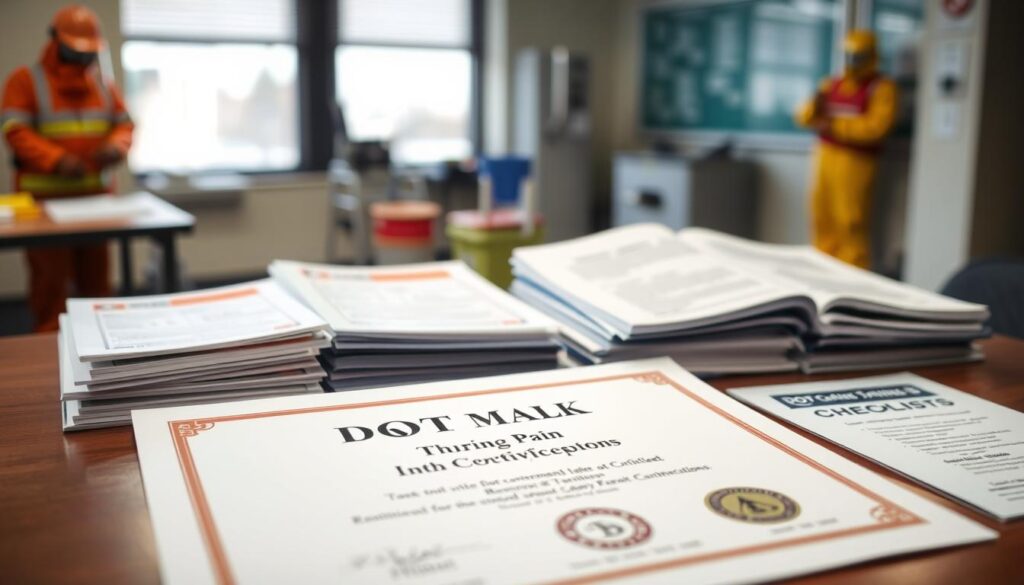
For example, the Function-Specific Labeling course is a two-hour deep dive. It teaches employees how to label packages correctly. This is not just about stickers; it’s about understanding safety labels.
Fred Nugen, a veteran inspector, says untrained employees are a liability. “Those with current DOT hazmat training move with purpose. They know the rules are their armor.”
The certificate from this course is valid for three years. It shows that employees are well-trained. Logistics manager Shaun Bolt calls it a “subscription fee for operating in the modern industrial world.”
So, what does this training landscape actually look like? The table below breaks down the core components. It’s your cheat sheet for building a competent team.
| Training Component | Key Content Focus | Standard Frequency | Critical Notes |
|---|---|---|---|
| General Awareness | Overview of hazmat regulations, hazard classes, and security awareness. | Once every 3 years | Provides the foundational “why” behind all rules. |
| Function-Specific | Hands-on instruction for specific tasks (e.g., labeling, packaging, paperwork). | Once every 3 years | Must be tailored to the employee’s actual job duties. |
| Safety Training | Emergency response, personal protective equipment, and accident mitigation. | Once every 3 years | Often the most overlooked, yet most critical for incident response. |
| Modal-Specific (e.g., IATA) | Detailed rules for air, ocean, or international highway transport. | Every 2 years (Air) | Required if your shipments use these specific modes of transport. |
This structure is not meant to burden you. It’s designed to protect you. The DOT hazmat training regimen is the ultimate intellectual armor against fines, accidents, and catastrophic failure. It turns your team from possible problems into the heroes of the supply chain. Don’t just comply. Empower.
Procurement checklist for compliant shipments
Think of this as your pre-flight checklist for the nuanced world of hazardous materials. After this deep dive, you don’t just buy stuff. You orchestrate a compliant shipment.
First, interrogate the Safety Data Sheet. Does it reveal a hidden hazard class? Your mission starts with pinpointing the correct Proper Shipping Name and its associated UN numbers. This is your material’s passport.
Next, decode the packing group. Is it I, II, or III? This Roman numeral isn’t just decoration. It dictates the fortress-like strength your packaging must possess.
Now, assess your quantity. Does your shipment volume qualify for a limited quantity exception? This regulatory loophole can simplify your life, but only if you meet the strict criteria.
Lastly, plan your visual signals. Have you sourced the right hazard labels? For larger shipments, are the correct placards arranged for your carrier? These are non-negotiable billboards for safety.
This checklist is your debrief. It turns abstract rules into a series of pointed questions. You move from passive purchaser to an active, analytical shipper. Your new procurement superpower is seeing the hazard behind the product.