


The chemical supplier qualification process shouldn’t be a game of chance. It should be clear and fair.
One bad spec sheet or a batch recall can turn “close enough” into a deadly standard. This is not just a quality issue; it’s a matter of life and death.
The 150 deaths from tainted heparin weren’t just a story. They were a result of failing to check the source properly.
This isn’t just about following rules. It’s the foundation of your entire product line.
We’re going to explore the whole process. From the start to the end, with a critical eye on COAs.
This guide will help you move past unclear SDS documents. We aim for real quality assurance.
Think of it as doing your homework. It’s about making sure your products are safe and work well.
Scandals like the glycerine contamination show a harsh truth. Often, patient safety comes down to paperwork.
So, let’s focus on being thorough. Let’s find out who is a reliable partner and who is a risk.
Pre‑bid requirements: SDS currency, COA format, spec tolerances
The pre-bid stage is where dreams meet reality. It’s all about three key documents. Think of it like a first date where you check for ID, a clear story, and boundaries. Get any wrong, and you’re in for trouble.
Companies often overlook an Safety Data Sheet that’s too old. SDS currency is essential. An outdated SDS means they might not keep up with safety and rules.
The APIC Guideline says start with the basics: product name and specs. If they can’t provide a current SDS, how can you trust their quality?
The Certificate of Analysis is next. Is it clear or confusing? A good COA tells you what’s in the batch. The APIC Guideline says specs must be checked by analytical testing. If the COA is unclear, how can you trust it?
You need a COA that lists parameters, test methods, results, and clear limits. No mystery. This is your proof of quality before the product ships.
Spec tolerances are critical. “Pharmaceutical grade” means something specific. Vague specs lead to problems.
You must set clear, measurable tolerances. It’s like setting criteria in a test. Is the purity 99.5% or 99.5% ± 0.5%? That small difference can make a big difference.
Here’s a quick guide to spot the pros during your pre-bid review:
| Requirement | Red Flag 🚩 | Green Flag ✅ |
|---|---|---|
| SDS Currency | Revision date > 3 years old; generic supplier name. | Current (within 1 year); specific manufacturer contact info. |
| COA Format | Non-standard format; missing test methods or batch numbers. | Structured, with clear columns for spec, result, and method. |
| Spec Tolerances | Vague statements like “high purity” or “meets standard”. | Numerical ranges with defined limits (e.g., 98.0–100.5%). |
Meeting these pre-bid requirements does more than filter suppliers. It sets a high standard. It shows you’re looking for a partnership, not just a low price. Skip this, and you’re risking your supply chain.
Regulatory confirmations: TSCA status, REACH/SVHC, RoHS (if applicable)
Asking a supplier for their TSCA status without proof is like asking a stranger for their horoscope and expecting investment advice. It’s a gesture of faith, not a due diligence strategy. In the global chemical bazaar, regulatory confirmations are your non-negotiable passport. Without the right stamps—TSCA, REACH, RoHS—your shipment isn’t just delayed; it’s permanently grounded.
This isn’t about bureaucracy for its own sake. It’s about market access. As the GMP Lab Article highlights, aligning with these frameworks is a cornerstone of initial supplier evaluation and risk-based classification. Non-compliance here doesn’t just cause a headache; it builds a wall between your product and your customer.
We must move beyond the supplier’s “trust me bro” assurance. We need auditable, documented proof. Let’s break down this compliance cocktail.
TSCA Status: The U.S. Gatekeeper
Think of the Toxic Substances Control Act (TSCA) as the EPA’s guest list for the U.S. chemical party. If your substance isn’t on the TSCA Inventory, it’s not getting past the bouncer. A supplier’s verbal “yeah, it’s listed” is worthless.
You need the TSCA Accession Number or a signed certification stating the substance is listed for your intended use. This isn’t a minor detail. It’s the foundational permit for doing business in the United States. Verifying this is your first, non-negotiable move.
REACH & the SVHC List: The EU’s Expanding Universe
While TSCA manages a U.S. inventory, the EU’s REACH regulation is more like an active, expanding universe. Registration, Evaluation, Authorisation, and Restriction of Chemicals is a living system. Its most notorious feature is the Substances of Very High Concern (SVHC) list.
This list grows like a celebrity gossip column—new entries are added regularly. The APIC Guideline rightly folds REACH compliance into the “Assurance of Supply” assessment. Your ask is simple but critical: a formal declaration confirming the substance is either registered under REACH or exempt, and a statement on its SVHC status (if any, and above the 0.1% w/w threshold).
Assume nothing. A substance not in compliance with REACH is a one-way ticket to a blocked European border.
RoHS: The Electronics and Medical Device Filter
If your world involves electrical and electronic equipment or certain medical devices, the Restriction of Hazardous Substances (RoHS) directive is your filter. It’s not about inventory; it’s about purity. RoHS restricts specific heavy metals and flame retardants (like lead, mercury, cadmium).
Your supplier must provide a RoHS compliance certificate or a detailed material declaration. For high-risk components, you might need test reports from an accredited lab. This isn’t an optional accessory. It’s a market-access requirement for selling in the EU, China, and many other regions that have adopted similar rules.
Keeping these three giants straight is a job in itself. The table below is your quick-reference playbook.
| Framework | Governing Region | Core Focus | Key Documentation | Your Verification Ask |
|---|---|---|---|---|
| TSCA | United States | Chemical Inventory Listing | TSCA Accession Number; Signed Certification | “Provide the TSCA listing proof for this substance and use.” |
| REACH (SVHC) | European Union | Registration & Hazard Management | REACH Registration Number; SVHC Declaration | “Confirm REACH registration status and provide an SVHC declaration for this batch.” |
| RoHS | EU (Global Adoption) | Restriction of Specific Substances | RoHS Compliance Certificate; Material Declaration | “Provide a RoHS compliance certificate for all components in this material.” |
The consequence of skipping these steps is stark. Regulatory bodies don’t accept ignorance. A missing REACH registration or a RoHS non-conformance can trigger recalls, fines, and a very public loss of market access. Your supplier’s paperwork is your first and best line of defense. Treat it with the seriousness it deserves.
Packaging options: UN‑rated drums/IBCs, closures, tamper‑evidence, liners
Choosing packaging for hazardous materials is more than picking a container. It’s about creating a plan to protect your goods. The APIC Guideline focuses on keeping your supply chain safe. Your packaging is a system that must follow the law, protect your goods, and prevent fraud.
If you get it wrong, even the best quality control won’t save your batch. It could become a footnote in a regulatory report.
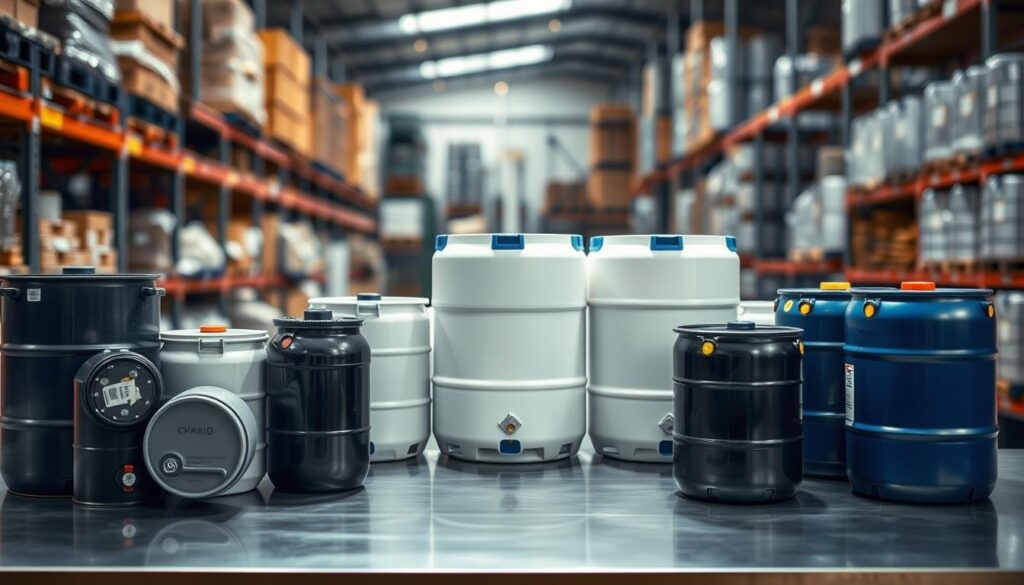
Let’s break down this unsung hero—or possible flaw—into its key parts.
The Vessel Itself: UN-Rated Drums & IBCs
A UN rating on a drum or Intermediate Bulk Container (IBC) is not optional. It shows the container has passed tough tests for stacking, pressure, and leakage. Think of it as the container having a PhD in containment.
The choice between UN-rated drums and IBCs depends on volume, handling, and cost.
| Feature | UN-Rated Steel Drum (e.g., 55 gal) | UN-Rated IBC (e.g., 275-330 gal) |
|---|---|---|
| Primary Advantage | Rugged, widely accepted, good for smaller batches or high-value materials. | Space and cost-efficient for large volumes, often designed for easy discharge. |
| Closure System | Typically a bolted ring with a gasket. Integrity lives or dies here. | Complex valve and lid assembly. More points for possible failure—or superior sealing. |
| Tamper-Evidence | Seals applied to the ring bolt are standard. | Requires seals on valve handles and lid latches. A multi-point security system. |
| Ideal Use Case | High-purity, sterility-sensitive, or diverse product portfolios. | High-volume, single-product shipments where logistics are streamlined. |
The Seal: Closures and Tamper-Evidence
The most robust UN-rated drum is useless with a bad closure. I’ve seen closures fail, like a screen door on a submarine. Your spec must dictate the closure type—bolted ring, lever-lock, tri-sure—and the gasket material compatible with your chemical.
Tamper-evidence is your detective control. Numbered seals, void labels, or frangible closures provide visible proof of integrity from the vendor’s dock to yours. It’s a powerful deterrent against diversion, adulteration, or simple curiosity. In supply chain security, what gets monitored gets respected.
The Inner Sanctum: Liners
Liners are the silent guardians. A properly specified liner acts as a barrier between your product and the container wall, preventing contamination, moisture ingress, or chemical interaction. For sensitive materials, they are non-optional. They also facilitate complete product discharge, saving money and reducing waste. The type—polyethylene, fluoropolymer, foil—is a direct function of your chemical’s properties.
Specifying packaging is where your quality agreement meets the road, literally. It demands a holistic view: the UN-rated vessel for legal transit, the engineered closure for a hermetic seal, the tamper-evident feature for chain-of-custody, and the liner for purity. Overlook any one, and you’re not just buying a container—you’re writing an invitation for that hazardous material incident report.
Logistics and Incoterms; temperature or hazmat constraints
Logistics turns supplier checks into a real challenge. You’ve checked the chemistry, approved the packaging, and confirmed the rules. Now, you need to get it from their place to yours without trouble.
Incoterms are three-letter codes that show who handles problems at customs. Is it EXW (Ex-Works, where you own the problem) or DDP (Delivered Duty Paid, a full-service option)? The choice affects risk, responsibility, and who pays for problems.
Materials that need special care face their own challenges. The APIC Guideline says to check distribution chains and ensure controls for transport. Will your product survive a hot day in a Houston warehouse? Does humidity matter more than cost?
Shipping hazardous materials is complex. They need special paperwork and controls. For chemical shipping, detailed guidelines are key. Missing a form can delay your shipment and stop production.
MOQ, or Minimum Order Quantity, is a big issue. It’s the supplier’s way of saying, “You can’t buy just a little.” MOQ affects pricing and storage space. A high MOQ might save money but could turn your storage into a chemical collection.
Lead and delivery times are promises that build trust. A supplier with great quality but unreliable shipping is not reliable. The APIC framework treats logistics info as important, not just paperwork.
To handle these terms well, map the whole journey from start to finish. Know every step, every temperature change, and every customs stop. Then, ask: where are our weak points? Could a different Incoterm or a higher MOQ help?
The aim is not to avoid all problems. It’s to know them so well your supply chain can handle them. When the next crisis comes, you’ll be ready with solutions.
Quality agreements: change control, non‑conformance, CAPA, recalls
A quality agreement is like a prenup for your supplier relationship. It’s about setting rules when things change. It’s not about distrust, but about being clear when things shift.
The APIC Guideline says a Quality Agreement is needed for suppliers of certain products. Skipping this is like ignoring the game rules. You might play, but you won’t win.
So, what makes a simple memo into a strong agreement? It’s the specific rules that cover all possible issues.
The Change Control Clause: Your Early-Warning System
Your supplier wants to change a step in making your product. Sounds good, but what if it changes your product’s key features? A good change control clause makes them tell you before making any changes.
Then, you check if the change is okay. This stops a good idea from becoming a big problem.
Non-Conformance: The Playbook for When Things Go Sideways
A batch fails a test. Time is running out. Without a clear plan, you’re stuck in a mess. A good agreement has rules for quick action, who does what, and how to handle bad batches.
This turns a mess into a team effort.
CAPA: Fixing the Root, Not Just the Symptom
CAPA is where quality really happens. Your agreement should say how fast you need to find and fix the problem. Is it 30 days? 60? Being vague here can lead to ongoing problems.
This clause makes sure a problem doesn’t keep happening.
Recall Protocols: The Nuclear Option
When a product might be bad, hope isn’t enough. A recall clause has rules for talking, deciding, and who pays. In a crisis, being clear and fair is key.
Here are the key parts of a strong quality agreement:
- Change Control: Notice and approval for any changes.
- Non-Conformance Reporting: Timelines for telling you, checking, and getting rid of bad stuff.
- CAPA Timelines: Deadlines for finding and fixing the problem.
- Recall Procedures: Rules for pulling products, who does what, and who pays.
- Audit Rights: Your right to check their quality work anytime.
In the end, a quality agreement makes your relationship stronger. It’s a smart move that protects your product, patients, and your peace of mind.
Shelf life, storage class, and rotation guidance from vendor
Checking a material’s shelf life is more than just looking at a date. It’s about understanding the science behind it. This advice from vendors is key to managing your stock well. It’s as important as any part of your supplier checklist, as APIC guidelines suggest.
Without this advice, managing your stockroom feels like digging through old layers. You’re hoping to find something good.

Decoding the Shelf-Life Claim: Data or Guesswork?
Is that expiration date based on real science or just a guess? I’ve seen dates that seemed more like guesses than facts. You need to ask for the proof.
For important items like microbiological media, shelf-life documentation is a must. It shows the material works as promised until the date says so. Ask your vendor: Is this from real testing or just a guess? The answer shows if they’re reliable or not.
Beyond “Store in a Cool, Dry Place”
General storage tips are a warning sign. Tips that work for bananas and drugs are not good enough for GMP rules. You need specific advice.
Your vendor should give you exact details:
- Exact temperature range (e.g., 15-25°C, not “room temperature”)
- Maximum relative humidity tolerance
- Light exposure restrictions (e.g., protect from UV)
- Any special atmospheric requirements (inert gas, etc.)
This detailed advice is key to keeping materials quality high. It turns vague tips into strict rules.
The Rotation Imperative: FIFO or FEFO?
FIFO is common in grocery stores. But for quality chemicals, FEFO is better. The difference is big.
FEFO means using the oldest items first, no matter when they arrived. Your vendor should suggest this, and you must follow it. Using FEFO makes your inventory system more than just a record. It becomes a quality check.
By treating shelf life, storage, and rotation advice as part of your quality agreement, you make your material management science-based. You’re not just storing chemicals; you’re keeping them safe from start to finish.
Documentation pack: lot traceability, batch certs, labels, freight docs
If your chemical shipment were a spy novel, the documentation pack would be the dossier of classified operations. It’s not just a stack of paper. It’s the legal, technical, and logistical biography of every drum and tote. Missing one page can ruin the whole mission.
Regulators like the APIC Guideline treat this pack with great care. Why? Because in an audit, this paperwork is your only defense. It’s the link from the reactor to your dock. Break that link, and you’re in trouble.
Let’s break down this essential dossier. Think of it as a four-act play where every document has a starring role.
The Cast of Critical Documents
Act I: The Birth Certificate (Lot Traceability)
This is the origin story. Full traceability means you can track a batch back to its exact manufacturing date, reactor, and even the raw material lot. It’s the unbroken chain of custody. For GMP audits, this isn’t just nice. It’s essential. A missing link here is like a novel missing its first chapter—the rest of the story is unbelievable.
Act II: The Diploma (Batch Certificate & COA)
The Certificate of Analysis (COA) is the chemical’s diploma. It proves it passed all its tests. It lists every spec—purity, impurities, density—and confirms it meets your tolerances. The batch certificate is the official seal. Together, they shout, “This material is qualified.” An inconsistent COA is a red flag the size of a billboard.
Act III: The Nametag (Labels)
The label is the chemical’s public identity. It must match the COA and SDS exactly. Correct product name, lot number, hazard symbols—everything. A wrong label isn’t a clerical error. It’s an identity crisis that can cause serious safety and compliance issues down the line.
Act IV: The Travel Itinerary (Freight Docs)
The bill of lading, packing list, and any hazardous material declarations are the travel logs. They tell you how the material got to you, under what conditions, and who was responsible. For temperature-sensitive or hazardous materials, these documents are your proof of proper handling.
Building Your Audit-Ready Narrative
Your goal is to turn this pile into a coherent story. Demand these documents from your supplier before the shipment arrives:
- Certificate of Analysis (COA) for the specific batch
- Safety Data Sheet (SDS) in the correct format and language
- Batch Certificate with full traceability information
- Commercial Invoice and Packing List
- Bill of Lading and any Transport Emergency Cards (for hazmat)
- Certificate of Origin, if required
The SDS deserves special mention. It’s the safety manual for everyone handling the chemical. An outdated or incorrect SDS isn’t just a paperwork flaw—it’s a genuine safety risk.
Store this pack digitally. Link supplier records directly to each batch’s documentation. When an auditor asks, you should be able to pull the entire life story of any lot in under a minute. That’s not just compliance. That’s control.
In the end, a perfect documentation pack does more than satisfy a checklist. It tells a complete, unassailable story of quality from start to finish. Make that your standard.
Scorecarding suppliers and site audits
A supplier audit should be like a deep investigation, not a tour. The fancy lobby and scripted talks are just a show. Your task is to find the real action happening behind the scenes.
This is when you really see if a supplier meets the standards. A simple walk-through is not enough. It’s called audit tourism. It’s good for your travel stories but not for checking risks.
To find the truth, think like a detective. Don’t just stick to the plan. Ask to see the hidden stuff: like the log of mistakes, maintenance records, and where raw materials are kept. Talk to the workers, not just the quality team. You want to know how things really work, not just what they say.
A strong supplier audit scorecard is your best tool. It turns complaints about late deliveries or unclear papers into clear data. A good scorecard helps improve suppliers by making quality clear to everyone.
| Aspect | The Audit Tourism Checklist | The Forensic Audit Checklist |
|---|---|---|
| Focus | Documentation completeness, facility cleanliness | Process robustness, deviation trends, CAPA effectiveness |
| Evidence | Provided samples, standard operating procedures | System data logs, employee interviews, unannounced spot-checks |
| Risk Assessment | Generic, based on supplier size | Specific, based on product criticality and historical performance |
| Outcome | A “Satisfactory” stamp and a follow-up in two years | A detailed action plan with clear CAPA timelines and ownership |
Creating a good supplier scorecard means focusing on what’s important. It should mix past actions with future signs. The APIC Guideline on Ongoing Monitoring and Evaluation supports this mix of metrics.
Scorecard categories often include:
- Quality Performance: Right-first-time rate, batch rejection rate, critical deviation frequency.
- Delivery Reliability: On-time-in-full (OTIF) percentage, lead time consistency.
- Responsiveness: Time to answer queries, time to resolve non-conformances.
- Improvement Culture: Proactive communication of issues, participation in continuous improvement projects.
This system isn’t static. The APIC framework suggests regular re-audits based on risk and performance metrics. Top suppliers might get less frequent audits. Troubled ones need more checks.
The last step is to act on what you find. Every audit finding and scorecard result should lead to action. Agree on fixes with deadlines. Then, track them. This cycle of audit, score, act, and re-audit makes quality ongoing.
A great supplier audit scorecard is more than a report. It’s a way to work together. It turns audits into a chance for growth and shared success.
Sample RFP clauses and acceptance checklist
Theory is for textbooks. Your supply chain lives in the real world of purchase orders and dock receipts. All our prior analysis crystallizes here, in the ink on the contract.
Think of sample RFP clauses as your purchasing DNA. They bake requirements for SDS currency, RoHS status, and quality agreements directly into the vendor’s obligation. Resources like the APIC Guideline Appendices offer proven templates—a Supplier Selection Check List and Due Diligence Check List provide the skeleton.
Your acceptance checklist is the field manual. It transforms vague promises into binary pass/fail criteria for packaging, documentation packs, and batch certs. This is your actionable roadmap, inspired by clear test plans from equipment qualification. It’s the cheat sheet that cuts through the fog.
A robust supplier qualification checklist is not a one-time event. Qualification is a verb, a process of continuous, enlightened scrutiny. Consider these sample clauses and your checklist the final exam. Luckily, we just provided all the answers.