


Every safety professional knows the Safety Data Sheet is a critical foundation. It holds the essential hazard data for the chemicals you use.
But here’s the reality. That document is just the starting point. Relying on it alone creates a dangerous gap.
Theoretical hazard knowledge does not automatically become safe, practical action on the shop floor or in the lab. This gap leads to inconsistent practices, higher risk, and serious compliance vulnerabilities.
A true chemical management system must go beyond basic awareness. It integrates GHS classifications, storage rules, and PPE prompts directly into daily work instructions.
Knowing the hazards is a fundamental “do.” The empowering step is turning that knowledge into specific, enforced procedures for each unit operation.
This proactive SDS implementation bridges static data with dynamic, task-specific controls. It builds a safer, more efficient, and audit-ready operation from the ground up.
Why SDS Alone Isn’t Enough: bridging to procedures
The gap between hazard data on an SDS and practical shop-floor controls is where real safety is built. A Safety Data Sheet is a vital source of truth. It tells you a chemical is flammable, corrosive, or toxic. But it doesn’t tell your team how to work with it safely during a specific unit operation.
Think of an SDS as a component manual. It lists the properties and dangers of the material itself. Turning that data into a safe work procedure is the job of safety leadership. This bridge transforms warnings into a clear roadmap for daily tasks.
Consider a common task: charging a flammable solvent into a reactor. The SDS states the liquid is highly flammable. It does not specify the safe sequence for connecting transfer lines, verifying inert atmospheres, or implementing bonding and grounding. That detailed, step-by-step guidance must come from a site-specific procedure.
This disconnect is why a proactive approach is essential. Supervisors play a key role in building this bridge. As outlined in effective safety programs, supervisory duties include:
- Checking workplaces regularly for unsafe conditions.
- Observing employees for unsafe actions.
- Taking prompt corrective action when hazards are found.
More importantly, they must ensure that Workplace Hazard Assessments (WHAs) and Job Hazard Assessments (JHAs) are updated whenever procedures change. This is the critical link. When a new chemical arrives, its SDS data should trigger a review of all related tasks and their associated controls.
The table below illustrates common disconnects and the necessary bridge actions:
| SDS Section & Hazard Info | Real-World Task Example | Missing Procedural Control | Bridge Action for Supervisors |
|---|---|---|---|
| Section 2: Hazards Identification – “Causes severe skin burns” | Tank cleaning after containing a caustic solution | Specific PPE donning/doffing sequence and emergency rinse station location | Update JHA for tank cleaning to include detailed decontamination steps |
| Section 5: Fire-Fighting Measures – “Water may be ineffective on fire” | Responding to a spill and possible ignition in a blending area | Location of Class B fire extinguishers and spill kit protocols | Conduct a drill using the site’s specific spill response plan and resources |
| Section 7: Handling & Storage – “Keep containers tightly closed” | Daily drum dispensing of a volatile compound | Procedure for using local exhaust ventilation (LEV) during dispensing | Verify engineering controls like LEV are functional and mandated in the SOP |
| Section 10: Stability & Reactivity – “Incompatible with strong acids” | Charging multiple raw materials to a reactor | Charging order and isolation procedures to prevent accidental mixing | Review and validate the batch sheet instructions against the SDS incompatibility data |
Bridging this gap is where safety culture moves from paperwork to practice. The SDS becomes a powerful input, not the final answer. It feeds into dynamic tools like Job Hazard Analyses and Safe Work Permits. These documents translate generic hazards into task-specific engineering controls, administrative rules, and PPE requirements.
By focusing on this bridge, you empower your team. They move from knowing a hazard exists to understanding exactly how to control it during their shift. This proactive stance turns compliance into genuine competency. It sets the stage for the next logical step: mapping specific SDS sections to the real-world controls that keep your people safe.
Map SDS Sections to Controls: 2/3/4/5/6/8/10 in practice
Think of your SDS as a source code. Mapping it to controls is like compiling that code into an operating system. This step turns passive information into active protection.
It’s a direct, section-by-section translation. Each part of the SDS holds the key to a specific type of shop-floor control. The goal is to leave no hazard without a corresponding, documented action.
Let’s break down the critical sections. Section 2 (Hazard Identification) is your starting point. If it lists hazards like flammability or toxicity, it triggers specific permits. For example, a chemical with an asphyxiation hazard directly mandates a formal confined space entry program before any tank work begins.
Section 5 (Fire-Fighting Measures) goes beyond suggesting extinguisher types. It dictates exactly which class of fire extinguisher must be stationed at the blending unit. This information gets written directly into the work instruction.
Section 8 (Exposure Controls/PPE) is your blueprint for personal safety. It feeds into a task-specific PPE matrix. This tells operators exactly what gloves, respirator, and goggles to wear for charging a reactor, based on the stated exposure limits.
This mapping creates a cohesive safety net. It blends SDS data with site-specific resources and engineering realities. Advanced practice integrates this with PSM and HAZOP study outcomes, creating deeply robust work instructions.
| SDS Section | Key Hazard Data | Example Procedural Control | SOP Outcome |
|---|---|---|---|
| Section 2 | Flammable liquid, may form explosive atmospheres | Require hot work permit and atmospheric testing | Formal permit system for tank entry and welding |
| Section 5 | Use alcohol-resistant foam, CO2, or dry chemical | Station a Class B fire extinguisher at the blending station | Work instruction specifies extinguisher type and location |
| Section 8 | Wear chemical-resistant gloves (Butyl rubber) | Provide specific glove type in PPE locker for the task | PPE matrix lists “Butyl rubber gloves” for chemical handling |
| Section 10 (Stability) | Incompatible with strong oxidizers | Implement segregated storage and dedicated transfer lines | Storage SOP defines separation distances and dedicated equipment |

This visual guide reinforces the connection. It shows how abstract data becomes a concrete action plan. The process ensures nothing is lost in translation from the lab to the plant floor.
You move from a generic warning to a specific, actionable step. This is how you build a culture of precise safety. It eliminates guesswork and empowers your team with clear, reliable instructions.
Unit‑Operation Lens: blending, heating, closed transfer, charging to reactors, tank cleaning, confined space work
The most effective safety procedures come from focusing on the job, not just chemicals. This is the power of the unit-operation lens. It turns general hazard data into specific steps for tasks like blending, heating, or tank cleaning.
Operators work with tasks, not data sheets. A task-focused Standard Operating Procedure (SOP) speaks their language. It makes safety immediate and relevant.
Think about charging a reactor with a flammable solvent. The SDS lists flammability and toxicity. A great SOP, written through the unit-operation lens, turns those hazards into real controls.
It requires local exhaust ventilation (LEV) at the charging point. It also details bonding and grounding to prevent static sparks. The SOP will mandate checks for heating system interlocks and list the exact temperature and pressure safety set points.
For tank cleaning, the SDS informs the SOP, but the SOP defines the work. Hazards like vapors and oxygen deficiency dictate the required ventilation rates. They trigger the need for a full confined space entry permit, atmospheric testing, and standby personnel.
This task-centric thinking applies to every unit operation:
- Blending: SDS health hazards drive LEV design for powder addition points and procedural controls for sampling.
- Heating: Flammability data sets the parameters for temperature interlocks and pressure relief devices—key engineering controls.
- Closed Transfer: Toxicity information justifies using pump-and-pipe systems instead of open containers, containing the hazard at its source.
- Confined Space Work: This is a task defined by its controls—permits, ventilation, and rescue plans—all informed by the SDS of chemicals previously used in the space.
Procedures from sources like chemical fume hood manuals show this lens. They don’t just say “use ventilation.” They instruct on sash position, equipment placement, and daily airflow checks. This turns a general engineering control into a step-by-step work practice.
Lockout/tagout procedures for equipment maintenance are pure unit-operation thinking. They provide the specific steps to control hazardous energy during a task, keeping the worker safe.
| Unit Operation | Key SDS Hazards (Sections 2/3/4/5/6) | SOP Control Requirements (Engineering & Procedural) |
|---|---|---|
| Charging to Reactors | Flammable liquids, toxic vapors | LEV at charge point, bonding/grounding cables, inert padding, temperature/pressure interlocks verified |
| Tank Cleaning | Vapors, oxygen displacement, skin irritants | Forced-air ventilation system, confined space permit, atmospheric monitoring, supplied-air respirator protocol |
| Blending | Dust explosibility, skin sensitization | Dust collection system, closed transfer for powders, defined sampling procedure with PPE |
| Heating Operations | Thermal decomposition, high vapor pressure | High-temperature interlock, pressure safety valve, secondary containment for possible release |
| Confined Space Entry | Chemical residues causing toxic or flammable atmospheres | Permit system, continuous ventilation, attendant posted, rescue equipment on standby |
Adopting this lens is empowering. It moves safety from a paperwork exercise to an integral part of the job. When an SOP is built around the unit operation, compliance becomes natural because the procedures are practical and clear.
You bridge the gap between the SDS and the shop floor. The result is a safer, more confident operator and a more resilient process.
Engineering Controls: LEV, dilution ventilation, interlocks, bonding/grounding, temperature/pressure safeties
Turning SDS exposure limits into fume hood specs is key. Engineering controls are your first and most reliable line of defense. They remove or reduce hazards at the source, before a worker ever needs to rely on protective gear.
Start with ventilation. The exposure limits in SDS Section 8 aren’t just numbers for a file. They are the blueprint for your Local Exhaust Ventilation (LEV) or dilution ventilation system. If a process generates toxic or flammable vapors, your SOP must specify using a fume hood or other LEV. The SDS data tells you the capture velocity and airflow rate needed to keep operator exposure below the limit.
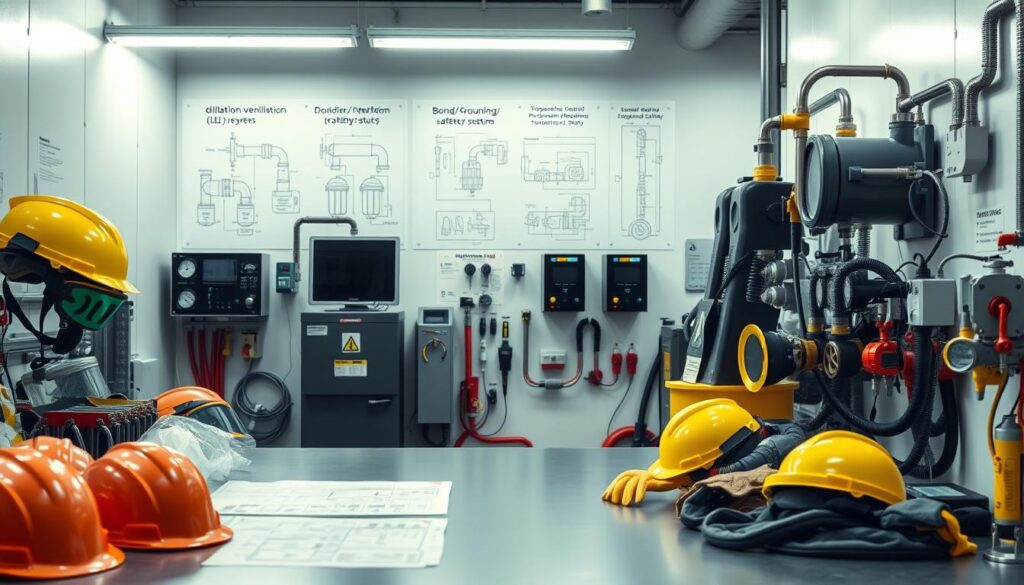
Flammability data from SDS Sections 2 and 9 demands concrete actions. Transferring liquids like solvents requires bonding and grounding procedures written directly into the SOP. This prevents static discharge that could ignite vapors. It’s a non-negotiable engineering control for safe material handling.
For automated safety, look to SDS Section 10 on stability and reactivity. This information justifies integrating fail-safes into your equipment. Chemical batching system interlocks prevent wrong-lot pulls and over-pours. Pressure relief valves and temperature controllers become critical guards against runaway reactions.
These controls create a smarter layer of protection. They work automatically, 24/7. Think of them as your always-on safety team. Energy Control (Lockout/Tagout) for maintenance, as outlined in standards like Appendix F, is another prime example. It physically isolates energy sources to guarantee zero mechanical movement during repairs.
Integrating these controls into your shop-floor SOPs elevates your entire safety program. They become the referenced standards for each unit operation. This robust foundation then informs your PPE matrix, which becomes a final, complementary layer. A strong PPE matrix is built upon the bedrock of solid engineering controls.
Your goal is to design hazards out of the process. When that’s not fully possible, you engineer barriers that stand between the hazard and the worker. This proactive approach is more effective and reliable than relying solely on human behavior and protective equipment.
PPE Selection with breakthrough time and decontamination considerations
Protecting workers means choosing PPE based on chemical data, not just general advice. This careful selection turns safety gear into a strong defense. It shows real care for those doing the work.
Your Safety Data Sheet is key for this detailed work. Section 8 gives a starting point, but the real magic is in matching it with task length. For chemical-resistant gloves, the key is breakthrough time.
Breakthrough time shows how long a chemical takes to get through a glove. A glove good for five minutes might not last two hours. Source 3 says to pick gloves that resist the chemical you’re using.
Create a PPE matrix for each task. It’s more than just listing “gloves, goggles.” Your matrix should include:
- Chemical & Concentration
- Specific Task (e.g., charging powder, tank cleaning)
- Recommended Glove Material (e.g., Nitrile, Butyl, Viton)
- Manufacturer’s Rated Breakthrough Time
- Mandated Glove Change Frequency (set well before breakthrough)
- Required Other PPE (apron, face shield, respirator)
This matrix is part of your SOP. Workers need to know what to wear and for how long. Source 2’s training on PPE limits is key.
Donning and doffing procedures are critical. Removing a contaminated glove wrong can spread hazards. Train workers on safe removal and disposal. Source 1 suggests using digital checklists for reminders.
Decontamination is key with PPE selection. SDS Section 2 gives data on skin effects. This guides your emergency response.
If a chemical irritates or corrodes skin, your SOP must include:
- Exact Location of the nearest emergency shower and eyewash.
- Required Flush Duration (typically 15-20 minutes).
- Procedure for Washing after routine contact, as per Source 3’s rule to wash skin promptly.
Put these steps into your spill plans. A small splash on a glove isn’t just a wipe-and-go event. It starts a decontamination sequence. This protects the worker and prevents secondary contamination.
A good safety culture has clear, backed-up rules. When workers understand the why behind the glove type and the 15-minute shower time, they follow better. They feel cared for. You move from handing out equipment to delivering a verified, durable shield for their entire shift.
This level of detail, fueled by SDS data, turns PPE from a cost into a cornerstone of your operational integrity. It ensures that when a spill plans activation is needed, the human element is already protected by foresight and precise planning.
Spill and Fire Response aligned to Section 5/6 with site resources
A Safety Data Sheet tells you what hazards exist. A well-crafted SOP tells your team what to do when those hazards become emergencies. Generic SDS instructions for spills and fires are a starting point. But they lack the critical, site-specific details that empower fast, confident action.
True operational safety requires translating SDS Sections 5 (Fire-Fighting Measures) and 6 (Accidental Release Measures) into clear, location-aware procedures. This SDS to SOP mapping transforms vague guidance into a precise playbook.
Your SOP must answer specific questions an operator will have during a crisis. For a spill, the SDS may list “contain and collect.” Your SOP must specify:
- The exact type and size of spill kit required (e.g., “Universal absorbent kit for 5-gallon liquid spills”)
- Its precise location (e.g., “Wall-mounted next to Reactor B”)
- When to initiate evacuation (e.g., “If vapor cloud extends beyond secondary containment”)
- Internal emergency contacts, not just 911 (e.g., “Notify Plant Supervisor at ext. 555 and EHS Officer at ext. 702”)
This approach aligns with fundamental safety rules, like knowing the location of spill kits and fire extinguishers. It turns a reactive instruction into a proactive plan.
For fire response, SDS Section 5 provides chemical-specific advice on suitable extinguishing agents. Your SOP must layer this with your facility’s reality. List the specific class and location of fire extinguishers or suppression systems that match the chemical’s properties. Define clear roles: who attacks a small, contained fire, and who triggers the full alarm.
A robust SDS to SOP mapping for emergencies also integrates your site’s Fire Prevention Plan. It mandates reporting all incidents and near-misses, creating a feedback loop that improves your procedures over time.
Consider this practical mapping exercise:
- SDS Section 5 (Fire): “Use dry chemical, CO2, or foam.” → SOP Action: “Extinguisher Type ABC is located 15 feet from the mixing station. Do not use water.”
- SDS Section 6 (Spill): “Prevent entry into drains.” → SOP Action: “Deploy drain cover from spill kit #3 immediately. Notify maintenance to block floor drains in Bay 2.”
This level of detail bridges lot-specific SDS data to real-world process safety. It ensures that the right resources are used at the right time, minimizing risk and damage.
Ultimately, the effectiveness of these plans hinges on training competency. Workers must be drilled on these specific scenarios, not just general safety principles. Competency records should prove that each team member can locate the designated spill kit, identify the correct extinguisher, and recite the internal notification protocol.
By embedding site resources and clear action triggers into your procedures, you move from hoping your team reacts correctly to knowing they will. This is the power of completing the SDS to SOP mapping for spill and fire response.
Training and competency records: who, when, evidence retained
Creating a strong system for training and checking skills is key to keeping everyone safe. It’s not just about making procedures from SDSs. It’s about making sure every team member can do the job safely.
Good records answer three important questions: who was trained, when, and what they learned. You need more than just a sign-in sheet. You need written proof for each employee, showing what they learned and when.
It’s not enough to just show up to training. You need to prove that people can do the job. This means supervisors watching, tests, or quizzes. The record should show that the employee really got it.
Records must be solid and easy to follow for audits or investigations. You need digital systems that keep everything safe and trackable. This means secure logins, electronic signatures, and a full history of every action.
The table below shows the difference between basic logs and detailed records.
| Record Element | Basic Training Log | Competency & Audit-Ready Record |
|---|---|---|
| Employee Identification | Name only | Unique user ID with electronic signature |
| Procedure Reference | SOP title | Specific SOP number and version |
| Evidence Type | “Attended” checkbox | Linked competency assessment (e.g., pass/fail score, observer sign-off) |
| Data Integrity | Paper form, can be altered | Digital audit trail showing date/time stamp and any changes |
| Retrieval for Audit | Manual file search | Instant report generation by employee, SOP, or date range |
Keeping these records is a big job. You need someone to make sure everything is up to date and safe. This team member will keep your safety records in order.
This whole process makes your safety culture strong and accountable. It shows your team that safety is important, not just a rule. When there’s an incident or an audit, you’ll have a solid story to tell.
Think about your audit checklist. A key item should be, “Can we prove our team is competent?” With this system, you can say “Yes.” This keeps your safety work safe and your culture always improving.
Audit checklist and sample SOP excerpts
Turning SDS data into clear procedures is a big step. A practical audit checklist makes sure everything is in place and working right.
Use this list to check your SOPs for unit operations. Make sure each item is documented and that your team understands it.
- Does the SOP reference the specific SDS name and lot number for the chemical used?
- Are engineering controls like LEV or bonding noted and inspected?
- Is the selected PPE matched to the chemical’s permeation breakthrough time?
- Are spill response steps aligned with SDS Sections 5 and 6 using site resources?
- Is there a record of training for this task, like the safety monitor logs in Source 2?
- Are KPIs, like mock-recall time from Source 1, tracked to measure readiness?
Looking at a model helps. These sample SOP excerpts show how to include SDS details.
Excerpt: Closed Transfer of Solvent X
Step 3: PPE & Preparation – Wear nitrile gloves (Grade Y, per SDS Section 8). Confirm bonding cable is connected (refer to SDS Section 7, handling).
Step 7: Emergency – For a spill, use absorbent pads from Station B (see SDS Section 5 for small spill response).
This audit checklist and sample SOP excerpts give your safety program a solid finish. They show that your controls are real, tested, and ready to protect your people every day.