

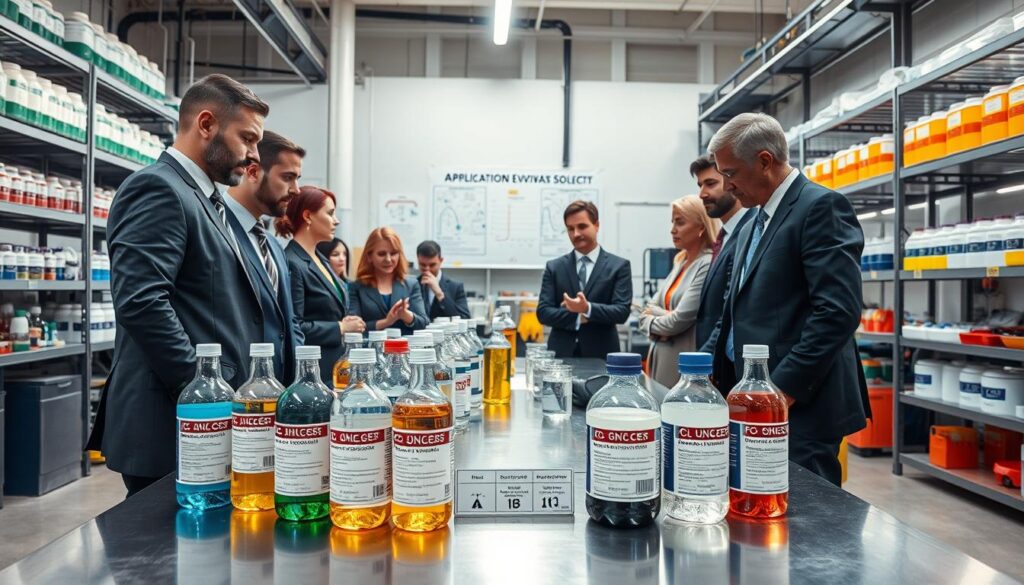
Choosing the right chemical for your production line is a big deal. It impacts how well your equipment works, keeps your team safe, and affects your costs.
This choice isn’t just about finding a strong cleaner. It’s about picking a dissolving agent that fits your specific needs. Whether it’s cleaning metal parts, extracting valuable compounds, or managing heat.
Industrial cleaners come in different types like oxygenated, hydrocarbon, and halogenated. Each type has its own strengths for tasks like precision cleaning or extraction.
Your success depends on several factors. You need to think about the material you’re working with, the application method, and safety and environmental rules.
Storage needs, recovery and reuse options, and total cost are also key. A smart approach to solvent selection can boost your operational performance and meet all standards.
Let’s dive into how a careful solvent selection process can help achieve your manufacturing goals.
Map the Use Case: dissolving, cleaning, extraction, heat transfer, reaction medium
Choosing the right solvent starts with knowing what it needs to do. You wouldn’t use a sledgehammer for a small task. Solvents need a clear purpose to avoid waste and failure.
Manufacturing uses solvents for five main tasks. Dissolving breaks down materials. Cleaning removes dirt and oils. Extraction gets a specific compound from a mix. Heat transfer moves thermal energy. And reaction medium helps chemical reactions.
Each task requires specific solvent properties. By mapping your needs, you create a list of what’s needed. This list guides your search for the right solvent.
Think about metal cleaning, a common task. It has two main types: heavy-duty degreasing and precision cleaning. Degreasing needs a strong solvent to handle thick oils.
Precision cleaning, like for aerospace or medical parts, requires a solvent that leaves no residue. The wrong one can ruin later steps.
Solvents are grouped by their best uses. Knowing these groups helps you start your search more focused.
- Oxygenated Solvents: Like alcohols and ketones. These are good for cleaning and reactions because they mix well with water.
- Hydrocarbon Solvents: Such as aliphatics and aromatics. They’re great for degreasing and dissolving oils and waxes.
- Halogenated Solvents: Including some chlorinated compounds. They evaporate quickly and are safe from flames in certain cleaning tasks.
Doing a detailed use case map is key. It lets you use Hansen Solubility Parameters to check if a solvent will work.
Without a map, finding the right solvent is like building without a plan. It might look good, but it won’t work well. Define your needs clearly to make the selection process better.
Performance Screens: Solubility Models and Key Properties
Performance screening turns finding the right solvent into a science. It starts with understanding your needs. Then, it narrows down choices based on how they’ll work in your process.
By focusing on a few key models and properties, you can pick solvents with confidence. This ensures reliable results in your work.
Understanding Solvency Strength: Hansen and KB Value
Solvency power is key in any screening. It shows how well a solvent dissolves your target material. Hansen Solubility Parameters (HSP) and the Kauri-Butanol (KB) value are two tools for predicting this.
HSP breaks down solvency into three parts: dispersion forces, polar interactions, and hydrogen bonding. Matching these to your solute gives a precise solubility prediction. The KB value, from the Kauri-Butanol test, directly shows a solvent’s ability to dissolve resins and oils. A higher KB value means stronger solvency.
The CHEM21 Solvent Selection Guide uses these metrics. It helps balance solvency with environmental and safety aspects. Understanding this data is a big step toward making a good choice.
Critical Physical Properties for Process Fit
A solvent must also fit your process mechanically and operationally. Here are the key physical properties to screen:
Evaporation Rate: This affects drying time. Fast-evaporating solvents are quick but can be hazardous. Slow ones might delay production.
Viscosity: It impacts flow, pumping energy, and penetration into materials. Lower viscosity means easier handling and better wetting.
Dielectric Constant: Important for applications involving electricity or polar compounds. It shows a solvent’s insulation or electrostatic support ability.
Azeotrope Behavior: Some solvents form azeotropes, constant-boiling mixtures. This can be a big advantage for drying or a challenge for distillation recovery.
Checking these properties gives a full picture of a solvent’s performance in your specific environment.
| Solvent | Evaporation Rate (n-BuAc=1) | Viscosity (cP at 20°C) | Dielectric Constant | KB Value |
|---|---|---|---|---|
| Acetone | 5.7 | 0.32 | 20.7 | >500 |
| Ethanol | 1.7 | 1.20 | 24.3 | ~230 |
| Deionized Water | 0.3 | 1.00 | 80.1 | N/A |
| Toluene | 1.9 | 0.59 | 2.4 | ~105 |
| Ethyl Acetate | 4.1 | 0.46 | 6.0 | ~250 |
This table shows the trade-offs. Acetone is fast and strong but risky. Water is unique. Toluene is good for non-polar uses.
By screening candidates, you narrow down to viable, high-performance options. This data-driven method sets a solid base for further checks on safety, compatibility, and cost.
Safety and EHS: flash/autoignition points, VOCs, exposure limits, aquatic toxicity, waste coding
The history of industrial solvents shows us the importance of EHS. Solvents like methyl chloroform and CFC-113 were phased out due to safety concerns. This teaches us to always consider EHS factors.
Assessing real-world risks is key. It helps ensure your solvent is safe for workers, meets regulations, and doesn’t harm the environment. A detailed review is essential for sustainable and compliant manufacturing.
Fire and Explosion Hazards: Flash Point and Autoignition
Knowing a solvent’s flammability is vital for safety. The flash point is the temperature at which vapors can ignite. A low flash point means a higher fire risk.
The autoignition temperature is even higher. It’s when vapors ignite from heat alone. Understanding both values helps in choosing safe storage, ventilation, and equipment.

Protecting workers starts with Occupational Exposure Limits (OELs). These limits show the maximum safe concentration in the air. Solvents with low OELs need strong controls, like closed systems or better ventilation.
Volatile Organic Compound (VOC) content is also regulated. This is to protect air quality. High-VOC solvents might require expensive equipment to control emissions.
Environmental Impact: Toxicity and Waste
What if a solvent spills or is thrown away? Aquatic toxicity data shows its impact on water life. This affects spill response plans and wastewater treatment.
Proper waste coding is also critical. It’s based on a solvent’s characteristics. Correct coding ensures safe and legal disposal, avoiding fines.
| Solvent Class | Typical Flash Point | VOC Content | Key EHS Considerations |
|---|---|---|---|
| Hydrocarbons (e.g., Heptane) | Low (< 0°F) | Very High | High fire risk, VOC concerns, generally moderate OELs. |
| Alcohols (e.g., IPA) | Mid-Range (~50°F) | High | Flammable, good OELs, biodegradable but regulated as VOCs. |
| Chlorinated (e.g., Methylene Chloride) | None (Non-flammable) | Low | Severe health hazards with very low OELs, possible groundwater contaminant. |
| Acetates (e.g., Ethyl Acetate) | Low (~25°F) | High | Flammable, strong odor, can have moderate OELs. |
| Water-Based / “Green” | None | Very Low | Minimal fire risk, low VOC, focus shifts to additive toxicity and waste treatment. |
Learning from History: Regulatory Drivers
Major solvent phaseouts were driven by EHS data. The Montreal Protocol targeted substances like CFC-113. The EPA’s SNAP program evaluates alternatives for safety.
- The Montreal Protocol: Phased out ozone-depleting chlorofluorocarbons (CFCs) and chlorinated solvents like methyl chloroform.
- EPA SNAP Program: Identifies and approves safer alternatives for use in specific industrial sectors.
- Regional Air Rules: Districts like SCAQMD drive innovation by setting strict VOC limits.
Evaluating the flash point, exposure limits, and toxicity from the start is key. It turns compliance into a strategic advantage. This approach protects your team, community, and operations.
Materials Compatibility: elastomers, seals, coatings, pump wet ends, hose liners
Your solvent must pass a final test: it can’t harm your plant’s parts. Just because it works on paper doesn’t mean it’s safe. Checking for compatibility is key to avoiding costly repairs and downtime.
Test every material the solvent will touch. This includes gaskets, O-rings, coatings, pump parts, and hose liners. Solvents with high VOCs or harsh chemicals can damage these materials.
Even a small leak from a failed seal can be a big problem. Material failure often happens slowly, until it’s too late. Testing upfront saves money and stress later.
Use the table below to understand material interactions. It shows how different solvents affect common plant materials. But remember, every combination is unique, so always test your specific situation.
| Solvent Class | Common Elastomers (Nitrile, EPDM) | PTFE Seals & Liners | Epoxy Coatings | Stainless Steel Pumps | High VOC Risk |
|---|---|---|---|---|---|
| Ketones (Acetone, MEK) | Poor – Rapid swelling | Excellent | Poor – Softens | Good | Very High |
| Chlorinated (Methylene Chloride) | Poor – Degrades | Excellent | Poor | Good (Check for stress corrosion) | Medium |
| Alcohols (IPA, Ethanol) | Fair to Good | Excellent | Good | Excellent | Low to Medium |
| Aliphatic Hydrocarbons (Heptane) | Good | Excellent | Good | Excellent | High |
| Aromatic Hydrocarbons (Toluene) | Poor – Swells | Excellent | Poor | Excellent | Very High |
For more detailed information, check out a chemical compatibility guide. It offers ratings for many chemical and material combinations.
Always test your materials in real-world conditions. Soak a sample in the solvent for 48 hours. Look for any changes in size, hardness, color, or texture. Check for cracks or softening.
Managing VOCs and compatibility is a big challenge. A solvent might be safe but have high VOCs. Or, it might be safe but have high VOCs. You need to find a balance.
This step keeps your operation running smoothly and safely. It protects your equipment and product. A little testing now means reliable performance for years.
Regulatory Fit: TSCA/REACH status, SCAQMD/VOC rules, food‑contact notes where applicable
Choosing a solvent is more than just its performance. It’s about making sure it fits within a complex web of regulations. Ignoring this can lead to fines, shutdowns, or a last-minute substitute.
By checking a few key boxes, you can confidently navigate this landscape. This ensures your operation’s long-term success.
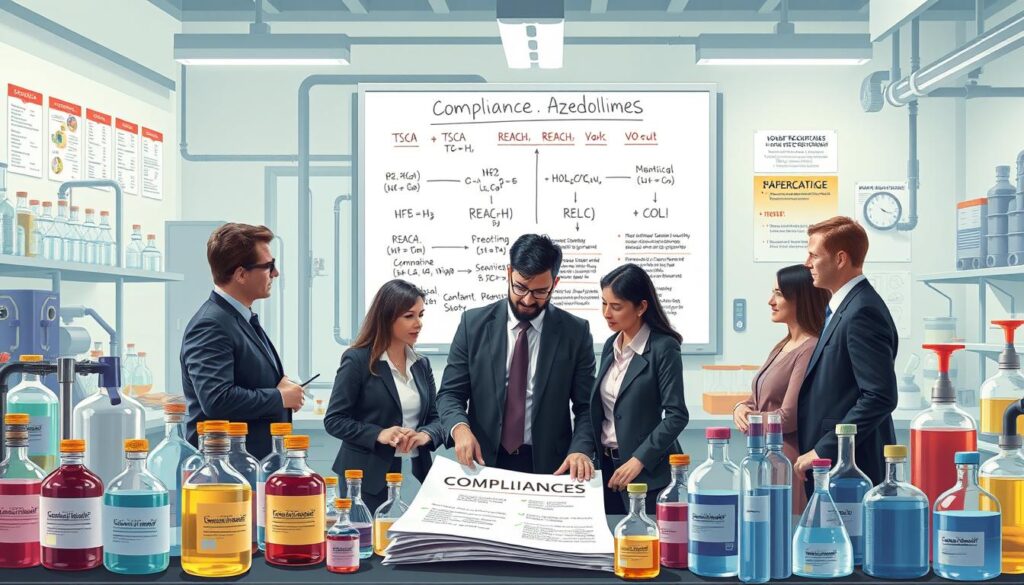
Begin with the basics of chemical legality. In the U.S., the Toxic Substances Control Act (TSCA) is your first stop. Confirm your solvent is on the TSCA Active Inventory. For older substances like certain HCFCs, be aware of phaseout schedules under the Clean Air Act and international agreements like the Montreal Protocol.
For global markets, the EU’s REACH (Registration, Evaluation, Authorisation and Restriction of Chemicals) regulation is key. A solvent approved in the U.S. might need special registration or be restricted in Europe. Always verify the status for each region where your product will be made or sold.
Local air quality rules add another layer. Regions with strict smog controls, like California, have powerful air districts. The South Coast Air Quality Management District (SCAQMD) sets tough limits on Volatile Organic Compounds (VOCs).
Your high-performance solvent might exceed these VOC limits. Checking SCAQMD Rule 1122 and similar regulations is a non-negotiable step for operations in affected areas.
For applications in food processing, packaging, or pharmaceutical manufacturing, the requirements tighten further. Solvents must comply with food-contact regulations. In the U.S., this means adherence to FDA Title 21 CFR. You need to look for specific food-contact notifications or clearances.
Assuming a solvent is safe because it’s used industrially is a major risk. Always get documentation from your supplier.
A special note concerns blended solvents. When you mix chemicals, you create a new substance in the eyes of many regulators. This is true for azeotropes, which behave as a single substance with a fixed boiling point.
The regulatory status of an azeotrope can differ from its pure components. You must evaluate the blend itself, not just the ingredients.
| Regulatory Framework | Key Focus | Primary Geographic Scope | Your Action Item |
|---|---|---|---|
| TSCA | Chemical inventory listing and general use controls. | United States | Verify the solvent is on the TSCA Active Inventory list. |
| REACH | Registration, evaluation, and restriction of substances. | European Union | Check the REACH registration status and any Authorisation List entries. |
| SCAQMD VOC Rules | Limiting emissions of volatile organic compounds to reduce smog. | California’s South Coast Air Basin | Review VOC content limits in relevant rules (e.g., Rule 1122). |
| Food Contact Regulations | Safety of materials that touch food or drugs. | Global (e.g., U.S. FDA, EU EFSA) | Obtain a FDA Food Contact Notification or equivalent compliance letter. |
Treating regulatory fit as a final checkbox is a mistake. It is a foundational part of your solvent selection. Proactive verification protects your investment and keeps your production line running smoothly.
This research empowers you to move forward with confidence, knowing your chosen chemistry is both effective and compliant.
Recovery and Reuse: distillation feasibility, inhibitor carryover, energy balance
Turning a solvent into a reusable asset is key to modern manufacturing. It cuts down on raw material costs and reduces environmental harm. A good recovery plan is essential.
To reuse a solvent, you need to check three things. First, can it be distilled easily? Second, are there risks of inhibitors carrying over? Third, what’s the energy balance? Getting these right makes a closed-loop system that pays for itself.
Starting with distillation feasibility is important. A solvent with a clear boiling point and no azeotropes is best. This makes recovery easy and cheap. But, high-boiling solvents need more energy, affecting costs.
Inhibitor or additive carryover is a big deal. Solvents often have stabilizers to prevent breakdown. But, these can concentrate or break down during recovery. This can change the solvent’s properties in your next production cycle, leading to problems.
The energy needed for distillation versus the cost of new solvent is critical. A good balance means recovery is profitable. This is key to your total cost of ownership.
Use the matrix below to score your solvent’s recovery chance. It looks at technical and green chemistry aspects for a full view.
| Assessment Factor | Key Questions | Low-Risk/High-Potential Indicator | Impact on Green Metrics |
|---|---|---|---|
| Distillation Feasibility | Is boiling point distinct from contaminants? Are azeotropes absent? | Simple, single-stage distillation is sufficient. | Lowers Process Mass Intensity (PMI) by reusing mass. |
| Inhibitor Carryover Risk | Do additives concentrate or degrade upon recycling? | Solvent is pure or uses negligible, non-interfering stabilizers. | Prevents waste from off-spec batches, improving E-factor. |
| Energy Balance | What is the kWh/kg for recovery vs. virgin solvent cost? | Recovery energy cost is | Reduces overall process energy, a key sustainability metric. |
| Closed-Loop Integration | Can the recovered solvent be fed directly back into the process? | Purity meets spec without additional costly polishing steps. | Maximizes resource efficiency and minimizes waste generation. |
This method follows green chemistry principles well. By recycling solvents, you greatly improve your PMI and E-factor. These metrics show waste reduction and resource use. A high recyclability score means you’re using less.
The economic benefits are strong too. You save on buying costs and waste disposal fees. This makes a good investment. Your solvent becomes a circulating capital asset, not a one-time consumable.
When choosing a solvent, think about recyclability. This makes your process more economical and eco-friendly. It’s a big step towards sustainable manufacturing.
Pilot‑to‑Plant: soil/load testing for cleaning, extraction yield curves, fouling checks, heat‑transfer stability
Scaling up from pilot to plant means facing real-world challenges. Your solvent’s performance under constant stress is key. It’s where your solvent truly proves itself.
Testing rigorously at this stage is vital. It helps avoid costly mistakes and ensures your operation starts smoothly. This way, your plant runs efficiently and safely from the start.
- Soil/Load Testing: Lab contaminants differ from real-world soils. Test with actual production residues to check cleaning or extraction efficiency. This step confirms if your solvent and equipment are a good match.
- Extraction Yield Curves: Don’t guess process times. Create detailed curves showing yield versus time at scale. This data helps find the best time for maximum output without wasting energy or solvent.
- Fouling Checks: Watch for residue buildup on heat exchangers and surfaces over extended runs. Early detection prevents costly downtime and maintenance later.
- Heat-Transfer Stability: Check if the solvent’s thermal properties stay consistent in a large, recirculating system. Inconsistent heat transfer can ruin product quality and increase energy costs.
A safety parameter that worked in a lab may not in a large plant. It’s essential to re-evaluate critical data like flash point and VOC emissions under full production conditions. This protects your team and ensures compliance with local air quality rules.
| Test Parameter | Pilot-Scale Insight | Plant-Scale Reality | Key Action Item |
|---|---|---|---|
| Soil/Load Capacity | Cleans a small, controlled sample. | Must handle variable, high-volume soil loads. | Conduct tests with real production waste at full concentration. |
| Extraction Kinetics | Shows basic yield over time. | Time becomes a major cost factor. Curve shape is critical. | Build detailed yield vs. time curves to find the economic optimum. |
| Fouling Potentia | May not be evident in short runs. | Long-term residue buildup can cripple heat exchangers. | Run extended tests and inspect equipment for any film or deposit. |
| Heat Transfer Efficiency | Easily maintained in a small loop. | System volume and flow rates can alter performance. | Monitor inlet/outlet temperatures consistently over a prolonged campaign. |
| Safety Parameters (Flash Point/VOCs) | Measured in a controlled, open environment. | Concentration in enclosed spaces or near ignition sources changes risk. | Re-assess flash point and VOC emission profiles in the actual plant layout. |
Successfully navigating from pilot to plant means turning data into reliable performance. This thorough approach mirrors industry trends toward validated, robust methods. Your reward is a process that delivers consistent quality, maintains safety, and protects your bottom line.
Selection Matrix and sample calculations
The last step in choosing a solvent is to make a decision-making tool. A good selection matrix helps you score and compare solvents. You look at their performance, safety, materials, rules, and cost.
Use frameworks from companies like Pfizer, GSK, and Sanofi. They have green solvent guides. These guides rank solvents based on their environmental and technical performance.
Simple calculations help a lot. You can figure out the Process Mass Intensity (PMI) to see the environmental impact. Also, calculate the true cost per liter, including savings from recycling solvents. This shows the benefits of designing for recyclability.
Your matrix will focus on what matters most for you. For example, a cleaning process might look at evaporation rate and VOC rules. On the other hand, a botanical extraction might focus on yield and toxicity.
This method helps you make a confident choice. It balances technical needs with cost and sustainability. This is the art and science of picking the right solvent for manufacturing.