

Let’s be honest: throwing a chemical at a material without checking is like a blind date with a fire hazard. You wouldn’t risk it in your personal life, so why in your process?
Getting to know your chemical application needs is key. It’s the difference between success and a big failure.
This isn’t just about a chemical name. It’s about the whole story. Things like concentration, temperature, pressure, and how long it’s exposed matter a lot. These details can make a big difference.
Think of it like making a dating profile for your chemical process. We’re looking at more than just the chemical. We’re talking about how much, how long, and under what conditions. Just like a college application needs every detail right, your material choice does too.
This part will show how to start with the right questions for application matching. We aim for success, not disaster.
Core Chemical Properties
Knowing what a material can do is one thing. Seeing how it reacts under chemical stress is another. It’s like the difference between an actor’s headshot and their live performance. The chemicals are your scene partners, and they don’t hold back.
Their interactions with plastics follow three basic scripts:
- Chemical Attack: A direct, corrosive assault that breaks molecular bonds. Think strong acids dissolving a set piece.
- Stress Cracking: A subtle, insidious drama where chemical agents exploit internal stresses, causing cracks to propagate like a bad plot twist.
- Physical Change: The material softens, swells, or gains weight—a literal change in character that ruins dimensional stability.
Your material’s core properties determine which of these scripts it can survive. It’s not just about a generic “chemical resistance” rating. It’s about specific, star-quality traits for the role.
You need to assess its range. Can it handle the intense method-acting of a concentrated acid, or does it only perform well in the light comedy of a mild detergent? The supporting cast of properties is critical:
Hydrolysis Resistance is its composure in a steamy, humid environment. UV Stability is its performance under the harsh spotlight of sunlight. Ozone Resistance tests its cool in a reactive atmosphere. And microbial resistance determines whether it becomes the stage for an unwanted fungal plotline.
Getting this process fit right means matching these properties to your exact chemical media—be it lubricating oils, aromatic solvents, or alkaline solutions. A mismatch here doesn’t mean a bad review; it means catastrophic failure.
Consider the Desmopan® TPU case study. A polyether-based grade might shrug off microbes and hydrolysis with the ease of a seasoned pro, while a polyester-based counterpart could succumb to a soggy, degraded finale in the same environment. The chemical script was the same, but the inherent properties of the materials dictated entirely different endings.
Analyzing core chemical properties isn’t an academic exercise. It’s the director’s cut that shows you whether your material will deliver an Oscar-worthy performance for years or flop on opening day. This deep understanding is what separates a good process fit from a legendary one.
Common Industry Matches
If chemistry were Hollywood, this section would be the casting director’s office. Here, we move from admiring molecules to finding their practical roles. The shift from lab to production line needs more than just compatibility charts. It requires a director’s eye for the right material in the right part.
Chemical blending is when ingredients merge at a molecular level to form new substances. This isn’t just mixing sugar into coffee. It’s creating fertilizers, paints, and soaps with engineered efficiency. The components lose their identity to become something greater.
Consider thermoplastic polyurethane (TPU). It’s a versatile polymer. In lubricated gear assemblies, it shines, stable at high temperatures and unaffected by test oils. But, cast it wrongly, and it fails. Expose it to benzene, and it swells. In DMF, it dissolves completely.
Here, engineering shines by separating from guesswork. We map chemical families to their ideal industrial stages with purpose:
- Aliphatic Hydrocarbons: Reliable character actors. Think mineral oils, hexane. They’re stable and predictable for mechanical parts and processes.
- Aromatic Hydrocarbons: Volatile leading men. Benzene, toluene. They’re powerful but need careful handling. Mis-cast them, and they’ll damage materials.
- Ketones & Esters: Transformative scene-stealers. Acetone, ethyl acetate. They fundamentally alter materials for new functions.
Understanding these matches prevents industrial disasters. A paint formula isn’t just color and binder—it’s a blend where each chemical plays its part. This precision is critical in fields like cosmetic product development, where color and texture depend on material harmony.
The hallmark of good engineering isn’t avoiding failure—it’s anticipating it. Knowing a seal made of TPU will thrive in oil but vanish in DMF is key. Creating a powdered detergent through blending is a different discipline from mixing pre-made components. This knowledge turns properties into a blueprint for success.
So, when specifying a material, ask the casting director’s questions. What’s the real environment? Who are the chemical co-stars? What’s the expected runtime? Getting this match right is more than chemistry. It’s the art of industrial storytelling, where every component performs as written.
Verifying Compatibility
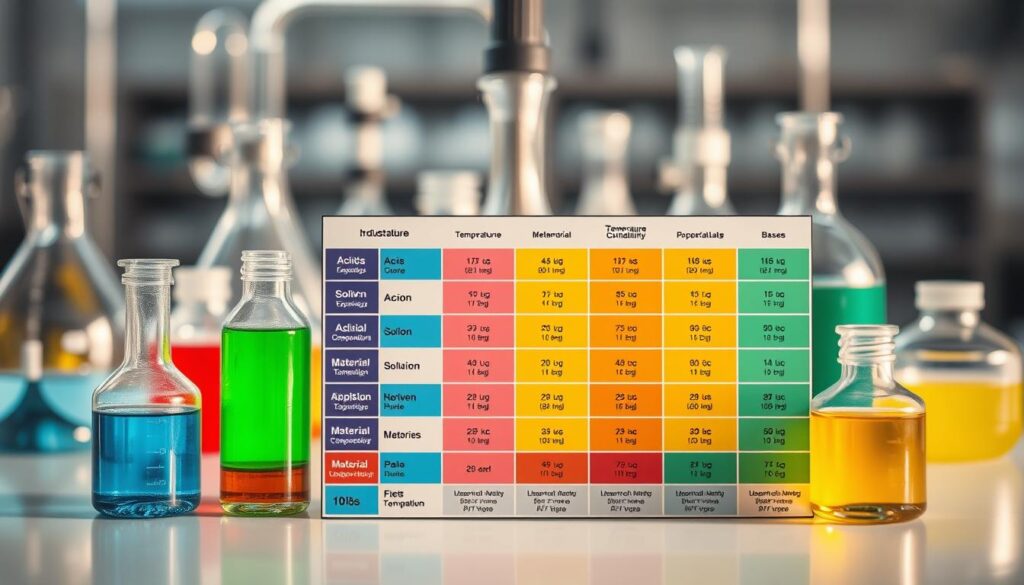
Ronald Reagan’s “trust, but verify” is key for chemical application. A compatibility chart is a good start, like a first handshake. But, you need to do more research before making a decision.
First, understand the chart’s language. It uses letters to show risk levels.
| Rating | Meaning | Real-World Translation |
|---|---|---|
| A – Excellent | No effect, or minor effect. | Blissful inertia. The chemical and material coexist like old friends ignoring each other in a comfortable silence. |
| B – Good | Minor corrosion or effect. | A slight, manageable annoyance. Think of it as a neighbor who plays their music just a bit too loud on weekends—annoying, but not deal-breaking. |
| C – Fair | Moderate effect, not recommended for continuous use. | Here there be dragons. Suitable for short, supervised encounters, but long-term exposure invites trouble. |
| D – Poor | Severe effect, not recommended. | Catastrophic, and often immediate, damage. This is the chemical equivalent of a slap in the face. |
| N/A – Unknown | No data available. | The chart shrugs its shoulders. This is a vote of “no confidence” and your cue to proceed with extreme caution or not at all. |
Using the chart is a three-step dance: find your chemical, compare it to material options, and note the rating. Simple. But, these charts are for an ideal world. They ignore real-world messiness.

Real-world chemicals mix in ways charts can’t predict. Temperature changes can also affect how materials react. And stress cracking can quietly damage materials under tension.
Verification is a multi-act play. Act One is the chart consultation—the necessary background check. Act Two is the controlled sample test. This is where you become a scientist. Before permanent installation, you must test the component with your exact chemicals, under your specific environmental conditions. It’s the difference between reading a restaurant review and actually tasting the food.
This hands-on testing is the only way to answer the questions the chart can’t. It confirms suitability for your unique chemical application. It accounts for the impurities, the pressures, and the temperatures of your real-world operation. Ultimately, the final judgment call rests with you, the user, armed with both the chart’s data and your own empirical evidence.
So, trust the chart’s alphabet. But verify it in your world. That’s how you move from theoretical compatibility to practical, and profitable, operation.
Requesting Technical Support
When your process involves a complex chemical mix, you need expert help. Asking for technical support is not a sign of defeat. It’s a smart move by a project manager who knows some problems need special solutions.
So, what are the warning signs? Look out for “N/A – Unknown” ratings on chemical resistance charts. These are like “here be dragons” warnings. Also, watch for extreme temperatures, big pressure changes, or high chemical concentrations. These conditions make standard data sheets useless.
Services like the Thermoplastics Testing Center (TTC) can be your forensic team. They don’t guess; they test. Their chemical resistance analyses simulate your exact process fit in a lab setting. It’s like a time machine for your material.
What can they find out? Here’s a breakdown:
- Immersion Testing: Your material is tested in the exact chemical mixture it will face. No guesses or “close enough” solutions.
- Stress-Cracking Analysis: This shows how mechanical stress and chemicals affect your material. It’s the double-whammy that often causes failures.
- Long-Term Aging Studies: These tests speed up time to show how your material behaves over months or years. It’s like a fast-forward nature documentary.
Remember, data shows that small changes in temperature, pressure, and concentration can cause equipment failure. Your process fit is dynamic, not static. Small changes can have big effects.
When the TTC suggests special testing, they’re giving you something valuable: certainty. Their data helps you make informed decisions. They turn “probably fine” into “tested and verified.”
Requesting technical support is like insuring your production line. Testing costs less than failure. When your operation’s integrity is at risk, expert analysis is a necessary investment. It prevents industrial disasters.
Getting the right process fit confirmed through testing means you’re not just hoping for success. You’re engineering it with evidence. In the world of chemical applications, this is the difference between success and failure.
Conclusion
So, what did we learn from our chemical compatibility journey? It’s not just about memorizing charts. It’s about understanding a material’s true nature under pressure. This is where data and intuition come together.
Think of that compatibility chart as a guide, not a strict rulebook. Chemical blending is key in many industries, from medicine to paint. Choosing the right components is what makes a project succeed or fail. This is the heart of practical engineering.
A good match is like a Teflon seal in a corrosive environment. It works so well, you forget it’s there. A bad match, on the other hand, fails loudly and at a high cost. The aim of smart engineering is to make the complex seem simple.
Your path from knowing a chemical’s name to using it effectively combines science and art. Master this blend. The goal is not just to make something work. It’s to make it work so well, its engineering becomes invisible. That’s where true value lies.