

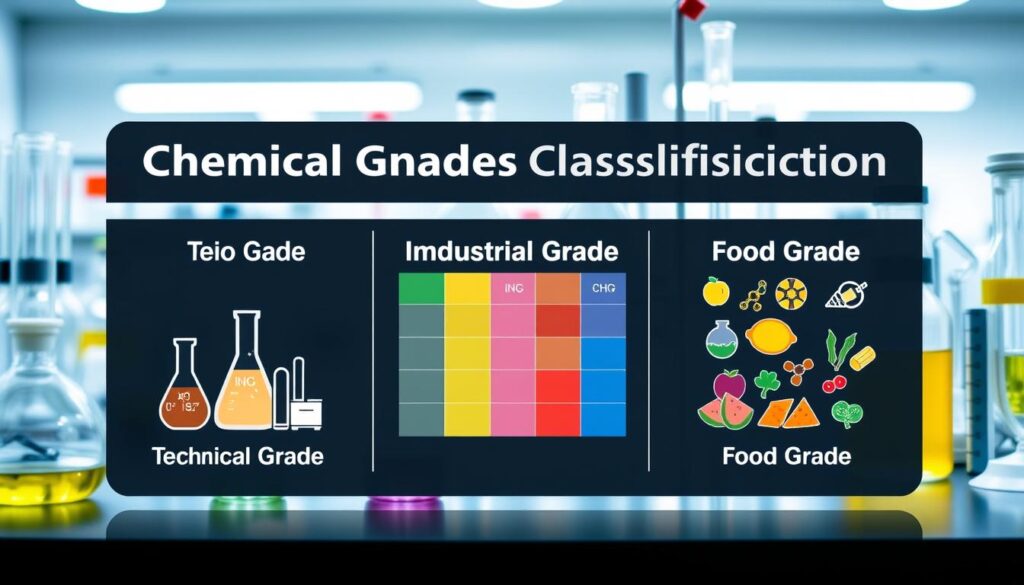
Imagine walking into a party where everyone is introduced by their job title. You’ve got the brain surgeons, the certified accountants, the line cooks, and the folks who keep the factory running.
A chemical grade is like that title. It shows a substance’s purity level and its importance in the lab.
This isn’t just about being fancy. It’s like a molecule’s resume. The grade tells you what it’s good for. Is it clean enough for medicine or food? Or is it for heavy industrial use where cost is key?
There are different grades like ACS and Reagent, and Technical. Each one has its own rules about impurities. Picking the wrong one can ruin an experiment or make it very expensive.
Differences Explained
Chemicals are like cars, and using a dump truck for a Formula 1 race is a bad idea. That’s why product specs are so important. The chemical world has a strict hierarchy. Your choice can make or break your project.
Purity is key, like horsepower in cars. But, the real cost is in the details. A small difference in purity can ruin a big project.
Chemical grades have a social hierarchy, with purity being the main factor. It’s like a social ladder.
Technical Grade (85-95% pure) is for industrial use. It’s like bulk coffee for the office. It works well where purity isn’t a big deal.
Use it for cleaning engine blocks or industrial cleaning. It’s good for manufacturing where impurities can be washed away. But, it’s not right for analytical work.
ACS/Reagent Grade (95%+ pure) is the opposite. It’s like single-origin espresso. Every impurity is controlled.
It’s for precise work like calibrating mass spectrometers. The product specs are detailed, like a pharmaceutical patent.
USP/FCC/Food Grade focuses on safety for human use. It meets strict standards beyond just purity.
It’s in your medicines, food additives, and supplements. The specs ensure no harmful substances are added.
Water Treatment Grade is for removing contaminants from water. It balances effectiveness with environmental safety.
Laboratory and Purified grades are in the middle. They’re good for educational demos and general lab work. They’re like reliable family sedans.
The cost difference between these grades is real. It reflects the expensive purification and testing. Technical grade might cost dollars per gallon. ACS grade can cost hundreds per liter.
This creates a problem in buying chemicals. The bean-counter wants the cheap stuff. The scientist needs the pure stuff. The product specifications sheet helps solve this.
Here’s a quick comparison to show the chemical hierarchy:
| Grade | Typical Purity | Primary Use | Cost Perspective |
|---|---|---|---|
| Technical | 85-95% | Industrial applications | Budget option |
| Laboratory/Purified | 90-99% | Education, general use | Middle ground |
| ACS/Reagent | 95%+ | Analytical research | Premium investment |
| USP/FCC/Food | Very High | Human consumption | Safety-critical |
| Water Treatment | Optimized | Water systems | Specialized efficacy |
Reading a spec sheet is important. Purity percentage is just part of the story. The listed impurities are more important.
For technical grade, impurities might be “trace metals” or “organic residues.” For ACS grade, specific compounds are listed with maximum allowable concentrations. This precision costs money.
The wrong choice can cause problems. Using technical grade solvents in sensitive instruments can leave residues that need expensive cleaning. Using ACS grade chemicals for cleaning floors is a waste of money.
Choosing the right chemical is like using the right tool for the job. Your product specs are like an instruction manual. Ignore them at your own risk.
When reviewing a chemical order, ask important questions. What purity level does your application need? What impurities can your process handle? Is it for brute force or fine precision?
The answers will tell you if you’re buying a dump truck or a Formula 1 car. Both have wheels, but only one will win the race.
Regulatory Considerations
Getting through the regulatory world of chemical grades is tough. It’s like trying to get into a fancy club without the right pass. The “bouncers” are big names like ACS, USP, FDA, and EPA. They have strict rules, and regulatory compliance is your key.
Using a Technical Grade solvent in a lab is risky. It’s like bringing a knife to a gunfight where the other side has lawyers and inspectors. Compliance isn’t optional; it’s essential for every legitimate operation.
Different grades have different rules. ACS Grade chemicals must meet the American Chemical Society’s high standards. There’s no room for doubt—it’s a yes or no situation for analytical work.
For products meant for people to eat, the rules get even stricter. USP and NF grades are for pharmaceuticals. FCC grade is for food ingredients. Water Treatment chemicals are watched closely by the EPA.
Ignoring these rules can lead to big problems:
- Legal Liability: You could face fines, sanctions, and lawsuits.
- Safety Issues: Contaminated products can harm people.
- Product Recalls: This can damage your brand and cost a lot.
- Regulatory Action: You might get warning letters or even have your facility shut down.
The compliance requirements for each grade are strict. Using industrial paint in a toy factory is a bad idea. Applying this logic to chemicals is not just smart—it’s necessary for survival.
It’s important to understand this framework. For more information, check out our guide on chemical grades.
Procurement in regulated industries is more about checking things off a list. Your list should include:
- Checking if the chemical meets the right standard for your use.
- Looking at supplier certifications and audit trails.
- Having the right compliance documentation, like Certificates of Analysis (CoA).
- Knowing which body oversees your specific use case.
Skipping any of these steps is like trying to sneak in. The regulators are very good at spotting tricks. They have methods that are more precise than any nightclub bouncer.
Creating a strong compliance strategy means respecting these rules. It turns chemical sourcing into a strategic move. The right grade isn’t just about purity—it’s about getting permission.
Use Case Examples
Choosing the right chemical grade is not just about following rules. It’s about success or failure. It’s like casting a movie. You wouldn’t pick a Shakespearean actor for a stunt or a comedian for surgery.
Let’s look at real-world examples where chemical grades shine. This is where theory meets reality.
Technical Grade: The Workhorse. This grade is for industrial use. It’s for processes where a chemical is used but not the final product. Think of acetone for stripping paint in a body shop—it’s effective and affordable.
It’s great for industrial cleaning and teaching labs. The question is, does the impurity matter for the process or product safety? If not, Technical grade saves money.
ACS/Reagent Grade: The Precision Instrument. This grade is for exact science. It’s essential for analytical chemistry, pharmaceutical R&D, and biotech. Using ACS-grade solvents is like tuning a Stradivarius with a toy pitch pipe.
In research, where a breakthrough depends on detecting compounds at very low levels, Reagent grade is key. Its purity is the foundation of trust.
USP/FCC/Food Grade: What We Consume. This category is for what we eat and drink. For a new soft drink, citric acid must be FCC grade. For tablets or creams, active ingredients need USP certification.
Using Technical grade preservatives in food is risky. It’s like using questionable water for your brand. These chemical grades ensure safety for human consumption.
Water Treatment Grade: Public Health Guardians. This is about chemistry on a big scale. Sodium hypochlorite and alum for water treatment need strict standards. The purity is about keeping water safe, not just for analysis.
A water plant’s choice of chemical grades affects thousands of people’s health.
Laboratory Grade: The Educational Scaffold. Not every lab needs top precision. For teaching chemistry in high school or general tests in college, Laboratory grade is perfect. It offers good purity without the high cost of ACS materials.
The choice of chemical grades is about managing risks and resources. It’s about knowing what level of certainty a task needs. Getting it wrong can be dangerous, illegal, or a waste of purity. Choose wisely, because it matters.
Supplier Documentation
Think of a chemical’s label as its dating profile. It’s curated, highlights the best features (“99.9% Pure!”), and is designed to get your attention. The supplier documentation, on the other hand, is the full background check. It’s the unvarnished truth. Relying only on the label is a rookie mistake, like buying a used car based solely on a shiny hood ornament.
Your real due diligence happens in the paperwork. Two documents are non-negotiable: the Certificate of Analysis (CoA) and the Safety Data Sheet (SDS). One proves what the chemical is. The other tells you how not to let it ruin your day, your experiment, or the local ecosystem.

Let’s start with the CoA. This isn’t a generic spec sheet; it’s a birth certificate for a specific batch or lot. If the label says “ACS Reagent Grade,” the CoA is the sworn testimony. It provides lot-specific data on purity, a detailed breakdown of impurities, and confirms the tests performed against the claimed standard.
Reading a CoA is detective work. Look for chromatograms, numerical results that match the grade’s thresholds, and a clear statement of compliance. Vagueness is a red flag. A trustworthy supplier’s CoA reads like a forensic report, providing detailed product specs you can verify.
Next, the SDS. This is the sober-minded instruction manual everyone hopes they never have to use in earnest. It details hazards, required personal protective equipment (PPE), proper storage conditions, and safe disposal methods. It’s not about quality; it’s about liability, safety, and responsible science. Ignoring the SDS is like skimming the safety card on an airplane—foolish until you really need the information.
Consulting both documents is the only way to verify a product’s true suitability for your application. They are your shield for regulatory compliance and your blueprint for safe, effective use. Let’s break down their roles clearly.
| Document | Primary Purpose | Key Information It Provides | The Red Flag to Avoid |
|---|---|---|---|
| Certificate of Analysis (CoA) | Proves identity, purity, and quality of a specific batch. | Lot number, assay/purity percentage, impurity profiles (e.g., heavy metals, moisture), test methods (e.g., USP, ACS), actual results vs. specifications. | Generic “conforms to standard” statements without supporting data. Missing batch-specific information. |
| Safety Data Sheet (SDS) | Details hazards and safe handling procedures. | Hazard classifications, PPE requirements, first-aid measures, fire-fighting advice, storage & disposal guidelines, physical/chemical properties. | An outdated format (old MSDS), overly vague hazard statements, or missing disposal codes. |
So, how do you use this in practice? When evaluating a supplier, request the CoA and SDS before purchase. A reputable source provides them readily. Cross-reference the product specs on the CoA with your application’s requirements. Does the impurity level matter for your sensitive reaction? The CoA tells you.
Then, study the SDS. Do you have the right fume hood and gloves? Do you know the spill procedure? This document translates raw product specs into a safe operational plan. It turns data into actionable protocol.
This isn’t bureaucratic box-ticking. It’s intellectual hygiene. In a world where “grade” can be a marketing term, the CoA and SDS are the objective reality. They separate credible partners from cowboy operations. Your project’s integrity, your lab’s safety, and your regulatory standing depend on this paper trail. Read it like your success depends on it. Because it does.
Making the Right Choice
Choosing chemicals is like playing a high-stakes poker game. Your data, safety, and budget are at risk. One wrong move can ruin your experiment, production line, or publication. It’s not about picking the shiniest or cheapest option. It’s about making a precise choice where application, compliance, and cost meet.
Start by asking tough questions before looking at catalogs. Is it for a groundbreaking discovery or a simple demo? Will the substance be used in humans or just clean floors? Your answers help you make a sharp decision.
Let’s look at the four key areas of chemical choice:
- Application Mission: What’s the task? Is it for consumption, analysis, or industrial use? Food-grade and technical-grade citric acid are different, even if they have the same formula.
- Regulatory Requirements: Here, compliance is more than paperwork. Do you need to follow FDA, USP, or EPA standards? Ignoring this can be illegal.
- Cost vs. Catastrophe: Saving money upfront can cost you more later. A cheap solvent that damages a $10,000 HPLC column is a bad deal.
- Required Purity & Sensitivity: Your tools need specific materials. LC-MS needs ultra-pure solvents. But for a classroom titration, ACS-Reagent grade might be too much.
Consider the “Fit-for-Purpose” matrix:
| Scenario | Recommended Grade | Key Driver | Risk of Under-Specifying |
|---|---|---|---|
| Pharmaceutical Formulation | USP/NF Grade | Human Safety & FDA Compliance | Catastrophic (Patient harm, legal liability) |
| Academic Research (Publication) | ACS or Higher | Data Integrity & Peer Review | High (Failed experiments, retractions) |
| Industrial Cleaning Process | Technical Grade | Cost Efficiency & Volume | Low to Moderate (Process inefficiency) |
| Analytical Method Development | HPLC or GC Grade | Instrument Sensitivity & Accuracy | High (False results, method failure) |
Avoid both cutting corners and wasting money. Using USP-grade water to clean the lab floor is a waste. But using technical-grade acids in sensitive synthesis is risky.
Developing “chemical intuition” is key. It’s the feeling that matches the tool to the task. You build it by asking: “What’s the minimum purity for the best outcome?”
When unsure, talk to your suppliers. A good supplier helps solve your problems. For more on this, check out this guide on purchasing different grades of chemicals.
In the end, choosing the right chemical protects more than your experiment. It keeps your reputation, regulatory standing, and sanity safe. In the lab and in life, the right tool is essential for success.
Conclusion
Our journey through the world of chemical grades has led us to a key question. Which grade is right for you? There’s no one-size-fits-all answer.
Choosing the right chemical grade depends on several factors. These include the intended use, purity requirements, legal rules, and overall cost. Knowing the range from Technical to ACS to USP gives you a big advantage. It’s the difference between making an educated guess and knowing for sure.
This knowledge empowers you to make informed decisions. You can understand a supplier’s catalog better. You can ask for a Certificate of Analysis from trusted sources like Sigma-Aldrich or Fisher Scientific. This way, you build processes based on the right quality.
Understanding chemical grades shows you respect both science and practical needs. In labs or factories, this knowledge ensures purity, safety, and cost-effectiveness. The right choice protects your work, product, and finances.
Always check the documentation. Seek advice from experts when needed. With this approach, you move through the complex world of chemical grades as an informed explorer. Make your choices carefully.