

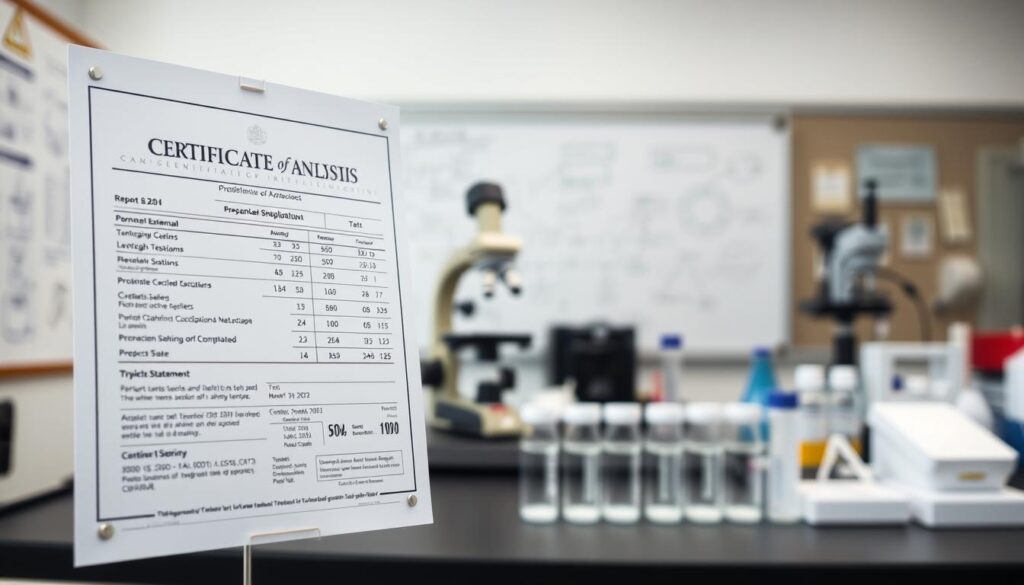
In the world of chemicals and materials, a Certificate of Analysis is often seen as just a formality. It’s the document you’re supposed to have, filed between the invoice and the safety data sheet.
But thinking this way is dangerous. A COA is more than just paperwork. It’s your material’s report card.
Imagine it like a thorough background check for a new hire or the detailed nutritional label on your food. Instead of listing calories and carbs, this document shows purity, dangerous impurities, and trace metals for a specific batch. It proves the material in the drum or bag actually passed lab tests.
Ignoring your COA is a big risk. In today’s world, we check everything. Treating this compliance documentation as optional is like buying a used car without checking under the hood. It’s a shift from guesswork to real quality assurance.
Key Sections Explained
Compliance documents are like novels, with the Certificate of Analysis being a mystery. It’s not just about reaching the end. You need to check every detail for consistency and proof.
Let’s break down this detailed report. What seems like just paperwork is actually a strong argument for a chemical’s quality and existence.
1. Product Identification & Lot Information: The “Who’s Who”
This section is like the chemical’s resume and birth certificate. The product name is the start, but the CAS number is key. It’s like a global ID number.
The lot or batch number is important for tracking. It connects a specific item to its production time. Without it, you’re left with no leads.
2. Test Results & Analytical Data: The Performance Review
This part is the heart of the matter. It’s not just about purity. It’s a detailed review with strict standards. Symbols like “≥” and “≤” show if it meets these standards.
These symbols are more than math symbols. They’re legal statements. A purity of ≥99.5% means it meets the standard. An impurity listed as confirms it’s below the limit. This section shows how good the material is with clear data.
3. Physical Properties: The Chemical Fingerprint
Appearance, specific gravity, and melting point are like a compound’s fingerprint. They confirm its identity. Two substances might have the same name but different properties.
Verifying a painting is similar. You check the signature, but experts look at brushstrokes and materials. This is where fake substances fail.
A mismatch here is a big warning sign. It could mean contamination or substitution. The numbers here prove the chemical’s identity.
4. Test Methods & Analytical Techniques: The Rules of Evidence
This section explains how the data was collected. Was it HPLC or GC? The method is very important.
Different methods have different levels of accuracy. Using a standard method like USP or ASTM means the test followed a trusted procedure. It’s like the difference between a guess and DNA evidence. For reliable compliance documents, the method must be clear and trusted.
5. Quality Assurance Approval & Authentication: The Final Seal
This section is about who approved the document. An unauthorized copy is worthless. A signature or digital seal from an approved person makes it official.
The method of authentication tells a story about security and modernity. Let’s look at some common methods.
| Authentication Method | Security Level | Verification Speed |
|---|---|---|
| Ink Signature & Company Stamp | Medium. Familiar but susceptible to forgery. | Slow. Requires manual cross-reference. |
| Digital Signature (PKI) | High. Cryptographically secure, tamper-evident. | Fast. Instant validation via certificate. |
| QR Code Linking to Secure Database | High. Dynamic, can be revoked if compromised. | Very Fast. Scan with a smartphone. |
| Blockchain or Digital Ledger Seal | Very High. Immutable, timestamped record. | Fast. Independent decentralized verification. |
Digital methods are becoming more common. A digital signature is more secure than a handwritten one. The best compliance documents use both human approval and digital verification.
Reading a COA is not just passive. It’s an active investigation. You’re checking a story of identity, performance, and trust. Each part must match, creating a strong narrative. When they do, you’re holding verified truth.
Understanding Safety Data Sheets
The Safety Data Sheet is like a detailed report card for chemicals. It lists all the dangers and what could go wrong. It’s like a guide to staying safe when using chemicals.
OSHA requires every workplace to have an SDS. It’s not just about the chemical’s purity. It warns about dangers like breathing in dust or mixing the wrong chemicals. Ignoring it is risky and could lead to accidents.

To use an SDS effectively, treat it as a tool for safety checks. Don’t just file it away. Check it before starting a new task or procedure. It’s like a safety plan for handling dangerous chemicals.
The SDS has 16 sections, but a few are key for daily use:
- Section 2: Hazard Identification: This warns about dangers like physical and health hazards. It uses symbols to show how careful you need to be.
- Section 4: First-Aid Measures: This is your emergency guide. It tells you what to do in case of accidents. Knowing this can save lives.
- Section 5: Fire-Fighting Measures: This tells you how to put out fires safely. It’s important to know the right extinguisher to use.
- Section 13: Disposal Considerations: This section explains how to dispose of chemicals safely. It’s important for protecting the environment.
Let’s compare the Certificate of Analysis and the Safety Data Sheet. The COA checks the chemical’s quality. The SDS is about staying safe while using it.
| Document | Primary Focus | Key Question It Answers | Audience |
|---|---|---|---|
| Certificate of Analysis (COA) | Quality & Identity | “Is this material what the supplier says it is, and is it pure enough?” | Quality Control, R&D, Purchasing |
| Safety Data Sheet (SDS) | Hazard & Safety | “How do I handle, store, and dispose of this material without causing harm?” | Every employee handling the material, Safety Officers, Emergency Responders |
An SDS is more than a document. It guides how to work safely with chemicals. It helps choose the right gloves and ventilation. It keeps your team safe.
The COA sets the stage for safety. The SDS outlines the rules. Knowing both is key to a safe workplace.
Legal and Safety Requirements
Think of the regulatory landscape as a rulebook for a high-stakes game. The FDA, EPA, OSHA, and ISO are like referees. Your Certificate of Analysis and Safety Data Sheet prove you follow the rules.
This isn’t just a suggestion. It’s the foundation of any responsible operation. Without proof, your claims of quality and safety are just stories. But with it, they become solid evidence.
So, who are these referees, and what do they want to see? Your COA and SDS are like translators, speaking the language of proof to different agencies.
| Regulatory Body | Primary Focus | Key Documentation | The “Why” Behind the Rule |
|---|---|---|---|
| FDA (Food & Drug Admin.) | Consumer safety, purity, and labeling for food, drugs, and cosmetics. | COA (for ingredient purity, potency), SDS (for safe handling). | Prevents adulteration and misbranding. A COA proves what’s on the label is in the bottle. |
| EPA (Environmental Protection Agency) | Environmental impact and safe use of chemicals and pesticides. | SDS (critical for hazard communication and disposal guidelines). | Manages chemical risks to protect air, water, and soil. The SDS is your environmental playbook. |
| OSHA (Occupational Safety & Health Admin.) | Worker safety in the handling of hazardous materials. | SDS (non-negotiable for workplace hazard communication). | Ensures employees have the right to know about workplace dangers. No SDS? That’s a direct violation. |
| ISO/GMP (Quality Standards) | Process consistency, quality control, and traceability. | COA (as objective proof of quality specifications). | Moves quality from a promise to a measurable, repeatable fact. It’s the data behind your process. |
In day-to-day operations, these documents are informative. But during an audit or inspection, they become defensive evidence.
A missing or incomplete COA is an open goal for a compliance citation. An inaccurate SDS is a liability lawsuit waiting for its opening scene. These documents are your first, and often best, line of defense. They answer the inspector’s question before it’s asked. They satisfy the lawyer’s demand for proof before the subpoena arrives.
This transforms your approach. Maintaining perfect COAs and SDSs stops being a clerical task and starts being a strategic one. You’re not just filing papers. You’re forging a regulatory shield. You’re building a case for your own integrity, piece by documented piece.
The ultimate goal is simple but profound: to turn the subjective claim of “we’re safe” into an objective, document-backed truth. It’s the difference between hoping you’ll pass an audit and knowing you will. In the world of legal and safety requirements, your documentation isn’t just recommended reading. It’s the only testimony that matters.
Supplier Best Practices
Checking a chemical supplier’s COAs is like tasting a chef’s food. It shows if they’re reliable. The COAs are like a character reference for the supplier.
Compliance documentation is like a truth serum. A detailed Certificate of Analysis shows a supplier’s hard work. A vague sheet is a warning sign.

To find the best suppliers, look at their COAs. Check if they test everything. Are the methods standard, like HPLC, or vague?
The margin of compliance is key. A purity of 99.8% shows confidence. But 99.51% is risky. Choose the supplier who’s sure of their quality.
Professional COAs matter. A clear, digital PDF shows respect. A blurry scan shows indifference.
Knowing chemical grades is essential. You’re buying more than just a compound. You’re buying its quality.
- ACS Grade: The highest standard. Meets American Chemical Society specs for analytical use. Ideal for critical applications.
- USP Grade: Meets United States Pharmacopeia standards. Crucial for pharmaceuticals, food, and medical use.
- Technical Grade: Good for industrial use where high purity isn’t needed. Cost-effective but not for critical use.
Choosing the wrong grade is a false economy. Technical Grade in analytical methods is bad. ACS Grade for cleaning is overkill.
Your supplier’s actions show their values. Do they give COAs and SDSs freely? Or only after you ask? A proactive supplier is reliable. A reactive one might hide something.
A cost optimization tip: The cheapest supplier might be the most expensive. Poor Compliance Documentation leads to delays, quality issues, and fines. Good documentation is worth the cost.
Check if their Safety Data Sheets are up-to-date. Are they in the latest GHS format? An outdated SDS is a safety risk. A supplier who ignores SDS updates is not prioritizing safety.
Choosing the right suppliers is key to a strong supply chain. It’s the difference between smooth operations and constant crises. Your supplier’s paperwork is their report card. Choose the best.
Document Verification
Getting a COA shouldn’t feel like just going through the motions. It’s more like solving a mystery. That piece of paper is like a passport for the material, showing its history and legal status. Verification is what makes you stand out from the crowd. It’s not just about filing it away.
Think of it like checking if a Picasso is real. Would you buy it just because the seller says so? Or would you look at the brushstrokes, the history, and the signatures? Your COA needs the same careful check.
Here’s how to do it right, step by step. Follow this, and you become a quality guardian, not just a passive receiver.
| Verification Step | The Critical Question | Common Pitfall | Best Practice |
|---|---|---|---|
| Match the Lot Number | Does the number on the COA match the physical container? | Assuming all material from an order is identical. | Check before unloading—this is non-negotiable. |
| Confirm Product & Grade | Is this exactly what I ordered? | Accepting “similar” or “equivalent” grades. | Verify against your purchase specification verbatim. |
| Review Critical Parameters | Are the values for my key application needs within spec? | Glazing over technical data you don’t fully understand. | Highlight the 2-3 make-or-break parameters beforehand. |
| Verify Specifications Are Met | Does every tested property pass the required limits? | Focusing only on the “big” tests and missing marginal fails. | Use a checklist. Every. Single. Time. |
| Check All Dates | Is the manufacture date acceptable? Is shelf life a concern? | Ignoring dates if the material “looks” okay. | Calculate if the material’s lifespan fits your production schedule. |
The first step is key: matching the lot number. This is the foundation. A COA for lot #12345 doesn’t tell you about container #67890. It’s like using the wrong medical chart. Check it at the dock before the truck leaves.
Next, do a detailed review. Does the product name and grade match your order exactly? Not “close,” but exactly. Then, check each parameter. Are the specs for your application right? Is the expiration date a problem for your project?
This isn’t being negative. It’s being thorough. The last step is often overlooked: filing for records. A verified COA is a legal document. Store it digitally, link it to the lot number, and keep it ready. It’s your defense in audits or quality checks.
In short, a COA without verification is just paper. Verification gives it power and meaning. For more on why this matters, see the importance of document verification in today’s supply chains. Trust is important, but proof is everything.
Conclusion
So you’ve decoded the COA. Now what? The real test begins with practical application, not just knowing the theory.
Many questions arise. Like, what about retention times? OSHA suggests five years, but some industries might need ten. Remember, just keeping last year’s playlist won’t do.
Using one COA for different containers is risky. It’s only safe for identical batch numbers. Anything else could put your facility’s safety at risk.
This isn’t just about filing papers. It’s about using supplier data to understand your operations. We see these documents as keys to understanding material risks.
When the FDA or EPA comes knocking, your compliance documents protect you. They show you’re not just following rules, but actively understanding them. This shift from reacting to proactively managing is key.
Learn to speak the language of compliance documentation. It’s essential for your safety, quality, and legal standing.