

Procurement, quality assurance, and environmental health and safety experts often face a big challenge. They must deal with a lot of technical and compliance documents.
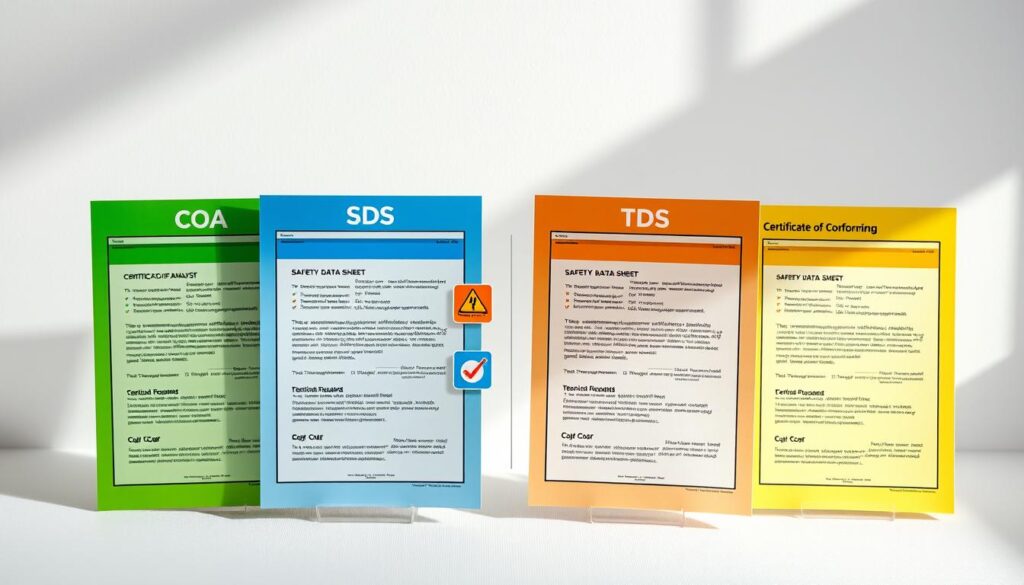
Each document has a distinct, non-interchangeable purpose in the supply chain. A Safety Data Sheet (SDS) is a detailed document made by a manufacturer. It talks about a hazardous chemical’s physical properties and possible dangers.
A Certificate of Analysis (CoA) is a formal quality report for a certain batch. A Technical Data Sheet (TDS) gives details on performance and how to use it. A Certificate of Conformance (CoC) shows that a product meets certain standards or rules.
This article will make it clear what each of these four main documents is for. It will show how each one answers different questions about safety, quality, performance, and following rules.
Document Decoder
Many people get confused about different documents. But, knowing what each one is for can clear up the confusion. In the world of chemicals and materials, there are four main documents. Each one answers a key question that helps keep things safe, of good quality, and in line with the law.
The Safety Data Sheet (SDS) answers the question: “Is this material safe to handle, store, and dispose of, and what must we do in an emergency?” It’s the go-to for knowing about hazards. It tells you about dangers, what safety gear you need, and how to act in an emergency. The SDS is required for dangerous materials and follows a set format, with Section 2 being very important.
The Certificate of Analysis (CoA) answers: “Does this specific batch of material meet our agreed-upon quality and purity specifications?” It’s a document that checks if a batch is up to standard. It has a special number for tracking and shows test results against certain standards. The CoA is important for making sure what you get is what you ordered. For more on this important document, check out how to read a chemical Certificate of.
The Technical Data Sheet (TDS) answers: “How will this material perform in our intended application or process?” It gives you the technical details you need. It talks about how the material works, its properties, and how to use it. The TDS also has information on if it meets certain rules, like RoHS or REACH.
The Certificate of Conformance (CoC) answers: “Does this product or batch comply with a specific regulatory or customer-mandated standard?” It’s a document that says a product meets certain rules. It’s about making sure a product is allowed under laws or customer agreements. The CoC is key for making sure things are done right in the supply chain.
It’s important to know the difference between CoA and SDS. The SDS is about safety and emergency procedures for dangerous materials. The CoA checks if a batch is of good quality. They deal with different things: danger and quality.
The TDS and CoC work together too. The TDS tells you how to use the material right. The CoC makes sure it’s okay to use it under the law or customer rules. These four documents together help manage materials responsibly.
Side‑by‑side matrix: owner, legal status, update cadence, tests included, acceptance criteria, who signs
Key differences in document origin, legal force, and content are best visualized through a consolidated comparative table. This matrix provides a professional reference for quality, safety, and compliance teams.
It synthesizes core administrative and technical attributes for four critical documents. Use it for quick checks during material qualification and supplier audits.
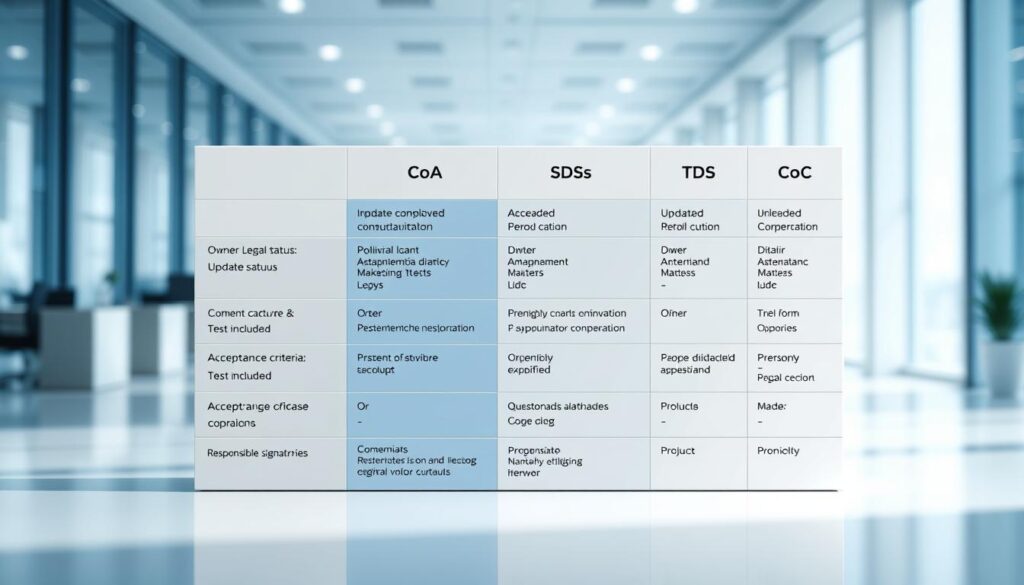
The following table details the responsible parties, regulatory standing, and core content for each document type.
| Document Type | Owner | Legal Status | Update Cadence | Tests Included | Acceptance Criteria | Who Signs |
|---|---|---|---|---|---|---|
| Certificate of Analysis (CoA) | Manufacturer (or authorized lab) | Contractual / Commercial requirement | Per batch or lot | Assay, impurities, physical constants (e.g., pH, density) | Results must meet pre‑defined product specifications | Quality Assurance (QA) personnel; digital signature common |
| Safety Data Sheet (SDS) | Manufacturer or importer | Legally mandated (e.g., under GHS, OSHA) | Upon regulatory change or new hazard info | Hazard classification, composition, physical/chemical properties, toxicological data | Must comply with hazard communication regulations | Responsible entity (e.g., regulatory affairs); not always individually signed |
| Technical Data Sheet (TDS) | Manufacturer | Informational; supports specifications | Upon product revision or reformulation | Application performance data, processing parameters, stability information | Data should accurately represent typical product performance | Technical or product manager; often hosted in a Technical Library |
| Certificate of Conformance (CoC) | Supplier or manufacturer | Standard‑specific declaration | Per batch or upon standard update | Pass/fail statement against a specific standard (e.g., RoHS, ISO) | Product must conform to the declared standard’s requirements | Authorized company representative; often available online for verification |
The owner column clarifies accountability. The manufacturer typically authors the SDS, CoA, and technical data sheet. A supplier may issue the CoC.
Legal status shows the SDS is a regulatory obligation. The CoA and CoC hold contractual weight. The TDS is mainly for technical guidance.
Update cadence varies from batch‑specific (CoA) to change‑driven (SDS, TDS). This impacts document control procedures.
Tests included reveal each document’s purpose. The SDS focuses on hazards. The CoA confirms chemical purity. The technical data sheet details performance. The CoC asserts compliance.
Acceptance criteria are either specification‑based (CoA) or regulation‑based (SDS). The signatory reflects the document’s authority, from QA to technical managers.
When You Need Multiple Docs (e.g., Food‑Grade Solvent, Pharma Excipient, Electronics RoHS)
For materials in sensitive fields like food, pharmaceuticals, or electronics, one document isn’t enough. You need a full set of documents. Each one covers a different area: safety, quality, or specific rules.
An SDS talks about safe handling and warning others about dangers. A Certificate of Analysis (CoA) checks if the product meets quality standards. A certificate of conformance shows the material meets certain rules or customer needs. Often, you need all three.
For food contact solvents, you need three documents. The SDS is key for worker safety. The CoA must show it meets the Food Chemicals Codex (FCC) grade.
This FCC grade has strict rules on things like heavy metals. A general CoA won’t do. You might also need a certificate of conformance for organic or allergen-free status.
Pharmaceutical Excipient: GMP and Ultra-Purity
An excipient in drugs needs strict documents. The SDS ensures safe making. The CoA must link to the United States Pharmacopeia (USP) monograph.
USP standards test for things like lead and arsenic. A CoA for an ACS Reagent grade is different. It doesn’t have the safety tests needed for people.
The third must-have is a GMP certificate of conformance. It shows the material was made under Good Manufacturing Practices. It’s vital for regulatory files.
Electronics Component: RoHS and REACH Compliance
Electronics parts need to show they don’t have banned substances. An SDS warns about chemical dangers. A standard CoA checks quality.
But, you also need a RoHS certificate of conformance. It says the product has no lead, mercury, or other banned stuff. You might also need a REACH compliance statement.
Just a CoA with “complies with RoHS” in a footnote isn’t enough. A dedicated certificate is safer and clearer for everyone.
The Imperative of Grade-Specific Documentation
The chemical grade determines the needed documents. ACS Reagent, USP, FCC, and Technical grades have different purity levels. A Technical grade CoA won’t pass a pharmaceutical check.
Getting the right documents is a smart quality move. It avoids delays, ensures rules are followed, and reduces risks. Always ask for the right grade when ordering.
In short, complex uses need a detailed document plan. An SDS, a specific CoA, and a focused certificate of conformance tell the whole story. They answer safety, quality, and rule questions clearly.
How to file and link them in ERP/MES
A digital library in an ERP or MES makes managing compliance documents easier. It keeps documents up-to-date, easy to find, and traceable.
Start with a single, searchable digital library. Index each document with key identifiers from your system. This makes them quick to find during production, quality checks, or audits.
The key data points for indexing are:
- Material Master ID: The unique code for the raw material or component.
- Supplier ID: The vendor who provided the material.
- Lot or Batch Number: The most critical link for full traceability.

Linking documents is powerful. When a goods receipt is logged in the ERP with a specific lot number, the system links to the digital CoA and SDS for that batch. This creates a complete and auditable chain of custody.
Always validate documents before filing. For modern CoAs, check digital signatures or scan QR codes to confirm authenticity. Make sure the document revision date matches the material receiving date to have the right version.
Handling exceptions is key. For missing paper documents, direct personnel to the supplier’s online library for TDS and SDS files. The system should also alert for certificates nearing expiration, prompting renewal requests.
This method turns filing into a controlled, auditable process. It supports quality systems and the organization’s compliance strategy.
Email templates to request missing documentation
Understanding the difference between coa, sds, tds, and coc is key. Without the right paperwork, you can’t meet compliance or production needs. A simple request can fix this problem.
These templates help you ask professionally. Send emails to the right people, like [email protected] or rh.nacustomerservice@henkel.com.
Requesting a Certificate of Analysis (CoA)
Subject: Request for Certificate of Analysis – [Material Name, Lot Number]
Body: Please issue the CoA for Product: [Material Name/Product Code]. Lot Number: [Specific Lot]. Reference our P.O. # [Number].
Requesting a Safety Data Sheet (SDS)
Subject: Request for Current Safety Data Sheet – [Material Name]
Body: Please provide the latest SDS for [Material Name/CAS Number]. Confirm the document revision date.
Requesting a Technical Data Sheet (TDS) or Certificate of Conformance (CoC)
Subject: Request for TDS/CoC – [Material Name]
Body: Please supply the active TDS or CoC for [Material Name/Product Code].
Make sure to include your company name and purchase order number. For a CoA, you need the specific lot number. For an SDS or TDS, the revision date is important. Also, copy Quality and Procurement teams.
This approach ensures you get the right documents. It keeps your standards high, no matter the situation.