


In the world of industry and rules, a specification is like a blueprint for material quality. It follows ICH Q6A guidelines, which say it’s a full list of tests and rules. These rules include specific limits and ranges for substances.
The document also considers the natural variation in analysis and the expected changes in processes.
Understanding a chemical specification sheet is key to quality assurance and smart buying. It’s not just about checking boxes. It’s about knowing if a material is really good for the job.
Big business decisions depend on this knowledge. Deciding what to buy, accepting batches, and checking if processes work right all need clear understanding of purity and tolerance.
This knowledge helps professionals make smart, informed choices. It’s about more than just following rules. It’s about picking the best materials and managing the supply chain well. Chemical composition testing gives the facts needed to check these specifications.
The next parts will show how to analyze these important documents. This will help teams use specification data to improve operations and stay ahead in the market.
Structure of a spec sheet: identity, grade, test list, methods, min/max, typicals, notes
Every chemical specification sheet has key parts that show identity, quality, and follow rules. Learning this layout is the first step to read chemical specifications well. A good spec sheet gives a full profile, turning raw data into useful info for quality control and buying.
The following breakdown details each standard section found in a technical data sheet.
- Material Identity
This part clearly names the chemical. It includes the chemical name, common names, CAS number, and molecular formula. Knowing the exact identity avoids mistakes in handling materials.
- Grade Designation
The grade shows the material’s use and purity level. Grades like Technical, Reagent, USP, HPLC, or Electronic are common. The grade tells you the quality level and what to expect before looking at test data.
- Test List (Attributes Measured)
This list shows the physical, chemical, and performance tests done. Examples are purity, water content, acidity, heavy metals, viscosity, or particle size. It tells you which characteristics are checked.
- Analytical Methods & References
For each test, the spec sheet lists the standard method used. Methods like Gas Chromatography (GC) or Karl Fischer (KF) titration are validated. Guidelines like ICH Q2 require validation for things like specificity and accuracy. A validated method means the results are reliable and can be repeated.
- Acceptance Criteria (Minimum/Maximum Limits)
These are the must-pass limits for each test attribute. If a result is outside these limits, the batch fails. Limits are often shown as “≥” (minimum) or “≤” (maximum) values. They are the non-negotiable quality standards.
- Typical or Average Values
Unlike strict limits, typical values show the average from past production. They tell you where the manufacturer’s process usually falls. Knowing the difference between strict limits and typical values is key to specs vs typicals. If typical values are close together, it means production is consistent.
- Notes and Clarifications
This section has important extra info. It might cover safe handling, storage, shelf life, or testing frequencies. Notes can also talk about the material’s origin or when to retest.
By carefully looking at these parts, experts can read chemical specifications accurately. It helps separate what’s required by law from what’s just descriptive. This knowledge helps with quality checks and choosing the right supplier.
The difference between strict limits and typical values is important. A material that meets specs but has typical values far from limits might be more reliable than one that barely passes. This detailed look at the structure makes a simple document a powerful tool for making decisions.
Parameters by Product Family: Solvents, Polymers, and Oils
To read chemical specifications well, you need to know the special qualities of each chemical type. These qualities, checked against rules like ICH Q2, show how well a chemical works and fits into a process.
Specification sheets are not the same for all. Tests for solvents, polymers, and oils are very different. Choosing the right material means looking closely at these special metrics.

For solvents, keeping them pure is key. Gas Chromatography (GC) purity checks how much of the main solvent is there, compared to other volatile stuff. Top-quality solvents usually have at least 99.5% or 99.9% purity by GC.
Water content, found by Karl Fischer (KF) titration, is also very important. A little water can stop reactions or cause things to separate. Acidity, or acid number, shows how corrosive something is. Keeping this low helps avoid damage to equipment and catalysts.
Polymer specs focus on how they process and their mechanical properties. The melt flow index (MFI) or melt viscosity range is the most important. It tells us how the polymer will act when molded or extruded.
A polymer with a high MFI flows well but might not be strong. A low MFI means it’s thicker and stronger but harder to process. Molecular weight (Mw) and its spread also affect strength and durability.
| Polymer Grade | Typical Melt Flow Index (g/10 min) | Viscosity Range | Primary Application |
|---|---|---|---|
| Injection Molding | 20 – 50 | Low | Thin-walled parts, high flow |
| Extrusion | 1 – 10 | Medium-High | Pipes, sheets, films |
| Blow Molding | 0.5 – 2 | High | Bottles, containers |
Oils, like lubricants and fatty acid derivatives, are defined by their chemical makeup. The acid number shows free fatty acids or breakdown products. A higher acid number means oxidation and it’s time to replace the oil.
The saponification value shows the average molecular weight of fatty acids. It’s very important for oils used in soap making or chemical reactions. These values tell us about an oil’s reactivity and how long it will last.
Knowing these special parameters helps make smart choices about using chemicals. A viscosity range must match the equipment. A solvent’s water content must be low enough for reactions. Getting good at this is key to understanding chemical specs.
Interpreting limits vs typicals and what “conforms” means
“Limit” and “typical” on a spec sheet mean different things. A specification limit is a strict rule. Any batch must meet it to pass. A typical value shows where the manufacturer usually operates.
This difference is key for making decisions. The limit is a promise. The typical value is a guide. Knowing both helps you read chemical specifications well and judge a supplier’s reliability.
Limits are set using tools like tolerance intervals (TI). A tolerance interval claims to cover a certain percent of future batches. It uses a confidence level. This creates the tolerance bands you see on a sheet. They are not random. They are set to manage quality over time.
“Conforms” has a clear meaning. A batch meets a spec if all tests pass within the limits. It doesn’t have to hit the typical value. A result right at the limit edge is okay. This is a clear pass/fail rule based on the criteria.
Typical values show the manufacturer’s process ability. They are the middle of the historical data. A big gap between a typical value and its nearest limit means a strong, controlled process. A small gap means the process is close to the limit. This gap shows risk.
Experts use this info to judge suppliers. A spec with tight limits but typicals far inside them shows high capability. A spec where typicals are near the limits suggests more variability. This could mean higher risk of future failures. This analysis is also useful when understanding a chemical Certificate of Analysis is important, which shows the actual batch data.
| Attribute | Specification Limit (Min/Max) | Typical Value |
|---|---|---|
| Primary Purpose | Defines absolute acceptance or rejection criteria for a batch. | Indicates the historical average or most common result from production. |
| Basis | Set using statistical tolerance intervals, safety data, and customer requirements. | Calculated from the manufacturer’s historical production data. |
| Legal & Contractual Status | Binding. A batch outside limits is non-conforming and may be rejected. | Informational. Not a guarantee for any specific batch. |
| Relation to Process | Represents the boundaries of the tolerance bands. | Represents the center of the process capability (where the process runs). |
| Risk Assessment Use | The width of the limit band indicates the allowed variability. | The gap from the typical to the nearest limit indicates process stability and margin for error. |
When you read chemical specifications, always check both columns. Look at the typical value and the limits. A typical purity of 99.7% with a minimum of 99.5% shows a 0.2% buffer. This buffer is your safety margin against process drift.
In contrast, a typical of 99.52% against a 99.5% minimum leaves almost no room for normal variation. The risk of a future batch failing is higher. This analysis helps move decision-making from simple compliance checks to a deeper evaluation of supply chain risk and quality consistency.
Build a comparison table across vendors; normalize units; evaluate risk of tight tolerances
When evaluating vendors, start by putting all the data into one place. This way, you can compare them side by side. It’s not just about looking at each sheet separately. It’s about seeing how they stack up against each other.
To objectively assess competing chemical products, create a table that makes everything equal. This table makes sure all the tests and measurements from different suppliers are on the same page.
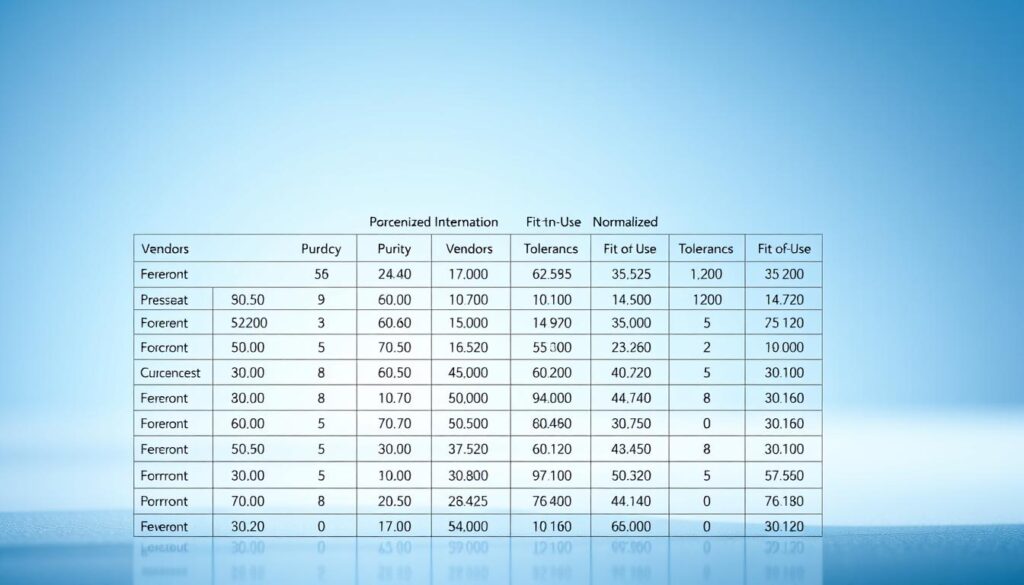
- List Key Parameters: Pick the most important tests for your needs from all the vendor sheets.
- Align Test Methods: Note down the testing methods used for each test. Different methods can give different results.
- Normalize Units: Make sure all measurements are in the same units (like converting ppm to percent).
- Document Limits: Write down the minimum, maximum, or typical values for each supplier.
Below is a table showing how to compare a common solvent.
| Test Parameter | Vendor A Specification | Vendor B Specification | Notes (Normalized) |
|---|---|---|---|
| Purity (GC) | 99.5% min | 99.8% min | Directly comparable. |
| Water Content | 0.1% max (by KF) | 100 ppm max (by KF) | Vendor B: 100 ppm = 0.01%. |
| Acidity (as Acetic Acid) | 0.002% max | 20 ppm max | Vendor B: 20 ppm = 0.002%. |
Understanding chemical specifications means looking at the acceptance criteria closely. Tight tolerance bands can be good. They show a supplier’s control. But they also raise the risk of rejecting batches.
This rejection can lead to higher costs and supply problems. It’s a trade-off between quality and cost.
When tolerances are tight, the risk of getting bad batches goes up. Every test has some error built into it.
Using the rules of metrology helps here. You need to think about the uncertainty of the test against the tolerance. A very tight limit doesn’t leave much room for error.
To check if tight tolerances are worth it, ask yourself:
- Does the tolerance account for typical measurement uncertainty?
- Is the tighter spec justified by my process sensitivity, or is it an unnecessary cost driver?
- What is the supplier’s historical batch acceptance rate?
Good acceptance criteria find a balance between quality and what’s possible to make. The goal is to pick a standard that works without being too risky. This is how you make a smart choice when reading chemical specs and picking a reliable supplier.
Case walkthrough: choosing between 99.5% and 99.9% purity given process sensitivity
Choosing the right purity level is key in chemical buying. Imagine a maker picking a solvent for a delicate process. This process can fail if there’s more than 0.6% impurity.
Two suppliers offer their products: one with a 99.5% purity, the other with 99.9%. The decision is tough.
To read chemical specifications well, look beyond the minimum. We compare the specs vs typicals for both. Vendor A’s 99.5% might have a typical purity of 99.7% with little variation. Vendor B’s 99.9% could have a typical purity of 99.9% but with more variation between batches.
Statistical tolerance intervals help measure risk. They show how often a batch might fall below the 0.6% impurity limit. The cheaper 99.5% material might be good enough if it consistently meets the high standards.
The choice depends on weighing upfront costs against the total cost of quality. Higher purity is worth it if it lowers the risk of process failure, rework, or yield loss. This example shows how to make a decision based on specs, process knowledge, and statistics.