


Hoping a chemical accident won’t happen is not a strategy. It’s a recipe for a regulatory footnote and a genuinely terrible Tuesday.
True spill prevention and response isn’t about bureaucratic box-ticking. It’s like war-gaming your own disasters. This is operational chess, not just mopping up.
We’re talking about architecting systems that anticipate failure. The goal is to contain chaos and turn a crisis into a managed incident. This isn’t driven by fear—it’s about control.
Drawing from pragmatic frameworks, the smart move is a shift from reactive to proactive management. It starts with the risk assessment you’ve been meaning to do. It ends with an after-action review that actually makes your team smarter.
So, are you just compliant, or are you strategically prepared? Let’s dissect the move from naive hope to masterful hazard control and genuine emergency preparedness.
Risk assessment: volumes, transfer points, floor drains, traffic
Forget generic safety checklists. A real risk assessment is like solving a crime scene. It’s the first step in your spill prevention series, turning vague worries into clear actions.
Start with your chemical inventory. Saying you have “some drums of solvent” is vague. We need exact details. What’s the volume? Where is it? Is it dangerous acid or diluted base in a busy area?
Next, look at the Safety Data Sheets for hazard identification. This isn’t just paperwork. It’s the story of your hazards. Does it burn, eat away, or harm water life? The SDS tells us what happens if containment fails.
Now, calculate the worst-case scenario. Regulators like those in British Columbia require this. If a 250-gallon tote of alkali spills, how far will it spread? This volume guides your entire response plan.
A detailed site survey is where theory meets reality. Walk the floor and find key spots. Transfer points are where spills often happen: filling, dispensing, drumming. These are moments of high risk.
Then, find every floor drain, trench, and low point. Imagine a spilled oil flowing into the storm drain. Your secondary containment plan is built here, at these escape routes.
Lastly, check the traffic flow. Forklift alleys, pedestrian paths, loading docks. A spill here is a big deal. It’s not just a cleanup; it’s a safety risk. This analysis completes your map of vulnerabilities.
To make sense of this, use a structured table. It helps you move from observation to action. Think of it as your case file.
| Risk Factor | Critical Question | Primary Data Source | Impact Score |
|---|---|---|---|
| Chemical Volume | What is the single largest container’s contents? | Inventory Logs & SDS | High |
| Transfer Points | Where do liquids most frequently move between containers? | Process Maps & Operator Interviews | High |
| Floor Drain Network | Which drains lead to sensitive environmental receptors? | Facility Blueprints & Site Survey | Medium-High |
| Internal Traffic | Do major pathways intersect with storage or transfer areas? | Traffic Flow Analysis | Medium |
This process turns worry into a clear profile. You’re no longer guessing. You know your weak spots. You’ve found where secondary containment is key and where your first responders need to be ready.
It’s the difference between feeling prepared and having proof. With this map, you can start building your defenses smartly.
Tiered Spill Kits: Your Curated First-Aid Station
Using a single spill kit for all spills is like trying to bail out a sinking ship with a teacup. Your chemical storage area needs different defenses, like fire extinguishers. You wouldn’t use water on an electrical fire, so why use a universal pad on corrosive acid?
A good plan starts with two main types of kits. First, a general-purpose emergency kit for small leaks like water, oils, or coolants. Then, specialized kits for acids, bases, solvents, or mercury. Each kit is a survival pack, not a mix of random safety items.
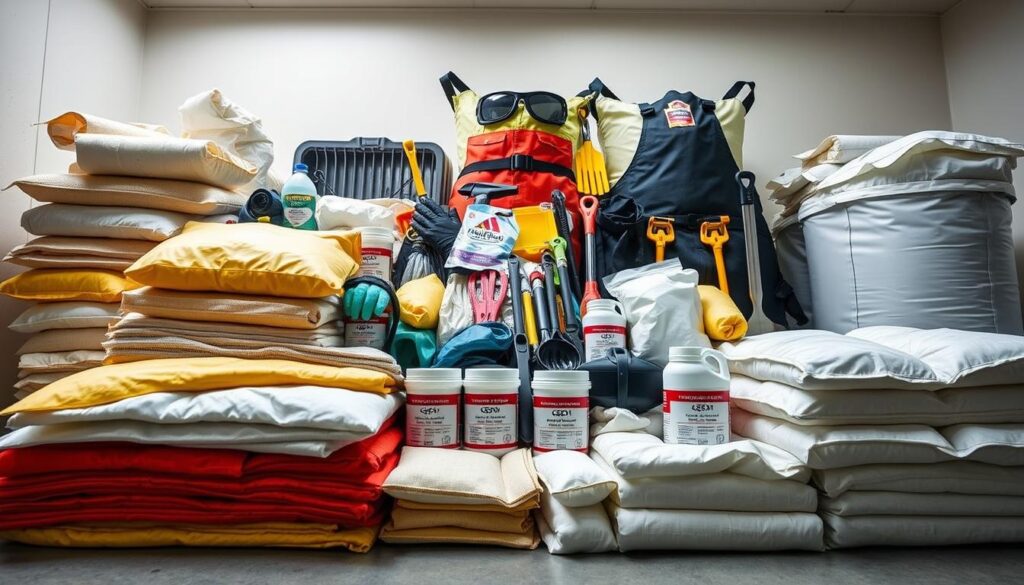
- Absorbent Materials: The frontline troops. They include socks for diking, pads for spreading leaks, and pillows for big puddles. Always choose materials that won’t react with the spill.
- Neutralizers: The peacekeepers. They calm down reactive spills, turning corrosive spills into safe compounds. But remember, they’re specific to certain types of spills.
- Personal Protective Equipment (PPE): Not just any gloves and goggles. The right PPE is key. The wrong suit can be as bad as wearing nothing at all.
- Tools & Overpacks: The support team. They include shovels, scoops, and brushes for cleanup. And the overpack drum is for safely storing contaminated waste.
Having these kits is just the start. Where you put them is also important. I’ve seen acid spill kits locked away, far from where they’re needed. Keep them close to where they’re used, so they’re easy to find and use.
Also, check your kits regularly. A missing glove or empty neutralizers bottle weakens your defense. Keep them stocked and ready. Your future self will appreciate it.
First response vs escalate: roles and communication tree
When the alarm sounds, confusion is the real enemy—not the spill. Your beautifully laminated plan meets the messy reality of human psychology. This section is where you build the organizational firewall against panic.
First, define the battle lines. First response is your on-site SWAT team. It’s a trained operator grabbing a Tier 1 kit for a small, contained leak. They’re the goalkeepers, handling routine saves. But what’s your threshold for calling in the whole squad? A spreading pool heading for a drain? A vapor cloud? That’s your trigger to escalate.
This isn’t a judgment call. It’s a binary switch. Your plan must state it plainly: “Any spill exceeding 5 gallons, involving hazardous vapors, or breaching secondary containment triggers a full incident response.” Ambiguity here is the root of all crisis failures.
Escalation activates your incident command system (ICS). Think of it as the movie director for your disaster film. It’s a standardized management system that prevents a debating society from forming at the worst possible time. The ICS pre-assigns emergency roles so people don’t have to volunteer.
Key roles include the Incident Commander (the ultimate decision-maker), a Safety Officer (the conscience of the operation), and an Operations Chief (the boots-on-the-ground leader). These aren’t titles for resumes; they are hats people have practiced wearing.
| ICS Position | Primary Responsibility | Typical Assignee |
|---|---|---|
| Incident Commander | Overall authority and accountability. Liaises with external agencies. | Plant Manager or Senior Supervisor |
| Safety Officer | Monitors hazards and ensures responder safety. Can veto unsafe actions. | EHS (Environmental Health & Safety) Specialist |
| Operations Section Chief | Directs all tactical field operations. Manages the response crews. | Maintenance or Operations Lead |
| Communications Officer | Manages all information flow, logs, and the communication protocol. | Administrative or IT Lead |
The communication tree is the neural network that must fire in sequence. It’s not a suggestion list. Who calls the internal team? Who alerts site management? Who has the unilateral authority to dial 911 or the external cleanup contractor?
This is your escalation matrix in action. A simple contact list isn’t enough. You need a clear, “if-then” flowchart. Operator sees major spill → Operator calls Incident Commander → Incident Commander activates ICS team and notifies management → Communications Officer alerts pre-approved vendor and regulatory bodies if required.
Why this rigidity? In a real event, nobody is Googling “who to call for chemical spill.” Adrenaline floods systems, and higher reasoning checks out. Your communication protocol must be muscle memory, drilled into the team until it’s automatic. The goal is to replace the frantic “What do we do?!” with a calm, “We are executing Phase Two.”
Ultimately, separating first response from escalation is about resource allocation and crisis psychology. It ensures small issues don’t balloon from overreaction, and big issues don’t fester from underreaction. Your incident command system and its clear emergency roles provide the scaffolding for a controlled, professional response. It turns a potentially chaotic situation into a well-coordinated operation.
Containment tactics: berms, drain covers, shut‑off valves
When a chemical spills, you need to guide it. This is leak control: not just cleaning up, but setting its limits. It’s like drawing a map to stop it from spreading.
The first defense is a spill berm. These barriers, from your kit, create a mini-pool. It’s like a tiny castle moat. The diking act is simple but powerful. It’s not absorbing the spill yet; it’s just containing it.
Then, the key move: covering the drains. Drain covers are the unsung heroes in this story. Putting one over a drain is your facility’s simplest, most effective way to contain spills. It can turn a messy cleanup into a minor incident.
While managing the spill, don’t forget the source. If it’s safe, go for the strategic win. Close the valve or tip the drum upright. This is like applying a tourniquet. You’re stopping the flow so you can handle the spill already out.
Good secondary containment uses a three-step plan: corral with berms or diking, seal exits with drain covers, and shut off the source. It’s a quick, planned action to reduce the spill’s area. In this phase, acting fast is key.
Waste handling: labeling, temporary storage, vendor pickup
Think of this as the aftermath of a spill. The action is done, but the details matter a lot. You’ve stopped the spill. Now, you have a pile of contaminated materials.
This isn’t just trash. It’s a sign of how well you handled the spill. The right steps can save you from trouble.
Labeling: “Icky Stuff” Won’t Cut It
A simple “spill junk” label won’t do. You need to label the waste correctly. This means telling what chemical is in it, not just the product name.
Why is this important? The disposal company needs to know what they’re picking up. And so do the regulators. Mixing things up can lead to more problems.
Every bag or container must have a clear label. Include the date, where the spill happened, and what’s hazardous. This makes the waste easier to manage.
Temporary Storage: Your Secure Holding Cell
You can’t just leave the waste by the dumpster. Temporary storage needs careful planning. It should be safe, away from where people walk, weather, and unauthorized access.
Also, the container must be right for the waste. That generic drum might not last. You need containers that can handle what’s inside. This stops leaks and keeps your site safe.
Keep different wastes apart. Mixing them is not smart. Keep acids from bases and flammables from oxidizers. Your future self will be grateful.
Your waste is labeled and stored. Now it needs to leave your property. You need a plan for this. Have a list of pre-qualified, licensed disposal vendors ready.
Don’t wait until there’s a spill to find one. Your plan should have them listed. The path from “site of spill” to “licensed vendor pickup” must be clear. This includes all the necessary paperwork, like manifests. As the guidance on preparing spill contingency plans says, a waste management plan is key.
Book the pickup quickly. Keeping waste for too long increases risks. A smooth handover to your vendor is the last step of a professional response.
| Pitfall | Consequence | Smart Practice | Rationale |
|---|---|---|---|
| Vague or missing labels | Vendor refusal, regulatory citation, unknown hazards. | Use standardized hazard labels with chemical name, date, and generator info. | Ensures safe handling and complies with transportation regulations. |
| Storing in incompatible containers | Container failure, new spill, chemical reaction. | Use containers made of material compatible with the waste (e.g., HDPE for many organics). | Maintains integrity of temporary storage and prevents secondary incidents. |
| Mixing incompatible waste streams | Creation of extreme heat, toxic gas, fire, or explosion. | Segregate wastes by hazard class (flammable, corrosive, etc.) from the moment of collection. | Eliminates reaction risk and simplifies downstream hazardous waste disposal. |
| No pre-arranged vendor contract | Delays, cost overruns, illegal dumping pressure. | Establish relationships with licensed disposal facilities as part of your planning. | Guarantees a legal exit path for contaminated materials when you need it most. |
Mastering this process is what makes a spill incident manageable. Your spill kit starts the job. Precise waste labeling, secure storage, and reliable vendor logistics finish it. Get this wrong, and the cleanup is just the beginning.
Reporting Triggers and Documentation (Site-Specific)
Think of spill spill documentation as your incident’s ‘black box’. It’s the key record that tells the story long after the mess is cleaned up. Without clear, site-specific rules, deciding to file an official incident report can be tough. And in crisis mode, you can’t afford to debate.
Is it a five-gallon drip or a fifty-gallon river? Is the chemical safe or hazardous? Did it spill into a storm drain? Your plan must answer these questions before they’re asked. Ambiguity is not just inconvenient; it’s a legal trap.
Effective triggers fall into three buckets. First, volume. A specific threshold, like any release over 10 gallons, auto-triggers a report. Second, chemical identity. Certain substances demand immediate regulatory reporting. Third, environmental release. Anything past the curb, into a drain, or onto the soil is an instant escalation.

This paperwork isn’t just about covering your backside. It’s your organization’s memory. A proper incident report turns chaos into data. It’s what your insurer will scrutinize, what regulators will subpoena, and what your team will use to learn. How do you build this vital record?
Start by photographing the scene from multiple angles. Log every action taken, by whom, and at what time. Note the weather conditions—was it raining, pushing the spill toward a drain? Track manpower hours and materials used. This detailed spill documentation creates an unassailable timeline.
| Trigger Type | Report Immediately (Example) | Internal Log Only (Example) |
|---|---|---|
| Volume | Any release >25 gallons of any liquid. | Spills under 1 gallon contained on secondary containment. |
| Chemical Type | Release of a CERCLA/SARA-listed hazardous substance. | Release of non-hazardous, plant-approved cleaning solution. |
| Release Location | Spill reaches a floor drain or exits the facility property. | Spill fully contained within a bermed storage area. |
| Near-Miss | Container failure caught just before a major release. | Minor drip from a valve during normal operations. |
As regimes like Canada’s emphasize, even deviations from the plan must be documented. Showing due diligence is everything. Was the drain cover missing? Log it. Did a valve fail? Photograph it. This record proves you weren’t just reacting—you were managing.
When a release hits a legal trigger, knowing your SARA Title III emergency release reporting duties is non-negotiable. But the foundation is your own internal clarity. Clear triggers stop the panic. Thorough documentation tells the story. Together, they turn a costly mistake into your most valuable lesson.
Drills and tabletop exercises; debriefs and continuous improvement
Think of your spill plan as a blockbuster script. Without rehearsals, it’s just a pile of paper. A plan that never gets tested is a work of fiction. The transition from theory to muscle memory happens through deliberate practice.
Training drills and tabletop exercises become your director and choreographer. They help you practice.
A tabletop exercise is a cost-free, high-impact simulation. You present a scenario—”A forklift punctures a drum of solvent near the main floor drain”—and your team walks through the response verbally. It exposes gaps in logic and knowledge without anyone breaking a sweat.
Then comes the full dress rehearsal: the live emergency drill. This tests the physical script. Can the team don PPE under pressure? Is the spill kit actually where the map says it is? Does the communication tree have live branches, or is it a dead network? This is the difference between knowing the steps and executing them while the clock is ticking.
The real magic isn’t in the performance; it’s in the critique. The after action review (AAR) must be a brutally honest therapy session. What worked? What failed hilariously? Was the absorbent supply sufficient, or did we use enough pads to soak up a small lake? This debrief is non-negotiable.
This cycle—drill, debrief, adjust—is the engine of continuous improvement. It’s what professional Response Organizations do for their triennial certification. Your facility should operate on the same principle, just on a different scale.
Without this cycle, you’re not improving; you’re just hoping. A single tabletop exercise per quarter and a live training drill biannually can transform your team. Document every AAR. Update your plans. Then do it all again. That’s how you turn a shelf-bound fiction into a reliable, actionable reality.
Stocking/inspection cadence and restock KPIs
Drills and containment tactics are great, but they’re useless if your spill kit is old. Maintenance is the key. It’s like a gym membership you never use, but it works if you do.
Set up a strict inspection schedule. Check your overpack drums every month or quarter. Look at expiration dates and seals. Make sure PPE is in good shape. It’s a check on your defense.
Good inventory management turns hope into action. Set restock KPIs like when a part is 30% used. Assign someone to keep track. A digital maintenance log is better than a notebook. It keeps a clear record and prevents last-minute scrambles.
This important work makes your spill response reliable. It’s the boring stuff that lets you sleep well. Knowing your defense is ready, not a box of regrets.