

The smartest solvent selection for manufacturing decisions rarely begin with the strongest dissolving agent on the shelf. They begin with a harder question: what exactly must the solvent do without creating a new operational, safety, or compliance problem?
That question matters because solvents sit at the center of several manufacturing pressures at once. A cleaning solvent can protect product quality or leave residues that cause rework. An extraction solvent can improve yield or contaminate the downstream process. A heat-transfer fluid can stabilize production or slowly foul the equipment that keeps the line running.
Why Solvent Selection for Manufacturing Is A Process Decision
Solvent choice is often treated as a purchasing decision, but it belongs much earlier in process design. The wrong chemistry does not simply underperform. It can change drying time, attack seals, increase vapor exposure, complicate waste handling, or make recovery uneconomical.
That is why the first screen should be use case, not brand, price, or habit. Cleaning, extraction, dissolving, heat transfer, and reaction-medium work all ask different things from a solvent. A fast-evaporating solvent may help precision cleaning but create ventilation demands. A high-boiling solvent may support thermal stability but raise energy costs during recovery.
The best selection process defines the job before comparing candidates. What soil or residue must be removed? What compound must be extracted? What temperature range must remain stable? What materials will the solvent touch? Without that map, a manufacturer may solve one problem while quietly creating three others.
The real goal is process-fit chemistry, not maximum solvency. A powerful solvent that damages elastomers or fails regulatory review is not a better solvent. It is a delayed failure.
Cleaning, Extraction, And Heat Transfer Need Different Screens
A solvent used for heavy degreasing faces a different test than one used for botanical extraction or recirculating heat transfer. Cleaning starts with soil identity, surface material, drying requirements, residue limits, and application method. Spray cleaning, immersion, vapor degreasing, and wipe-down operations all expose workers and equipment differently.
Extraction introduces a different set of questions. Selectivity becomes as important as solvency. A solvent must pull the desired compound efficiently without dragging unwanted impurities into the final stream. The process also needs realistic yield curves, because a solvent that works in a flask may be too slow, too expensive, or too difficult to separate at plant scale.
Heat-transfer use cases raise another concern: stability over time. A fluid may look suitable at the start but degrade, thicken, absorb contaminants, or foul heat-exchanger surfaces after repeated thermal cycles. In that environment, the solvent is not a consumable alone. It becomes part of the plant’s thermal control system.
A useful comparison starts with the function the solvent must perform.
| Manufacturing Use Case | Primary Selection Question | Main Risk If Misjudged |
|---|---|---|
| Precision cleaning | Will it remove residue without leaving contamination? | Rework, coating failure, product defects |
| Heavy degreasing | Can it dissolve oils under real soil loads? | Incomplete cleaning and longer cycle times |
| Extraction | Does it recover the target compound selectively? | Poor yield or impurity carryover |
| Heat transfer | Does it remain stable under operating temperature? | Fouling, degradation, energy inefficiency |
| Reaction medium | Does it support the chemistry without interfering? | Lower conversion or unsafe side reactions |
This table shows why one “best solvent” does not exist. The best candidate is the one that fits the manufacturing duty cycle, not the one that performs impressively in isolation.
Safety Screens Must Come Before The Pilot Run
Performance data can narrow the field, but safety determines whether a solvent is usable in the real plant. Flash point, autoignition temperature, vapor pressure, exposure limits, and ventilation requirements all shape the true operating cost.
This is where teams should avoid a common mistake: treating safety as a late approval step. A solvent with excellent cleaning power may still demand explosion-proof equipment, tighter air monitoring, or new waste procedures. Worker exposure limits and physical hazard data should be reviewed while candidates are still being compared, not after a formula has already been built around one option.
The OSHA Occupational Chemical Database is a practical starting point for checking chemical identification, exposure limits, sampling information, and physical properties. It should not replace supplier documentation or a site-specific EHS review, but it helps teams ask better questions before a solvent reaches production.
The key issue is hidden operating burden. A lower-cost solvent may become expensive once ventilation, storage, fire protection, personal protective equipment, permitting, and disposal are included. A safer solvent may cost more per liter yet reduce downtime, training load, waste complexity, and incident risk.
Compatibility Can Decide Whether A Solvent Survives The Plant
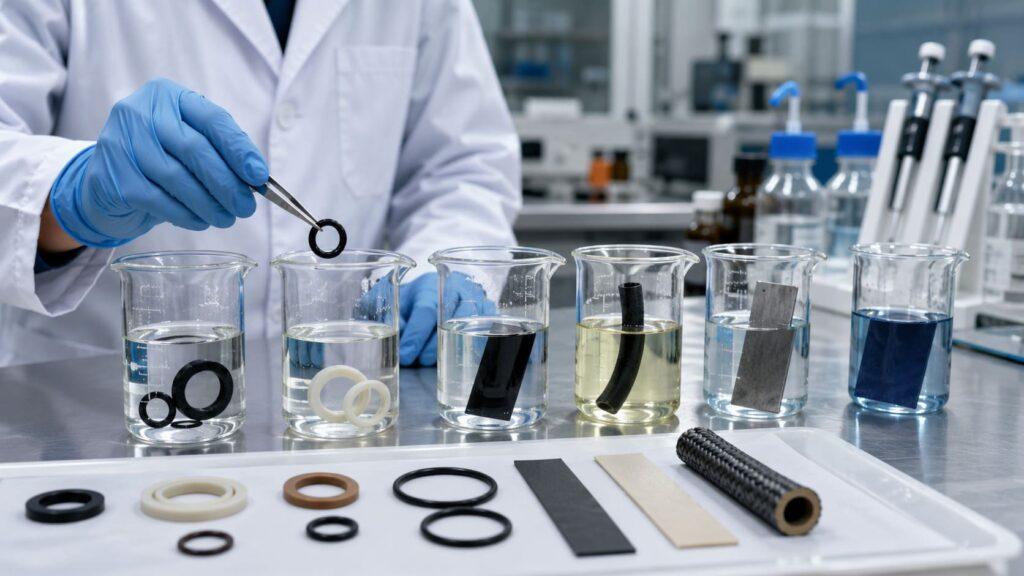
Solvent compatibility is where many promising candidates fail. A solvent may clean the product beautifully while swelling a gasket, softening a coating, weakening a hose liner, or changing pump-seal performance. Those failures often do not appear immediately. They develop through repeated exposure, temperature swings, and long production runs.
Compatibility testing should include every material the solvent will contact: elastomers, O-rings, pump wet ends, coatings, tanks, filters, hose liners, and any polymeric parts in the system. A simple lab exposure test can catch obvious swelling, cracking, discoloration, or softening. More demanding processes may require longer exposure, cycling, and inspection under real operating conditions.
This step is especially important when switching away from a legacy solvent. The new chemistry may have a better environmental or safety profile but interact differently with materials selected years earlier. That does not make the replacement unsuitable. It means the change must be engineered, not swapped casually.
A solvent decision that ignores compatibility can turn into maintenance-driven failure. The process may meet its cleaning or extraction target but lose reliability through leaks, seal replacements, unplanned shutdowns, or contamination from degraded materials.
Regulatory Fit Is Not A Final Checkbox
Regulatory review belongs near the front of solvent selection because compliance can determine whether a candidate is practical at all. In the United States, teams should confirm inventory status, use conditions, and any restrictions before committing to a solvent for commercial manufacturing. The EPA TSCA Chemical Substance Inventory is an important reference point for chemicals manufactured, processed, or imported under TSCA.
Air rules, VOC limits, hazardous waste classification, food-contact requirements, and regional regulations can all affect solvent viability. A solvent that works in one facility may be harder to justify in another location with stricter air-quality rules or different permitting obligations.
Blends deserve special attention. Azeotropes and formulated solvent systems may behave differently from their individual components in distillation, emissions, labeling, and recovery. The compliance review should evaluate the actual material being used, not just the headline ingredients.
The practical takeaway is simple: regulatory fit should influence the shortlist, not merely approve the winner. When compliance is postponed, teams risk reformulating after time, capital, and validation work have already been spent.
Recovery, Reuse, And Scale-Up Reveal The Real Cost
A solvent’s purchase price is only part of the economics. Recovery, reuse, waste volume, energy demand, and off-spec risk often matter more over the life of a manufacturing line. Distillation may make sense when boiling points are favorable and contaminants separate cleanly. It may be less attractive when azeotropes, stabilizers, or degradation products complicate the recovered stream.
The best solvent programs consider whether the material can become a reusable process asset. That means checking distillation feasibility, inhibitor carryover, purity after recovery, energy balance, and whether the recovered solvent can return directly to the process.
Pilot testing should also use real production conditions. Cleaning tests should include actual soils and load levels. Extraction trials should build yield-versus-time curves rather than assuming lab timing will scale. Heat-transfer trials should monitor temperature stability, fouling, and changes in fluid properties over extended operation.
This is where lab success meets reality. A solvent can pass early screening and still fail because cycle time is too long, recovery is inefficient, residues accumulate, or the plant layout changes exposure risk. Scale-up is not confirmation of the lab result. It is a separate test of durability, economics, and control.
The manufacturers that handle solvent selection well do not chase a perfect chemical. They build a decision matrix that weighs performance, safety, compatibility, compliance, recyclability, and total cost. That approach turns solvent selection for manufacturing into a disciplined process decision rather than a reactive substitution exercise.
A good solvent should help the line run cleaner, safer, and more predictably. The wrong one may still dissolve the target material, but it can also introduce the kind of slow, expensive problems that only become obvious after production depends on it. That is why solvent selection for manufacturing deserves early attention, cross-functional review, and plant-scale proof before it becomes standard operating practice.