
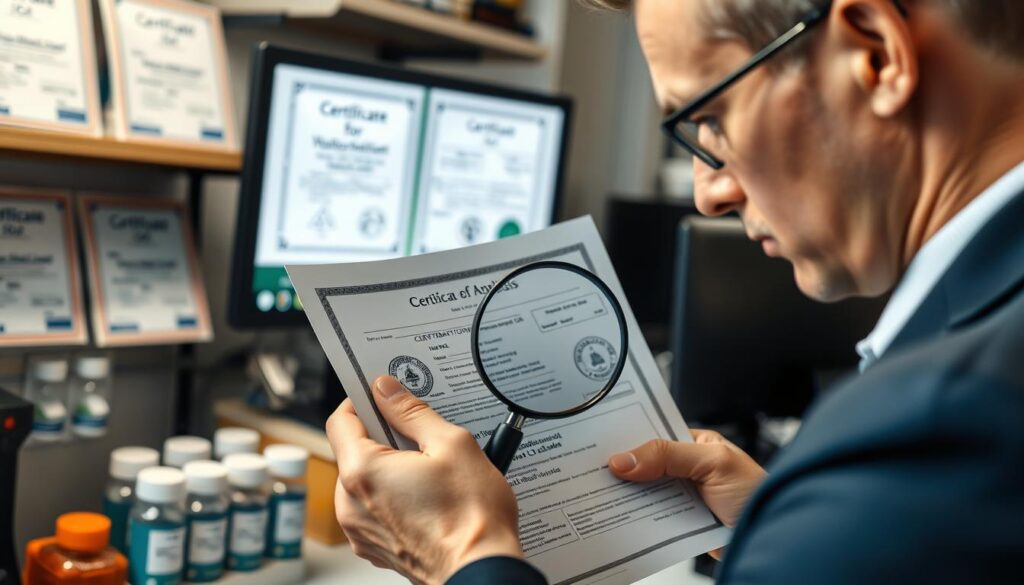
A Certificate of Analysis is key for quality control and following rules. But, it’s not enough on its own. You need to check it carefully before making big decisions.
Experts say it’s important to be careful. Companies like Inorganic Ventures warn that you must check the info yourself. Reliance is strictly at the user’s own risk. This shows why following this guide is so important.
This article will show you how to make sure a CoA is real and reliable. You’ll learn to check if it’s genuine, if the lab is accredited, and match it with other important documents. This way, you can trust the CoA for your business needs.
Match triangle: PO/spec → label → CoA fields
Getting materials right starts with a key step called the ‘match triangle’. It links purchase orders, labels, and CoA data. This check is the first and most important in quality control. It makes sure what we get matches what we ordered and tested.
The triangle connects three key points. First, we have the Purchase Order and its technical specs. These details tell us exactly what we need.
Next, we look at the product label. This label on the container must match the PO. It’s a quick way to check if we got what we asked for.
Last, we examine the Certificate of Analysis. The CoA fields should show results for the material on the label. Any mismatch could mean a quality problem.
Checking is done step by step. First, we make sure the product name and grade on the PO match the label. Then, we verify the lot or batch number on the label is the same as on the CoA.
Next, we check each detail from the PO on the CoA. The values must be within the agreed limits. This careful process avoids any guesswork.
Discrepancies can happen at any stage of the triangle. These issues affect whether we can accept the material. Regular checks help catch these problems early.
| Discrepancy Type | Typical Example | Impact on Material Acceptance |
|---|---|---|
| Lot Number Mismatch | Label shows Lot #A123, but CoA reports results for Lot #B456. | The CoA cannot be attributed to the received material. The shipment must be placed on hold. |
| Unit of Measure Inconsistency | PO specifies concentration in mg/mL, but CoA reports results in % w/v. | Prevents direct comparison to specifications. Requires clarification and potentially unit conversion. |
| Specification Tolerance Deviation | CoA reports purity as 98.2%, but PO requires a minimum of 99.0%. | The material fails to meet the agreed contractual specification. Rejection or supplier concession is required. |
| Missing Test Parameter | PO requires testing for heavy metals, but this analyte is absent from the CoA. | Incomplete data set. The material’s quality for its intended use cannot be fully verified. |
Unit inconsistencies often cause errors. They come from global supply chains using different standards. Clear PO specs help avoid this.
Even small deviations in tolerance are important. A result outside the range means the material might not work as expected. This protects our manufacturing process.
The match triangle makes quality checks clear and consistent. It gives quality managers and auditors a reliable method. This careful process is our main defense against getting the wrong materials.
Accreditation and competence: ISO/IEC 17025 scope, analyst signatures, calibration dates
ISO/IEC 17025 accreditation is the top standard for lab quality worldwide. It makes sure tests follow strict global rules. This mark shows a lab’s skill and trustworthiness.
Verifiers check if the test on the CoA fits the lab’s accredited scope. This list shows what tests the lab is good at. If a test isn’t on this list, it’s not sure if it’s right.
The FOCUS Standard says labs must follow global management systems. ISO 17025 accreditation meets this rule. It covers staff skills, equipment care, and quality checks.
Traceable analyst signatures are key. They link the results to a trained person. This shows who did the test and if they knew what they were doing.
Up-to-date instrument calibration dates prove the process is controlled. Equipment must be checked regularly with reliable standards. If the calibration is old, the results might not be trustworthy.
A good ISO/IEC 17025 accreditation, the right scope, signed tests, and recent calibrations build trust. They show a lab’s dedication to fair and strong science. This makes sure the data is reliable.
Data Integrity: ALCOA+ Principles and the Role of Audit Trails
The ALCOA+ framework is key for checking a lab’s Certificate of Analysis data integrity. It makes sure results are scientifically valid and legally strong. Good data integrity turns a CoA into a reliable document.

Each part of ALCOA+ covers a key aspect of making and keeping data reliable. Knowing these rules helps experts do a deep check on data integrity.
| ALCOA+ Principle | Application to a CoA | Potential Integrity Red Flags |
|---|---|---|
| Attributable | Every data point and action must link to the person or system that created it. This includes analyst signatures and instrument IDs. | Missing signatures, generic logins used for analysis, or results not traceable to a specific instrument run. |
| Legible | All entries must be readable and permanent, whether handwritten or electronic. This prevents misinterpretation. | Illegible handwriting, faded printouts, or data obscured by corrections without proper annotation. |
| Contemporaneous | Data must be recorded at the time the work is performed. This preserves the sequence of events. | Dates on raw data files that differ from the CoA issue date, or entries logged from memory after the fact. |
| Original | The first or source record must be preserved. A printed CoA is considered the original record if it is the primary output. | Providing photocopies or unverified electronic scans where the original cannot be produced for audit. |
| Accurate | Data must be correct, truthful, and free from errors. It reflects what actually happened during testing. | Unexplained outliers, mismatches between raw data and reported values, or arithmetic errors in calculations. |
The “plus” in ALCOA+ adds more. Complete information means all test data, even repeat analyses. A CoA should show the full picture.
Consistent data follows a logical sequence. Dates and times should align across the sample log, instrument printouts, and the final CoA.
Enduring records are kept for the needed time on good media. Thermal paper faxes that fade fail this principle.
Available data can be found for review throughout its life. The CoA and its supporting records must be accessible for audit or investigation.
Audit trails and system-generated timestamps prove these principles. An electronic audit trail is a secure, computer-generated log. It records the who, what, when, and why of any data creation, modification, or deletion.
Looking at timestamps checks the Contemporaneous principle. It shows the analysis was done in real-time. A secure audit trail protects the Attributable and Original data. It makes changes clear and traceable.
Data integrity backed by ALCOA+ and shown by audit trails is essential. It’s the base of analytical trustworthiness and following the law.
Digital tools: QR codes, e‑signatures, blockchain/eCoA portals
Modern supply chains use digital tools to keep quality documents safe and easy to access. This change moves from manual checks to automated, secure systems. Leading standards, like the Yanfeng Supplier Standards Manual, push for electronic commerce and secure records.
These systems aim for fast transactions and keep data safe.
QR codes on CoAs link to the original lab reports or secure portals. Scanning them quickly takes you to the source data. This cuts down on errors and speeds up the process. The linked data ensures the paper and digital versions match.
Digital signatures are now widely accepted. They offer stronger security than traditional signatures. They are unique to the signer and document, creating a clear audit trail. In many places, they have the same legal weight as wet ink signatures.
Blockchain and eCoA portals add an extra layer of security. They create an unchangeable record of transactions. Once a CoA is issued, it can’t be altered without being detected. This ensures the quality data’s integrity.
These systems produce a tamper proof PDF. Any changes after signing are immediately noticed. The tamper proof pdf format is becoming essential for secure document exchange in regulated fields.
Using these tools shows a move towards digitalizing supply chains. Companies want partners to use systems that prevent fraud and improve communication. Digital CoAs save on paperwork and storage. They also allow for real-time quality checks and analytics.
Embracing QR codes, e-signatures, and blockchain portals is a step towards better quality assurance. These technologies meet the needs for security, speed, and transparency in today’s supplier relationships.
Chain of Custody and Sampling Notes (Who, When, Where)
Without a clear trail of how samples were handled, even the most precise lab results are useless. The chain of custody is key. It links a physical sample to the data on a Certificate of Analysis. It proves the tested material is the same as what was received.
This trail is vital for supply chain traceability and logistics security. The Yanfeng Supplier Manual requires a complete audit trail from sampling to analysis. Without it, doubts arise about the sample’s true nature.
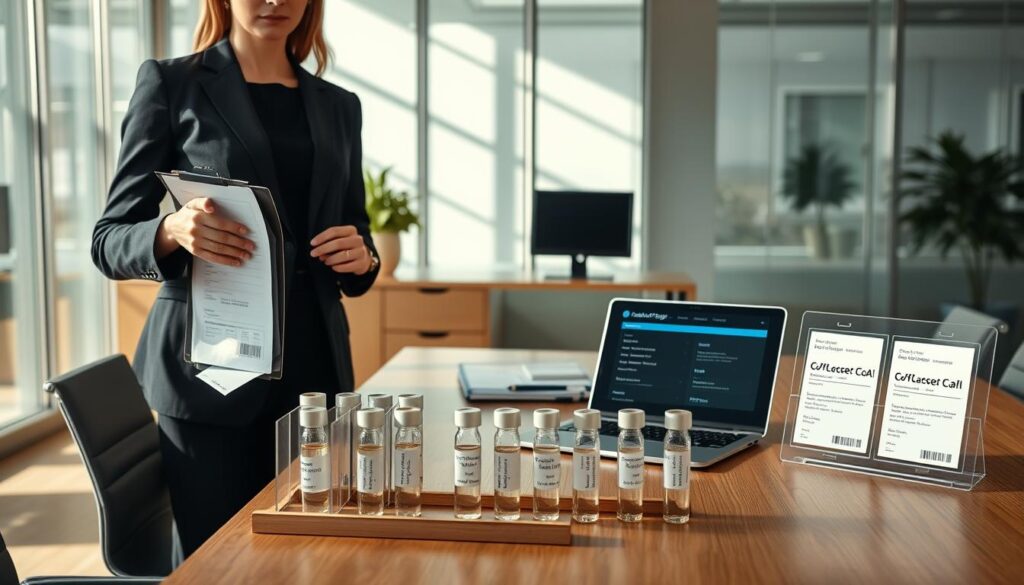
When checking sampling notes, we look at three important things on the CoA or its documents. A good review answers these questions:
- Who: Was the sample collected and handled by the right people? The collector’s identity or role must be noted. This shows accountability at each step.
- When: Are the dates and times of collection and transfers clear? This creates a timeline that matches shipping and receiving records.
- Where: Is the exact location of sampling noted? This includes batch, container, or lot numbers. It ties the sample to its source.
An uninterrupted chain of custody is essential for quality assurance. If the sample’s integrity is broken during transit or storage, analysis is flawed. Checking the “who, when, where” details safeguards the quality process from this risk.
Escalation flow for discrepancies (hold, quarantine, supplier CAPA)
Finding a non-conforming CoA is just the beginning. It starts a process to fix the issue. This process keeps the product safe and the supply chain running smoothly.
Quality systems, like the Yanfeng Supplier Standards Manual, guide this process. It’s clear, follows a sequence, and has deadlines.
When a CoA issue is found, the first step is to stop the problem. The bad material is kept separate to avoid any mistakes in production. This is done in two main ways:
- Hold: The material is set aside in the warehouse or production area for more checking.
- Quarantine: It’s moved to a special area and its status is updated to prevent it from being used.
This step is key to prevent the bad material from spreading.
After stopping the problem, the next step is to talk to the supplier. The quality team sends a formal claim. This includes details about the CoA issue and why it’s a problem.
The supplier then has to fix the issue and prevent it from happening again. This is called Corrective and Preventive Action (CAPA). They find and fix the main cause of the problem. They also look for ways to stop it from happening again.
If the supplier’s response is not good enough, there are more steps. These steps include:
- Talking to the supplier’s quality team or leaders during regular meetings.
- Using controlled shipping where the supplier checks every item before it’s sent.
- In serious cases, going to the procurement team for bigger actions.
This clear escalation flow makes sure every issue is handled the same way. It turns a quick fix into a formal process. This makes the partnership stronger and lowers risk in the supply chain.
Downloadable verification checklist
A new tool has been created to make the verification process easier. It’s a downloadable checklist that guides quality assurance professionals step by step.
This checklist helps you follow the steps from checking the PO, label, and COA to verifying lab accreditation. It also reminds you to look at data integrity and digital signatures. It makes sure you follow the chain of custody and know how to handle any issues.
The last step is to check if your company has a policy for keeping samples. Keeping samples is important for future analysis or if there’s a quality dispute. This step finishes the verification process and protects against future problems.
Using this checklist makes sure you evaluate suppliers the same way every time. It turns the article’s advice on how to read a chemical Certificate of into a daily routine. It makes your audits better and improves your quality control.
Download and use this checklist to make every material receipt clear and thorough. It’s a key tool for staying compliant and doing your job well.