


Let’s clear up the confusion. Imagine going to a tailor versus buying off the rack. That’s the gap between a standard chemical and a bespoke chemical solution.
In simple terms, we’re discussing a precisely designed blend. Every component and ratio is carefully selected to meet a specific goal. This is something mass-produced products can’t achieve.
It’s like comparing a common paperback to a rare, leather-bound book. One is functional; the other is crafted for a particular use, lasting longer, and looking better.
This isn’t just about mixing chemicals. It’s about using chemical knowledge to solve your specific, costly problems. If you need an adhesive for space or a coating that withstands harsh chemicals, you need something made for your needs.
That’s what custom chemicals are all about. They’re not just fancy blends. They’re custom-made solutions for your industrial challenges.
When to Consider Custom vs. Stock
Your supplier just dropped a bombshell: your go-to resin is being discontinued. Now what—scramble for a similar stock item or architect something truly yours? This moment of reckoning separates the reactive from the strategic. It’s the business equivalent of choosing between a rental car for your cross-country road trip and building the vehicle for the journey.
Let’s cut through the noise. The decision matrix isn’t complicated, but it does demand brutal honesty about your pain points. Ask yourself these questions:
- Has your current adhesive, coating, or polymer been slated for the corporate chopping block?
- Is your current resin no longer in regulatory compliance with evolving standards like REACH or Prop 65?
- Are you chasing a performance unicorn—a specific viscosity, thermal profile, or sustainability metric that doesn’t exist on any shelf?
If you answered yes to any of these, you’re in custom territory. Stock formulations are the reliable, cost-effective workhorses for generic needs. But when your challenges are unique, complex, or compliance-heavy, insisting on a stock solution is like trying to win the Indy 500 with that rental car. The engine might run, but you won’t be holding any trophies.
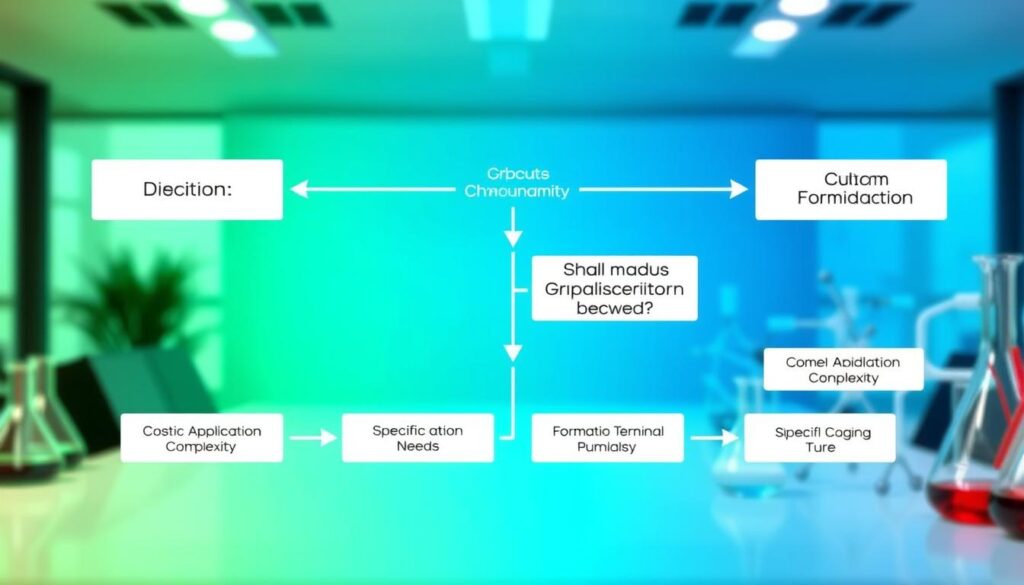
Consider the regulatory eviction notice. When legislation changes, your formerly compliant material might suddenly become a liability. A stock replacement that’s “mostly similar” isn’t good enough—it’s a regulatory game of whack-a-mole. Custom formulations enable companies to innovate and differentiate their products while building compliance into the molecular blueprint from day one.
Then there’s the performance chase. Maybe you need a polymer that behaves differently at extreme temperatures. Or an adhesive that bonds in high humidity. Off-the-shelf options offer compromises. Custom development offers solutions. The difference isn’t semantic; it’s strategic.
| Scenario | Stock Formulation Response | Custom Formulation Response | Strategic Implication |
|---|---|---|---|
| Product Discontinuation | Find closest available match; adjust process to fit material | Recreate or improve upon original properties; own the formula | Reactive adaptation vs. proactive control |
| Regulatory Change | Hope new stock item meets requirements; retrofit compliance | Design with compliance as a core parameter from inception | Risk management vs. risk elimination |
| Unique Performance Need | Accept trade-offs; work around limitations | Engineer exact specifications; achieve target outcomes | Making do vs. making it work |
| Market Differentiation | Use what competitors also use; blend into the crowd | Create proprietary advantages; stand out on the shelf | Commodity positioning vs. specialty solutions |
The financial analysis often trips people up. Yes, custom development has higher upfront costs. But have you calculated the true cost of stock? Include the engineering hours spent tweaking processes to accommodate “close enough” materials. Factor in the downtime when that stock item has its own supply chain hiccup. Account for the lost market share when your product can’t differentiate. Suddenly, the tailored solution looks less like a luxury and more like insurance.
This isn’t to say stock formulations don’t have their place. For routine applications with standard requirements, they’re the frugal, sensible choice. The problem arises when companies force unique problems into generic boxes. It’s the business version of wearing someone else’s prescription glasses—you might see shapes, but you’ll never achieve clarity.
For a deeper dive into the financial and operational comparisons, our analysis on stock formulation vs. custom formulation breaks down the numbers beyond the surface-level pricing.
So when do you pull the trigger? When discontinuation threatens your supply chain. When regulations rewrite your rulebook. When performance demands exceed commodity offerings. When “good enough” becomes the enemy of “exactly right.” Your specialty solutions deserve a specialty approach—one that treats formulation not as a purchase, but as an investment in your product’s future.
Working with Suppliers on R&D
Custom formulation work turns your supplier into a ‘lab-coat-wearing sage’ with deep chemical knowledge. It’s not just buying; it’s a partnership. You’re not just hiring a vendor, but a co-pilot with a lab.
The journey starts with a talk, not just a chemical order. A smart supplier acts like a forensic expert, understanding your needs. They want to know the why behind your what.

They focus on four main areas. First, product feasibility: Can you make it within budget and time? Second, product specifications: They nail down key details like solubility and shelf life. Third, application and performance: They consider how your product will work in real life. Fourth, regulations: They help you navigate compliance before starting.
This is where real R&D teamwork begins. Companies like Seatex or ResinLab don’t just take orders. Their experts become part of your team. They share market insights and suggest better materials.
It’s a two-way street of innovation. You bring the challenge; they offer their experience. They can even reverse-engineer a competitor’s product. And they can suggest better materials or formulations.
The best results come from a real dialogue. It’s a chemical courtship. You share your vision and limits; they offer solutions and challenges. Their chemists have seen many successes and failures.
This R&D partnership needs openness from both sides. Share your budget and dreams of scalability. The supplier aims to find a solution that works in the lab and on your production line.
In essence, working with suppliers on R&D means trading a simple order for a deep, shared lab notebook. It’s where the monomer meets the catalyst, and a true partnership is formed.
Compliance and Documentation Needs
Compliance is like solving a legal puzzle. Every piece is important. If you miss one, you face fines, recalls, or being banned from the market. It’s not just about following rules; it’s about keeping your product safe.
Your formulation partner is like a mapmaker. They guide you through the complex world of REACH, RoHS, Proposition 65, EPA, and NSF standards. They help you avoid legal trouble.
Documentation is key. It tells your product’s story and protects it legally. Each document is for a different audience, like regulators or customers.
The Safety Data Sheet (SDS) is like an emergency guide. It warns about hazards and how to handle your product. A good SDS is like a thriller where everyone stays safe.
The Technical Data Sheet (TDS) is like a resume. It shows what your product can do. It’s the opposite of the SDS, which warns about dangers.
Certificates of analysis prove your product’s purity. Country of origin statements and supply chain disclosures are also important. Each certificate is a promise that your product is as labeled.
| Regulatory Framework | Primary Scope | Key Documentation Required | Common Pitfalls |
|---|---|---|---|
| REACH (EU) | Chemical substances registration | Registration dossiers, SDS, exposure scenarios | Missing downstream user communication |
| RoHS | Restriction of hazardous substances | Material declarations, test reports | Incomplete supply chain data |
| Proposition 65 (CA) | Consumer exposure warnings | Warning labels, notification letters | Inadequate warning language |
| EPA Regulations | Environmental protection | Product registrations, efficacy data | Incorrect product categorization |
| NSF/ANSI Standards | Product safety certification | Test data, quality manuals, audit reports | Insufficient manufacturing controls |
Having complete documentation gives you regulatory confidence. It’s the peace of mind you need when your product is in transit or on store shelves.
Good compliance experts are proactive. They watch for new laws and help you stay ahead. This makes compliance a strength, not a weakness.
Your documentation is the first thing regulators see and the last thing customers check. It’s your introduction and lasting impression.
Working with compliance experts means more than just forms. You get strategic advice on what certifications you need and how to prepare for audits.
In the end, good compliance documentation makes things clear and manageable. It turns legal hurdles into chances to grow your market, one form at a time.
Managing Trials and Pilots
Think of your custom formulation’s pilot phase as its opening night off-Broadway. Here, the critics are your production line, and the audience is your bottom line. It’s not a delay in your grand premiere. It’s like out-of-town tryouts, where theory meets reality.
A good manufacturer sees trials as a core service. They make small batches, from pints to intermediate totes, for you to test. This is your first financial defense.
Why risk a big batch of a “wonder-chemical” that might fail? The pilot phase helps you find flaws, adjust proportions, and check performance. It’s a smart investment for your supply chain.
The real magic happens in the analytical backstage. A strong testing arsenal is key. You need data, not just guesses.
This means using HPLC and UHPLC for purity and potency checks. Gas Chromatography (GC) finds unwanted volatiles. FTIR spectroscopy confirms molecular identity—is your compound real?
Particle size analysis ensures consistency, vital for flow and dissolution. For metals and inorganic elements, ICP-OES gives a detailed report. Pilot reactors simulate scale-up conditions, asking if it works at larger scales.
This thorough analytical validation turns guesses into clear decisions. It shows if your formulation is Nobel-worthy or a spectacular failure.
| Test Method | What It Measures | Why It Matters for Pilots |
|---|---|---|
| HPLC/UHPLC | Purity, potency, and separation of components | Confirms the active ingredient is present at the correct strength and free of major impurities. |
| Gas Chromatography (GC) | Volatile organic compounds and solvents | Ensures residual solvents are below safety limits, affecting product safety and smell. |
| FTIR Spectroscopy | Molecular bonds and functional groups | Verifies the chemical identity and structure of your formulation—its fundamental fingerprint. |
| Particle Size Analysis | Size distribution of solid particles | Critical for consistency in flow, mixing, dissolution rate, and final product texture. |
| ICP-OES | Trace metal and inorganic element content | Detects contaminant metals or verifies essential mineral content, critical for safety and efficacy. |
This is a systematic de-risking protocol. You’re not just testing a product. You’re stress-testing a process. Each small batch shows how your formulation behaves under real conditions.
What looks good in a small beaker can fail in a big tank. The pilot phase catches that. It answers “what ifs” before they become expensive “oh nos.”
In the end, managing trials isn’t about hesitation. It’s about confident progression. You move from lab scale to full production with evidence guiding you. You replace anxiety with data. That’s not a delay. That’s a strategic step toward success.
Conclusion
So, here’s the final thought. Asking for a custom formula isn’t just shopping. It’s a bold statement against settling for less. You’re saying you want to lead, not follow.
Imagine choosing a custom-made suit versus buying one off the rack. The custom suit fits you perfectly, unlike the generic one. Dow and BASF offer more than just chemicals; they provide tailored solutions through their R&D work.
This path involves navigating through complex rules and testing. You need a partner who’s a mix of scientist, lawyer, and quality expert. It’s where smart planning meets magic.
The numbers show that custom formulas can change the game for businesses. In a sea of generic choices, your custom formula stands out. It’s the secret to your product’s success.
When picking a partner, think of it as choosing a co-pilot for a tough mission. Be clear about what you need. Then, watch as “good enough” fades away, replaced by something designed to win.