


Finding a chemical supplier shouldn’t be like swiping right on a dating app. It’s not about looks. It’s about finding your operational soulmate who knows “flammable” is serious.
Companies often pick the cheapest supplier without checking if they know what they’re doing. This can lead to a big problem. It’s not just messy—it’s a legal disaster.
True chemical logistics experts are rare. You need someone who knows more than just basic safety rules. It’s like hiring a team of experts, not a regular delivery service.
They should be experts in safety rules and ready for audits. The best partner will think ahead, preventing problems before they start.
Look for suppliers with the Responsible Care® badge. It shows they care about safety. Choosing the right supplier is more important than any other decision in chemical logistics.
Storage & Handling Guidelines
Proper chemical storage is more than just finding empty shelves. It’s about creating a controlled environment where chemicals are organized. Think of it as planning a city for molecules, where incompatible substances never meet.
Getting it wrong can lead to chaos. It’s like starting a story of an accident. The rules are based on past mistakes and are quite logical.
Segregation is key. It’s like not inviting both your exes to the same party. The data shows why:
- Acids and bases should be stored separately. Mixing them is dangerous, like combining baking soda and vinegar in a sealed container.
- Flammables and oxidizers must be kept apart. This is like not storing fireworks next to propane tanks.
- Toxics and corrosives need their own special storage, away from general items.
Modern facilities use color-coded cabinets. Red for flammables, yellow for reactives, and blue for health hazards. It’s a quick way to know what’s inside.
The Storage Spectrum: From Shelving to Specialized Cabinets
Not all storage is the same. Your choice depends on what you’re storing and the risks. Here’s a breakdown:
| Storage Type | Best For | Critical Features |
|---|---|---|
| General Shelving | Non-hazardous, stable chemicals in original packaging | Secure, ventilated areas with clear aisle space |
| Flammable Cabinets | Solvents, fuels, any Class I flammable liquids | Double-walled construction, self-closing doors, fire rating |
| Corrosive Cabinets | Acids, bases, etching solutions | Chemical-resistant liners, spill containment, venting options |
| Security Cabinets | Controlled substances, high-value materials | Locking mechanisms, access logs, restricted entry |
| Refrigerated Storage | Temperature-sensitive reagents, biologicals | Explosion-proof design for flammable materials, temperature monitoring |
Environmental control is essential. Temperature and humidity are not just comfort factors. They affect chemical stability. Your storage area needs to be monitored like a ICU.
The Handling Ritual: From SDS to PPE
Handling chemicals is a ritual with specific steps. Skipping one can be reckless.
First, check the Safety Data Sheet (SDS). It’s the chemical’s biography and medical history. Start with Section 7 (Handling and Storage) every time.
Second, wear the right PPE. It’s your personal protection. Choose gloves, eye protection, and lab coats that fit the job.
Third, use the right tools. No mouth pipetting. Use pumps, syringes, or automated dispensers. Work carefully in ventilated areas or under fume hoods.
Spill Containment: Planning for the Inevitable Maybe
Spills happen. The question is how bad. Your storage design should be ready.
- Secondary containment is key. Shelves should have lips. Cabinets should have spill trays. Floor areas should have berms or drains.
- Spill kits must be easy to reach. Not hidden. Immediately available like a fire extinguisher.
- Training is essential. Everyone who accesses the storage area should know how to handle spills. It’s basic survival knowledge.
Labs and industrial settings differ in scale, not principles. Labs might store milliliters in a fridge. Factories might store drums in a warehouse. The rules of segregation, labeling, and containment apply to both.
Clear labeling is important. Every container should show its contents, hazards, date received, and owner. Hazard symbols should be clear. It’s like a “Hello My Name Is” sticker at a dangerous conference.
Intelligent storage leads to predictability. It turns volatile chemicals into manageable ones. When everything has its place, you’re not just storing chemicals. You’re creating stability.
Regulatory Transport Requirements
Chemical transport is more than just loading trucks. It involves a complex web of rules and regulations. Each shipment must pass through a series of checks by various agencies. Missing a step can lead to serious consequences.
OSHA ensures workplace safety, while the EPA reviews environmental impact. These agencies have strict standards. Not following them can cause delays and fines.
Compliance is key in this process. It’s like getting a ticket to the show. Without it, you can’t proceed.
The first part of the process involves domestic regulations. OSHA focuses on workplace safety and chemical handling. NFPA 30 deals with fire safety, setting rules for storage and suppression systems.
The EPA under RCRA looks at environmental impact. Any mistake can lead to a lengthy review process.

When chemicals move, specialized rules come into play. For air transport, IATA certification is required. Sea shipments need IMDG code knowledge. Ground transport follows USDOT hazmat regulations.
Working with a qualified partner is essential. A third-party logistics provider (3PL) without the right credentials can cause problems. Non-compliance can damage your reputation.
Having expertise in chemical transport makes the process smoother. It ensures compliance and avoids regulatory issues. Your business can operate smoothly, without fear of shutdowns.
Traceability & Inventory
Traceability in chemical logistics is more than just paperwork. It’s a digital system that keeps operations safe and smart. Think of your centralized chemical inventory as a digital twin of your space. It’s not just a list; it’s a control center that shows you what you have, where it is, and its age.
Without it, you’re like a pilot flying blind. You might be moving, but you don’t know what’s ahead or what obstacles you’ll face.
Knowledge is power. A good system keeps things in order through smart organization and use.
A Warehouse Management System (WMS) is used to keep things organized. It enforces rules and keeps track of every item. This is your audit trail.
Managing the lifecycle of items is key. FIFO helps use older items first. This reduces waste and risk from old, unstable materials.
Inventory methods vary greatly. The difference between old and new systems is huge, like a sundial versus an atomic clock.
| Inventory Method | Key Capability | Risk Profile | Business Impact |
|---|---|---|---|
| Paper Logs & Static Spreadsheets | Manual entry, delayed updates | High. Prone to human error and data lag. | Reactive. You find problems after they occur. |
| Basic Digital Database | Tracks name and location | Medium. Lacks real-time insight and condition data. | Informative, but not predictive. |
| Advanced WMS with IoT Integration | Real-time location, condition monitoring, automated FIFO | Low. Provides predictive alerts and full traceability. | Proactive & Predictive. Prevents issues before they start. |
Technology makes management better by listening. Modern systems use IoT sensors and RFID tags. These aren’t just barcodes; they monitor your assets.
A sensor on a sensitive drum warns of rising temperatures. An RFID tag tracks who handled it and where it went.
This real-time monitoring turns your digital inventory into a crystal ball. You can predict problems and fix them before they happen. This makes your operation much safer.
In the world of hazardous materials, knowing what you have is key. True traceability is your defense against the unknown. It makes inventory management the heart of safety and wisdom.
Emergency Procedures
When dealing with volatile substances, knowing where the spill kit is is key. Emergencies in chemical handling aren’t like movie scenes. They’re messy and happen fast. Your whole operation depends on quick action.
Think of your emergency plan as a real fire drill. It’s not just something you do in school. It’s about having a plan that works when you’re in a panic. Specialized fire extinguishers, first aid kits, and emergency showers are essential. They protect you from a bad day turning into a disaster.
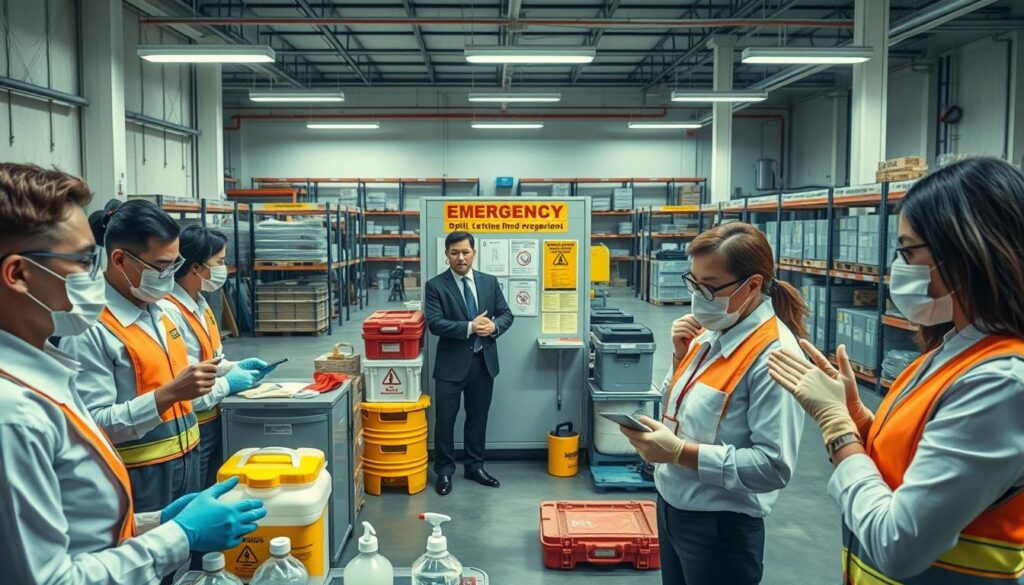
Eye wash stations are not just decorations. They can save someone’s vision in 15 minutes. You need to rinse with clean, lukewarm water for 15-20 minutes. Then, get medical help right away. This isn’t just a rule; it’s a matter of life and death.
So, what does a good emergency plan look like? It’s more than just a checklist.
Equipment is Geography. Know where your fire extinguisher is as well as your coffee machine. Your team should know which extinguisher to use in the dark. Spill kits should be easy to find, like they’re waiting for you.
The Plan is a Living Document. Don’t just read advice from suppliers. Practice your plan. Do mock drills and time how fast you can respond. A good plan saves lives.
Training is the Glue. Trained people can follow their emergency steps even when distracted. They know how to find the emergency shower and what to do with a spill. This turns panic into action.
The key is to have a system ready for emergencies. This includes having the right equipment, following protocols, and having trained people. The National Response System agrees.
Your emergency procedures show what kind of culture you have. They answer if you’re ready for emergencies or not. The data is clear: being prepared is the only smart choice.
Real-Life Scenarios
The most expensive lessons in chemical management aren’t taught in classrooms. They’re found in incident reports and insurance claims. Let’s look at a couple of real-life scenarios that happen more often than anyone wants.
Meet Alex, a lab technician who’s always running behind. One Tuesday, Alex decides to ignore segregation rules to save time. A bottle of chlorine bleach ends up next to acetone on the shelf.
Bleach is an oxidizer, and acetone is flammable. The lab’s ventilation is poor. Invisible vapors start a dangerous dance. Then, a spark from a lab coat ignites the fire.
The fire starts from storage laziness, not an experiment. This isn’t fiction; it’s a real result of ignoring chemical storage rules.
Now, let’s go to a manufacturing startup. They’ve got a big order but need to ship sensitive polymers. They pick a 3PL provider for a low bid.
The provider claims to handle chemicals, but they don’t know about hazard class rules. The polymers are shipped in a standard truck.
Two days later, the shipment arrives. The client gets a useless lump of plastic instead of resin. The cost savings? Gone, along with the product value. This shows the risk of using a 3PL without hazard-class expertise.
These stories show common mistakes:
- Improper labeling that hides a container’s true identity.
- Not checking the Material Safety Data Sheet (MSDS) before storage or handling.
- Thinking all logistics partners are the same, no matter their training.
Storing incompatible chemicals together is dangerous. It can cause fires, toxic reactions, or explosions. This is not just a rule; it’s a warning for your company’s safety.
The irony is that these shortcuts were taken to save time or money. The real cost is in damaged inventory, facilities, or worse. These real-life scenarios are cautionary tales for our industry.
So, what’s the lesson? Every storage decision and logistics choice is a story you’re writing. Will it be a boring story of compliance, or a thriller of disaster? The choice is yours. Don’t write a tragedy.
Conclusion
So, what’s the key takeaway from this journey of chemical stewardship? Safety isn’t just a part of the plan. It’s the heart of a smart, modern business. Choosing reliable suppliers in Dubai, Sharjah, or the UAE is the first step.
Think of it this way. Keeping chemicals safe shows respect for the materials. Following strict transport rules shows respect for the law. Using technology to track chemicals is respect for knowledge. And having a good emergency plan shows respect for the unexpected.
This isn’t just a list of tasks. It’s a way of thinking about how to run a business. When you see chemical management this way, your facility changes. It becomes a place of foresight, not danger.
Certifications like Responsible Care® are more than just symbols. They show a supplier’s dedication to safety. They mean a partner who knows that sourcing, storage, and transport are all part of the safety net.
Use your knowledge wisely. Organize your space carefully. Choose partners thoughtfully. This is how you become a master of safety.
Your reputation, your team, and the environment all depend on this approach. Make chemical stewardship your edge. Turn a necessary safety measure into proof of your smart management.