


For any company making industrial chemicals, managing what shouldn’t be in your product is just as vital as ensuring what should. A strong approach to purity isn’t just a regulatory box to check. It’s a critical lever for guaranteeing product safety, integrity, and reliable performance.
This responsibility spans a wide spectrum. It goes from monitoring the main assay components all the way down to trace-level elemental impurities and microbial bioburden. Each type requires specific attention and methods.
The regulatory landscape has evolved significantly. Modern standards like ICH Q3D and USP chapters have replaced older methods. They set clear impurity limits for trace metals in raw materials, in-process mixes, and finished goods.
Navigating this shift requires a proactive and risk-based impurity control strategy. Harmonizing these standards is a challenge, but it’s fundamental for operational excellence. Building this foundation is how you earn lasting market trust.
Define Critical Quality Attributes for Your Process
The journey to effective impurity management starts with a simple question: what are the Critical Quality Attributes for my process?
Critical Quality Attributes, or CQAs, are the measurable properties that define your product’s quality. For impurities, they are the specific limits you must meet to ensure your chemical performs as intended. Defining them is the cornerstone of your control strategy.
These targets are not one-size-fits-all. They come directly from your product’s final use. A solvent for electronics manufacturing has different purity needs than a pharmaceutical intermediate. Your CQAs must reflect that.
You build your impurity CQAs from three core pillars:
- Patient or End-User Safety: This is non-negotiable. Any impurity with toxicological concern must have a strict limit.
- Product Efficacy: Will the impurity hinder the chemical’s function? Trace metals can poison a catalyst. Moisture can stop a polymerization.
- Process Robustness: Can the impurity cause handling issues, corrosion, or shelf-life problems? It affects your manufacturing reliability.
Start by mapping your chemical’s life. Ask pointed questions about each stage. Could a residual solvent affect the final product’s color or odor? Might a trace metal deactivate a precious catalyst in the next reaction? Could a change in stabilizer concentration lead to dangerous decomposition later?
This focused questioning saves immense time and cost. Without clear CQAs, you test for everything. You scatter your analytical resources on impurities that don’t impact your outcome. You might miss the one that does.
Defining CQAs turns impurity control from a guessing game into a science. It tells your lab exactly what to look for and how precise they need to be. It informs your sampling plan and your supplier agreements.
This first step creates a filter. The many possible impurity classes—like metals, moisture, or bioburden—only become relevant if they touch a defined CQA. This is how you build a strategy that is both lean and all-encompassing.
By setting your CQAs first, you lay a logical foundation. The following sections on specific impurity classes and test methods will then make perfect sense. You’ll see them not as a checklist, but as tools to protect what you’ve defined as critical.
Typical Impurity Classes: moisture, residual solvents, metals, stabilizers/inhibitors, bioburden/particulates
Managing impurities starts with knowing the common types found in industrial chemicals. Understanding these groups helps you set better standards and avoid surprises in your work.
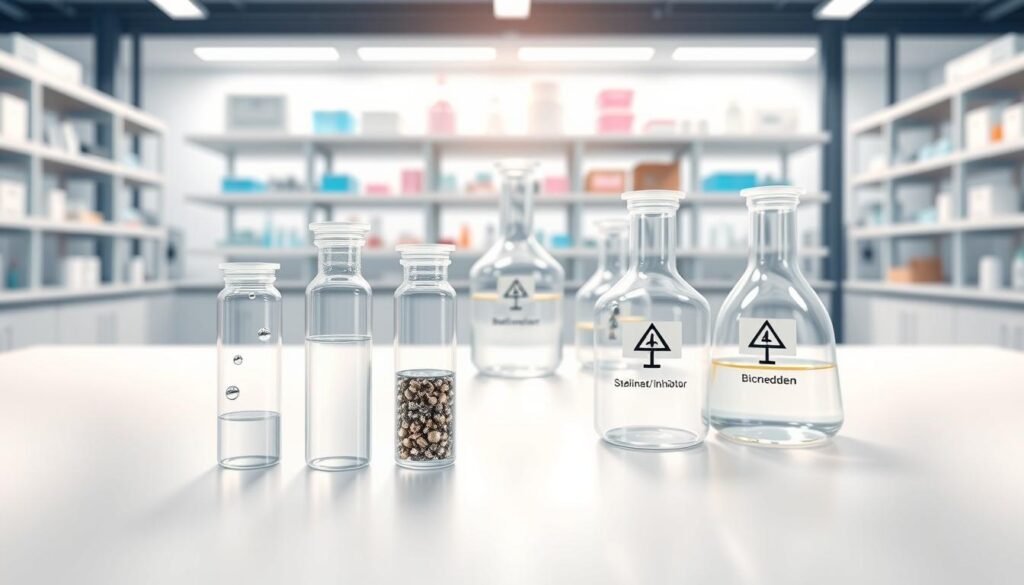
Moisture, or water content, is a key impurity to consider first. Even a little water can cause problems in sensitive reactions. It can damage your product or change how it works. So, controlling water content is very important for chemicals used in places where moisture is a problem.
Residual solvents are left over from making or purifying chemicals. Some can be harmful. Others can change how the chemical behaves, like its thickness or how it crystallizes. You need to know which solvents might be left behind and how much.
Metals are another big group of impurities. They often come from leftover catalysts in making chemicals. Metals can also come from equipment or containers. These impurities don’t help your product and can make it less stable over time.
Even in small amounts, metals can mess with reactions later on. They can also cause color changes or make your product degrade faster. It’s important to keep an eye on metals for safety and to make sure your product is consistent.
Stabilizers and inhibitor packages are added to prevent damage during storage. But, you have to control how much is added. If there’s too little or too much, your product might not work as well.
Think of stabilizers as important additives that affect your product’s quality. Your inhibitor packages need to be just right. Not too little, not too much. This ensures your product behaves as expected for your customers.
Bioburden and particulates are important even in non-sterile settings. Microbes can use up reactants or make unwanted products. Particulates can block filters, damage equipment, or ruin your final product.
Each type of impurity comes with its own risks. By understanding these, you can prevent problems instead of just fixing them. This knowledge helps you choose the right tests, which we’ll look at next.
Remember, a clear impurity profile is your roadmap to consistent quality. Starting with these five classes gives you the confidence to set the right limits and ask the right questions.
Test Methods and Sensitivity: Karl Fischer, GC/GC‑MS, ICP‑OES/ICP‑MS, HPLC, particle counts
Your analytical toolbox must match each impurity class with a technique known for its sensitivity and specificity. The right instrument turns a quality target into a reliable number you can trust.
This empowers you to make confident decisions about your materials. Let’s explore the core methods that form the backbone of modern impurity control.
Karl Fischer Titration for Water Content
Moisture might seem simple, but it can ruin a sensitive reaction. Karl Fischer titration is the gold standard. It delivers precise measurements for both free and bound water.
Modern coulometric Karl Fischer instruments can detect water down to single-digit parts per million. This precision is vital for hygroscopic materials or processes where water acts as a poison.
Gas Chromatography for GC Residuals
Tracking leftover solvents, or GC residuals, requires a technique built for volatiles. Gas Chromatography, often paired with a Mass Spectrometer (GC-MS), is the perfect fit.
GC separates the solvent mixture. The MS detector then provides a chemical fingerprint for positive identification. This combo allows you to quantify trace solvents at sub-parts-per-million levels with great confidence.
Metal Analysis: From ICP-OES to Superior ICP-MS
For elemental impurities, techniques like Atomic Absorption (AA) and Inductively Coupled Plasma Optical Emission Spectrometry (ICP-OES) are useful. But for the strict limits of ICH Q3D, you need ultimate sensitivity.
That’s where ICP-MS (Inductively Coupled Plasma Mass Spectrometry) shines. It offers detection limits that are often 100 to 1000 times lower than ICP-OES. This makes it ideal for measuring toxic metals like cadmium or lead at safe, ultra-trace levels.
Guidelines like USP specify procedures for elemental impurities using modern instrumentation for elemental impurities. This cements ICP-MS’s role in regulatory compliance.
Organic additives like inhibitors and stabilizers are not volatile. High-Performance Liquid Chromatography (HPLC) is the method of choice here. It separates complex mixtures based on how they interact with a column.
You can use HPLC to assay the main stabilizer concentration. You can also monitor its degradation products over time. This is key for change control and ensuring consistent product performance.
Particle Counters for Bioburden and Particulates
Visible haze or microbial contamination often starts with tiny particles. Automated light-obscuration or microscopy-based particle counters provide direct, quantitative data.
They don’t just count particles. They give you a size distribution. This helps pinpoint the source of contamination, whether it’s from processing, packaging, or the raw material itself.
| Impurity Class | Primary Test Method | Key Advantage | Typical Sensitivity / Note |
|---|---|---|---|
| Moisture / Water Content | Karl Fischer Titration | High precision for bound and free water | Down to 10 ppm (0.001%) |
| Residual Solvents (GC residuals) | Gas Chromatography (GC & GC-MS) | Positive identification & quantification of volatile organics | Sub-ppm levels with GC-MS |
| Elemental Impurities / Metals | ICP-OES / ICP-MS | Ultra-trace multi-element analysis per ICH Q3D | ICP-MS detects parts-per-billion (ppb) or lower |
| Stabilizers, Inhibitors | High-Performance Liquid Chromatography (HPLC) | Separates and quantifies non-volatile organic compounds | Varies; often ppm-level |
| Bioburden & Particulates | Automated Particle Counters | Direct count and size distribution | For particles >1 µm |
Choosing the right test method is more than a technical step. It’s your pathway to control. With sensitive tools like ICP-MS and specific methods for every impurity type, you transform risk into manageable data.
This data forms the solid foundation for the specifications and performance links we’ll discuss next.
Linking Spec to Performance: catalyst poisons, color/odor, deposit formation, corrosion
Impurity limits are not just numbers. They are barriers to protect your process from harm. This part shows how contaminants affect your work. Setting the right impurity limits keeps your product safe and effective.
Your spec sheet is like a promise of quality. Each limit has a reason. Why can’t certain metals or solvents be in your product? The answers help avoid major problems.
Catalyst Poisons: The Silent Yield-Killers
Even tiny amounts of metals like lead can harm your catalysts. These impurities block the catalyst’s work. This can stop your production cold.
Setting strict impurity limits is key. It keeps your catalysts working well. This ensures your production runs smoothly.
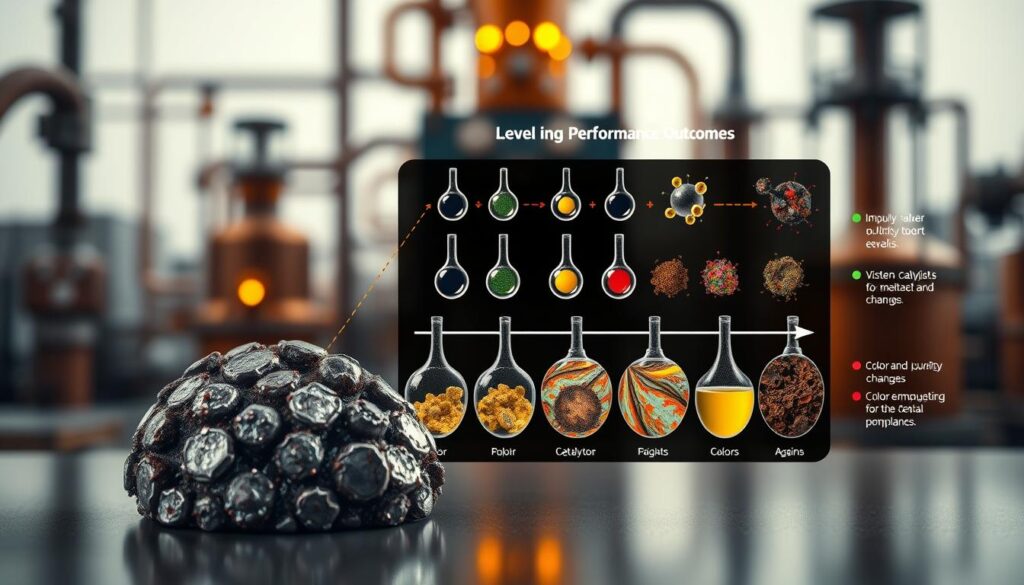
Small amounts of impurities can change color or smell. A slight yellow or a bad smell means trouble. These signs show your product might not be good.
Rules for these impurities are based on how they affect your product. They stop problems that hurt your reputation and shorten shelf-life.
Deposit Formation: Fouling Your Equipment
Some impurities don’t stay dissolved. They form hard deposits on your equipment. This makes it harder for your equipment to work right.
These deposits can cause big problems. They lead to costly cleanings and downtime. Your impurity limits help keep your equipment running smoothly.
Corrosion: Attacking Asset Integrity
Impurities like chlorides can start corrosion. They damage your equipment, leading to leaks or worse. This is a big risk to your safety.
Rules for these impurities are all about safety. They help prevent damage to your equipment over time.
Every limit on your spec sheet is a defense. It’s based on science and safety. By linking specs to risks, you protect your work. This lets your team focus on making quality from the start.
CoA vs In‑House Verification: sampling plans, acceptance ranges, retains
Your chemical supply chain’s integrity is more than just a piece of paper. It needs a proactive CoA verification strategy. A supplier’s Certificate of Analysis is just the start. True confidence comes from your own checks.
This isn’t about distrust. It’s about smart risk management. Working with labs like Pace, Cambrex, or Scientech is a good middle ground. They help with testing, method development, and validation.
A strong program starts with a statistical sampling plan. You can’t test every item. A good plan makes sure your samples represent the whole batch.
Think about these for your plan:
- Sample size: Based on batch size and risk.
- Sampling points: Top, middle, and bottom of containers.
- Sampling frequency: Every lot, or based on supplier performance.
Then, set your acceptance ranges. The vendor’s spec sheet isn’t enough. Your ranges should match your process’s Critical Quality Attributes.
Ask yourself: Is the impurity limit tight enough to prevent catalyst poisoning? Will a slight moisture increase cause corrosion? Set ranges that protect your performance, not just meet a generic standard.
Keeping retains is your safety net. Always store samples from each verified lot. If a problem arises later, you have evidence for investigation.
This makes CoA verification a core quality activity. Firms like Cambrex often focus on risk-assessment strategies. These guide how often and deeply to verify.
So, when do you test in-house versus outsource? Use this simple guide:
- In-house: For high-volume, routine tests where you have equipment and expertise.
- Third-party lab: For complex analyses (trace metals, GC-MS), method validation, or to audit critical suppliers.
Building this verification layer takes effort. But the payoff is huge. You get control, reduce surprises, and build a stronger operation. Start by reviewing your highest-risk materials today.
Change Control for Inhibitors/Stabilizers and their impact on downstream steps
Changing your supplier’s inhibitor package might seem small, but it can affect your whole production line. These components are key for keeping your product safe and fresh. Any change needs a strict, formal process.
Why is this so important? Stabilizers and inhibitor packages do more than just fill space. They work with your chemical in a special way. A new formula, even from the same supplier, can act differently. You need to review everything carefully to spot these changes early.
Look at three main areas: your lab, your plant, and your final product. First, will your current tests work with the new stabilizer? It could mess with your purity or concentration checks.
Next, think about the process. Could the new package harm a catalyst or cause problems in pipes and reactors? It’s important to check for any unexpected issues.
Lastly, check how the change affects your product. The main goal is to keep it stable. Make sure the new stabilizer doesn’t make your product degrade faster.
| Impact Area | Potential Risk | Recommended Action |
|---|---|---|
| Analytical Methods | New formulation causes interference in GC, HPLC, or other tests, leading to inaccurate impurity data. | Perform method verification or re-validation. Update CoA reporting requirements. |
| Downstream Process | Adverse interaction with catalysts, other additives, or equipment surfaces, affecting yield or causing fouling. | Run small-scale compatibility tests. Review process parameters with engineering teams. |
| Final Product Performance | Altered degradation pathway reduces shelf-life or changes key attributes like color or odor. | Conduct accelerated stability studies. Re-evaluate product specifications. |
This careful planning turns a risk into an opportunity for improvement. By understanding these impacts, you can make sure the change helps your quality goals. Proper documentation of this review is key to managing this important control point.
Documentation: method references on CoA, reporting significant figures, uncertainty notes
A good control strategy has three key parts: clear method references, accurate significant figures, and acknowledged uncertainty. Your data’s trustworthiness depends on the supporting paperwork. Clear documentation builds trust with customers and meets regulatory standards.
Your Certificate of Analysis (CoA) tells the story of your product’s purity. Each test result must link back to its method.
Method references are essential. Saying “Metals: 5 ppm” isn’t enough. You must specify the exact method, like “USP <233>” or “In-House SOP-ICP-05.” This ensures clarity and validity.
Standards like ISO/IEC 17025 require this traceability. It’s key for cGMP in pharmaceuticals and best practice in all chemicals. Clear references make your CoA a solid quality record.
Then, there’s how you report the numbers. Reporting significant figures correctly shows your method’s precision.
For example, “0.1567% moisture” suggests a precise method. But if your Karl Fischer titrator is only precise to 0.1%, report “0.2%.” Avoiding false precision sets realistic expectations.
The last pillar is the uncertainty note. No measurement is perfect. Every result has a range of doubt, called measurement uncertainty.
Advanced labs under ISO/IEC 17025 report this uncertainty. A simple note like “Reported value ± 0.5 ppm” gives context. It shows the result’s reliability within a known margin. This builds trust and supports better risk assessment.
These documentation practices create a complete, transparent picture. They turn raw data into useful information for controlling impurities. Robust documentation ensures quality and meets global regulatory compliance standards.
Case Examples and a worksheet to translate process risk into impurity limits
Setting impurity limits is the last, key step. It comes after you’ve assessed your process risks. Real examples show how this works.
Think about a synthesis that uses palladium as a catalyst. You need to set a limit for impurities to avoid poisoning the catalyst. You use ICH Q3D guidelines to figure out how much palladium is safe.
For a sensitive monomer that reacts to moisture, you must control water levels. This prevents unwanted reactions during storage. Karl Fischer titration is used to check for moisture.
Companies like Cambrex use detailed risk-assessment methods. Their Elemental Impurity Risk Assessment Method follows ICH Q3D. They also have a Material-Specific Method Development for unique materials.
Pace Analytical tests many types of materials. They work with excipients, APIs, and finished goods. Scientech helps with USP and ICH compliance for these projects.
To make this easier, use a practical worksheet. It guides you step-by-step. It helps you turn your process risks into specific impurity limits.
Begin with your key quality attributes. List known impurities from your suppliers. Connect each impurity to a possible failure in your process. Then, set a limit based on rules and performance data.
This approach makes a complex task easier. You create a solid plan for your industrial chemicals.